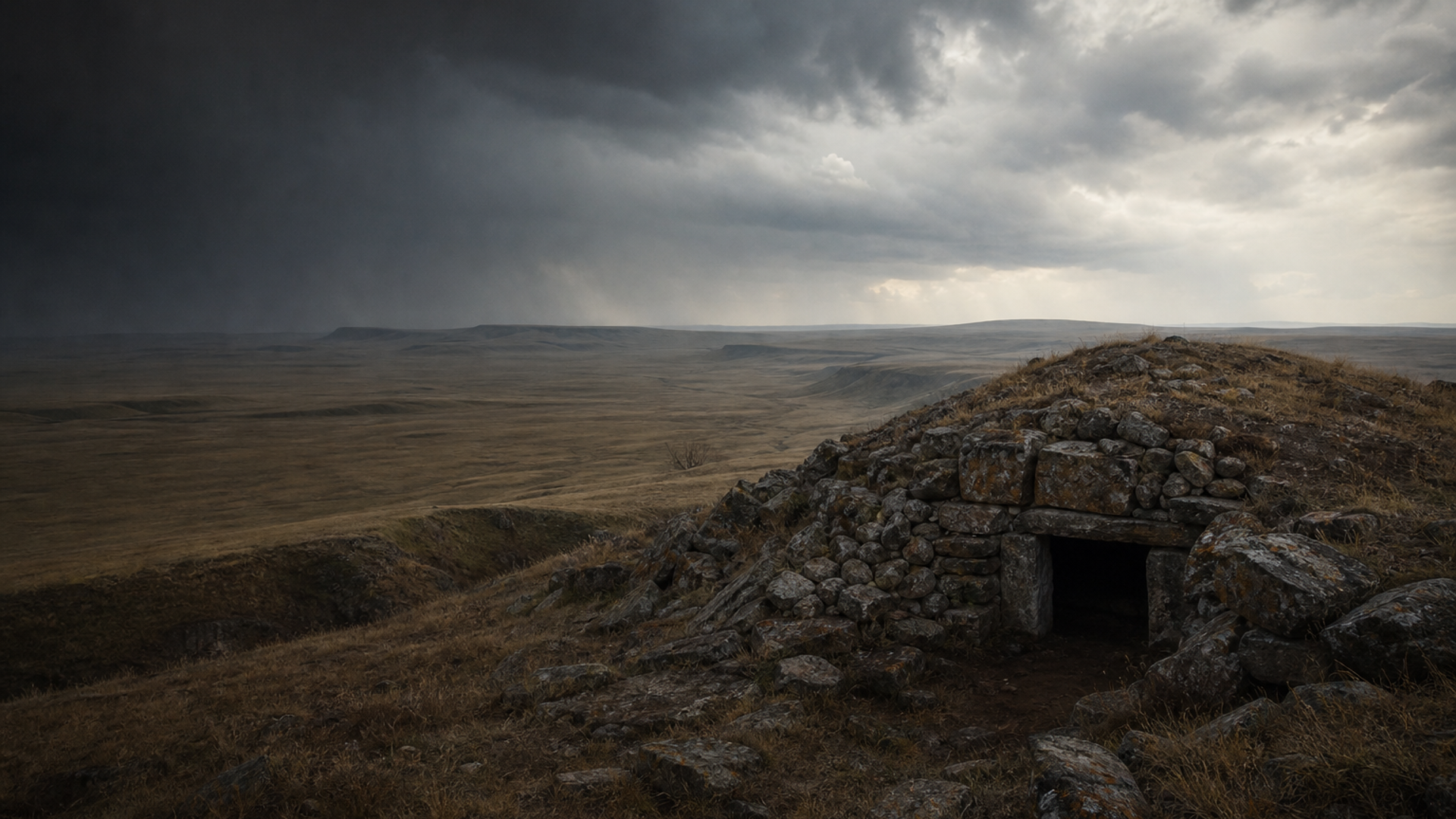
Beneath the wind-swept grasses of the North Caucasus and adjacent Kuban and Caspian steppes, the Catacomb horizon carved a new funerary language into the Bronze Age landscape. Archaeological data indicates these communities, often dated to the third millennium BCE, practiced burial rites involving chambered and catacomb-style graves—deep pits, lateral chambers and sometimes timber or stone architecture. The four Russia_Steppe_Catacomb samples (radiocarbon range 2662–2201 BCE) come from discrete localities: Piedmont. Mar'inskaja 3; Kuban steppe. Rasshevatskij 4; and Kaspi steppe. Šarachalsun 6. These sites anchor a regional expression of the broader Catacomb Culture, itself a successor and local transformation of earlier Yamnaya and contemporaneous steppe traditions.
Material culture—pottery styles, weapon fragments, and burial constructions—suggest a mobile pastoral economy with strong ritual focus on the dead. Limited evidence suggests increasing regionalization: local ceramic motifs and grave architectures vary across the piedmont and plain. Archaeological stratigraphy and radiocarbon dating place these burials squarely in a dynamic phase of steppe social reorganization, when communities negotiated mobility, pastoral resources, and long-distance contacts across Eurasia.