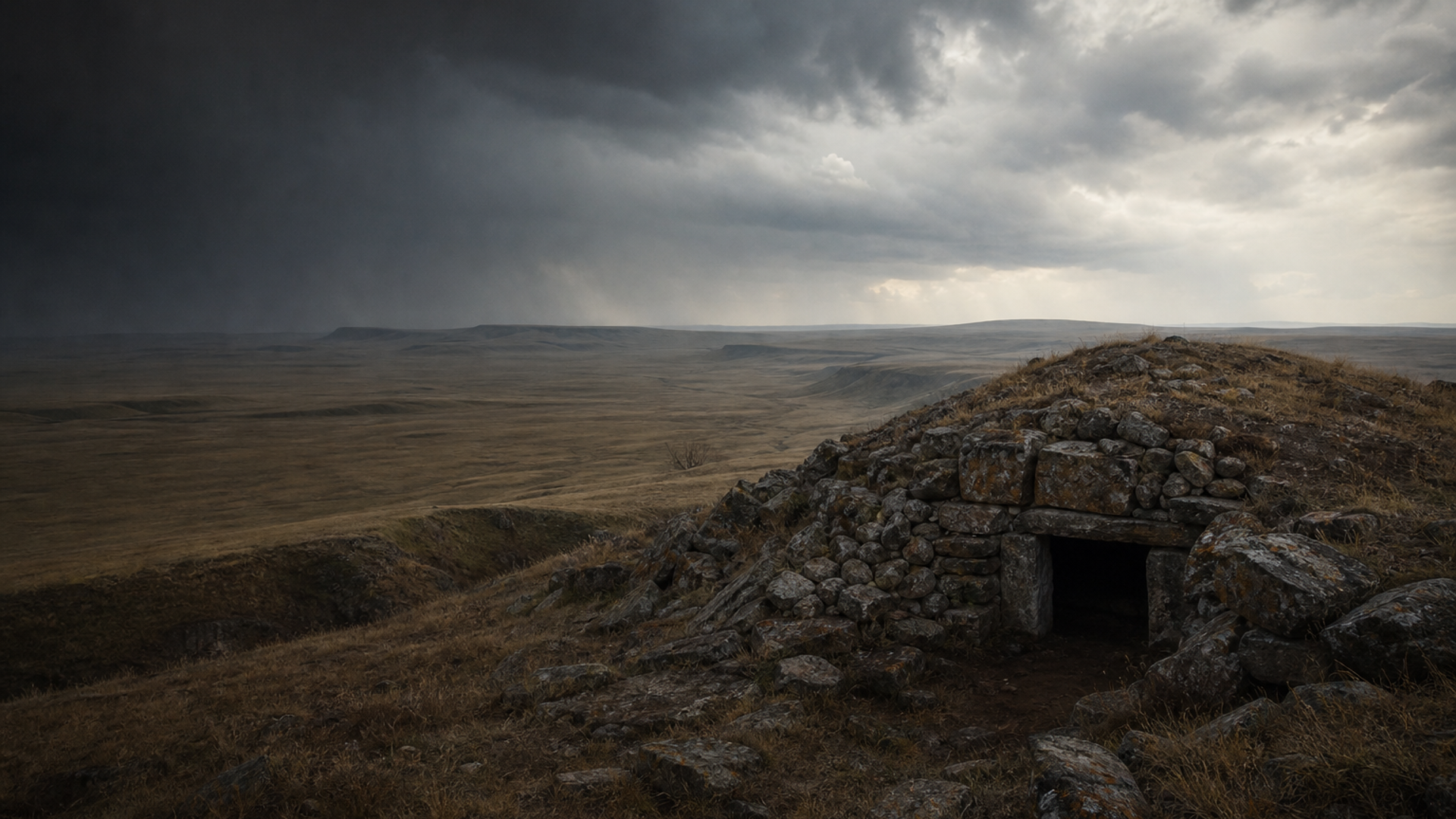
Steppe Catacomb Echoes

下载的 PDF 是图像副本。如需可选中文本及更好的辅助技术支持,请使用打印功能。

跳转到主内容
文明焦点

Steppe Catacomb Echoes

Catacomb-period communities on the North Caucasus and Kuban steppe, glimpsed through graves and genomes

2662 CE - 2201 BCE
Russian steppe (Kuban, Kaspi, Piedmont)

剧情

Archaeological and genetic traces from four Russia_Steppe_Catacomb individuals (2662–2201 BCE) illuminate Catacomb Culture lifeways on the Russian steppe. Limited samples suggest continuity of Y-haplogroup R and maternal U lineages, linking burial traditions to wider Bronze Age steppe populations.

Time Period

2662–2201 BCE

Region

Russian steppe (Kuban, Kaspi, Piedmont)

Common Y-DNA

R (3 of 4 samples)

Common mtDNA

U (4 of 4 samples)

时间线

2500 BCE

Catacomb burials in the North Caucasus

Catacomb-style graves are constructed on the Kuban and Caspian steppes, reflecting a regional funerary tradition within the broader Bronze Age steppe world.

Origins & Emergence

Beneath the wind-swept grasses of the North Caucasus and adjacent Kuban and Caspian steppes, the Catacomb horizon carved a new funerary language into the Bronze Age landscape. Archaeological data indicates these communities, often dated to the third millennium BCE, practiced burial rites involving chambered and catacomb-style graves—deep pits, lateral chambers and sometimes timber or stone architecture. The four Russia_Steppe_Catacomb samples (radiocarbon range 2662–2201 BCE) come from discrete localities: Piedmont. Mar'inskaja 3; Kuban steppe. Rasshevatskij 4; and Kaspi steppe. Šarachalsun 6. These sites anchor a regional expression of the broader Catacomb Culture, itself a successor and local transformation of earlier Yamnaya and contemporaneous steppe traditions.

Material culture—pottery styles, weapon fragments, and burial constructions—suggest a mobile pastoral economy with strong ritual focus on the dead. Limited evidence suggests increasing regionalization: local ceramic motifs and grave architectures vary across the piedmont and plain. Archaeological stratigraphy and radiocarbon dating place these burials squarely in a dynamic phase of steppe social reorganization, when communities negotiated mobility, pastoral resources, and long-distance contacts across Eurasia.

  • Associated with Catacomb Culture burial practices across the North Caucasus
  • Radiocarbon-dated contexts between 2662–2201 BCE
  • Sites: Mar'inskaja 3, Rasshevatskij 4, Šarachalsun 6

Daily Life & Society

Archaeological traces paint a world of seasonal movement, animal herding and tightly governed funerary ritual. Ceramic fragments, bone tools, and occasional metal artefacts hint at a pastoral economy dominated by sheep, cattle and horses, supplemented by hunting and small-scale cultivation where soils permitted. Settlement evidence in Catacomb contexts is often ephemeral—temporary encampments, hearth scatters, and low-density habitations—supporting a model of mobility punctuated by ritual investments in fixed graves.

Social life appears organized around kin groups with marked attention to ancestry: catacomb burials required labor and planning, implying social coordination and investment in lineage memory. Grave goods are variable but often sparse, suggesting status differences existed but may not have been ostentatious. Regional interaction is evident from non-local raw materials and stylistic affinities with neighboring steppe and piedmont communities, indicating exchange networks that linked the Kuban and Caspian margins to broader Bronze Age circuits.

  • Pastoral economy with seasonal mobility
  • Grave architecture implies social coordination and lineage emphasis

Genetic Profile

Genetic data from four Russia_Steppe_Catacomb individuals provide a tantalizing, though preliminary, view of ancestry in this region. All four sampled individuals carry mitochondrial haplogroup U, a lineage often found across European hunter-gatherers and recorded in later steppe groups; its ubiquity here suggests persistence or incorporation of maternal lineages common to northern and eastern Europe. On the paternal side, three of the four males belong to haplogroup R. The designation "R" encompasses several sublineages known from Bronze Age steppe populations; however, low sample numbers prevent confident assignment to specific subclades or firm population-level conclusions.

Archaeological data indicates continuity with broader steppe populations that spread pastoral lifeways across Eurasia. The genetic pattern—dominant R paternal markers and U maternal lineages—aligns qualitatively with other steppe datasets showing strong steppe-related ancestry and complex admixture with local groups. That said, with only four genomes available, these signals are provisional: statistical power is limited, and regional heterogeneity could be obscured. Further sampling across additional Catacomb sites and contemporaneous settlements is essential to test whether these patterns reflect local demographic stability, recent migrations, or selective burial practices that favored particular lineages.

  • All four individuals carry mtDNA haplogroup U
  • Three of four males belong to Y-DNA haplogroup R; sample size is small and conclusions are preliminary

Legacy & Modern Connections

The Catacomb communities left a lingering imprint on the cultural palimpsest of the Russian steppe. Archaeologically, their burial architectures and motifs fed into subsequent Bronze Age and Iron Age traditions, while mobile pastoral lifeways helped shape regional land use and exchange routes. Genetically, the presence of Y-haplogroup R and mtDNA U in these samples resonates with broad steppe ancestries that later contributed to populations across Eurasia.

Caution is warranted: with only four samples, direct links to modern populations or sweeping narratives about migrations cannot be firmly established. Nonetheless, these genomes form part of a growing dataset that, when combined with further archaeological discovery, will clarify how Catacomb groups participated in the dynamic population shifts of the third millennium BCE.

  • Contributes to Bronze Age steppe genetic heritage across Eurasia
  • Current genetic links to modern groups are suggestive but require larger datasets

AI 助手

AI 助手 由DNAGENICS公司制作

解锁此特性
Ask questions about the Steppe Catacomb Echoes culture. Our AI assistant can explain genetic findings, historical context, archaeological evidence, and modern connections.
AI 样本分析

Steppe Catacomb Echoes 文化是人类历史中值得了解的一章……

遗传分析揭示了与早期种群的联系,同时显示了独特的适应和文化创新的证据。 古代DNA样本提供了对迁徙模式、社会结构以及古代种群之间的生物关系的深刻见解。

这是人工智能分析的预览。 解锁全AI 助手, 以探索关于:

  • 遗传组成和祖先
  • 移徙模式和起源
  • 日常生活和文化习俗
  • 现代遗传遗产
使用优惠码 可减免 30% • 11月14日 到期