Menu
Store
Blog
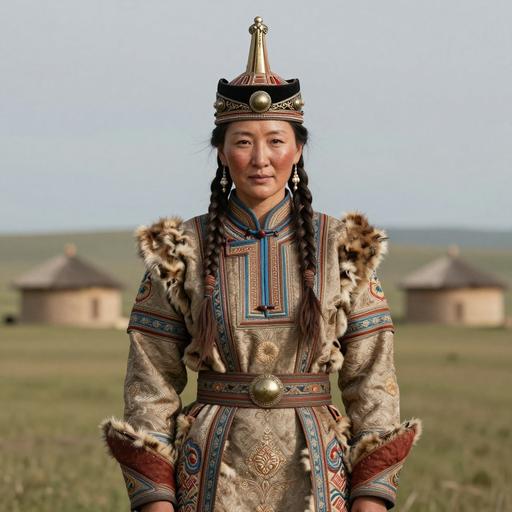
Portrait reconstruction of CHD001
Ancient Individual

A woman buried in Mongolia in the Middle Ages era

CHD001
1000 CE - 1500 CE
Female
Late Medieval Khentii, Mongolia
Mongolia
Scroll to begin
Chapter I

Identity

The biological and cultural markers that define this ancient individual

Sample ID

CHD001

Date Range

1000 CE - 1500 CE

Biological Sex

Female

mtDNA Haplogroup

F1g

Cultural Period

Late Medieval Khentii, Mongolia

Chapter II

Place

Where this individual was discovered

Country Mongolia
Locality Khentii. Chandgan Talyn Uurkhai
Chapter III

Time

When this individual lived in the broader context of human history

CHD001 1000 CE - 1500 CE
Chapter IV

Story

The narrative of this ancient life

The Late Medieval period in Khentii, Mongolia, primarily corresponds to the height and decline of the Mongol Empire, which was established by Genghis Khan in the early 13th century. The Khentii region, part of what is now northeastern Mongolia, holds significant historical and cultural importance as the traditional homeland of the Borjigin clan to which Genghis Khan belonged.

Geographical and Cultural Context: Khentii is characterized by its mountainous terrains, sweeping steppes, and dense forests, a landscape that shaped the nomadic lifestyle of the Mongol people. This area, rich in natural resources, provided the Mongols with ample grazing land for their livestock, which formed the backbone of their economy and sustenance.

Socio-Political Structure: During the Late Medieval period, the societal structure in Khentii, as part of the broader Mongol Empire, was hierarchical yet flexible, allowing for mobility based on merit and martial prowess. The khans, or leaders, were at the top, chosen from the noble Borjigin line and confirmed through assemblies known as kurultai. These assemblies were crucial for decision-making and demonstrated a semblance of collective governance, though ultimate power often lay with the khan.

The Mongol Empire's administrative practices were innovative for their time, incorporating local customs and leaders from conquered regions into their governance system. This adaptability contributed to the empire's endurance, even as it expanded across Asia and into Europe.

Military Influence: Khentii's inhabitants, like other Mongol groups, were exceptional horsemen and archers, skills fostered from a young age. The Mongol military was a dominant force during this era, renowned for its strategic prowess and ability to move quickly over vast distances, adapting to various terrains—skills honed on the challenging landscapes of Mongolia.

The military was organized into units based on the decimal system, with rigorous discipline and a well-thought-out hierarchy that ensured efficient command and control during campaigns. The Mongol's use of psychological warfare, intelligence-gathering, and incorporation of enemy technologies (such as siege warfare learned from the Chinese) highlighted their adaptability and strategic depth.

Economic and Cultural Aspects: The economy in Late Medieval Khentii, and by extension in the Mongol Empire, was largely pastoral, based on the seasonal movement of people and herds. Trade was also a significant aspect of life, especially as it expanded with the empire's growth. The Mongols played a crucial role in the revival of the Silk Road, facilitating extensive trade networks that connected the East and West, spreading goods, technologies, and ideas.

Culture in Khentii during this period was influenced by the interconnectedness of the vast Mongol Empire. While maintaining a robust element of their traditional shamanistic and animistic beliefs, Mongols also interacted with other religions, such as Buddhism, Christianity, and Islam, particularly as they encountered diverse cultures through conquest and trade.

The oral tradition was vital in maintaining the historical and cultural narratives of the Mongols. Epic tales like \The Secret History of the Mongols" chronicled the life of Genghis Khan and were pivotal in shaping Mongol identity and heritage.

Legacy and Historical Significance: The Late Medieval Khentii is often seen as a crucible of leadership and cultural fusion—a place where the Mongol Empire's essence was both nurtured and celebrated. It remains symbolically significant as the region associated with Genghis Khan's birth and the foundational myths of the Mongol state. The impact of Mongolian rule left an indelible mark on world history, influencing global culture, commerce, and political systems long after the empire's fragmentation.

In summary, Late Medieval Khentii under the Mongol Empire was a time of dynamic change and unparalleled expansion, marked by its strategic, cultural, and economic achievements. The Mongol statecraft, military prowess, and integration of diverse cultures and ideas reflect the transformative legacy of this era."

Chapter V

Genetics

The genetic ancestry of this ancient individual

Ancient Genetic Admixture

This analysis compares the DNA profile of CHD001 with ancient reference populations, showing the genetic composition in terms of prehistoric ancestral groups.

Ancient Asians 91.1%
Western Steppe Pastoralists 5.0%
Neolithic Farmers 3.9%

Modern Genetic Admixture

This analysis compares the DNA profile with present-day reference populations, showing what percentage of genetic makeup resembles modern populations from different regions.

Asia 99.8%
Northern Asian 61.1%
Mongolian 34.6%
Siberian 26.6%
Central Asian, Northern Indian & Pakistani 18.2%
Central Asian 18.2%
Japanese & Korean 15.0%
Japanese 15.0%
Chinese & Southeast Asian 5.5%
Tibetan 5.1%

Closest Modern Populations

These are the modern populations showing the closest statistical alignment to A woman buried in Mongolia in the Middle Ages era, ranked by genetic distance. Lower distance values indicate closer statistical similarity.

1
Khamnegan
3.2923
Chapter VI

Context

Other ancient individuals connected to this sample

Sources

References

Scientific publications and genetic data

Scientific Publication

A Dynamic 6,000-Year Genetic History of Eurasia's Eastern Steppe

Authors Jeong C, Wang K, Wilkin S
Abstract

The Eastern Eurasian Steppe was home to historic empires of nomadic pastoralists, including the Xiongnu and the Mongols. However, little is known about the region's population history. Here, we reveal its dynamic genetic history by analyzing new genome-wide data for 214 ancient individuals spanning 6,000 years. We identify a pastoralist expansion into Mongolia ca. 3000 BCE, and by the Late Bronze Age, Mongolian populations were biogeographically structured into three distinct groups, all practicing dairy pastoralism regardless of ancestry. The Xiongnu emerged from the mixing of these populations and those from surrounding regions. By comparison, the Mongols exhibit much higher eastern Eurasian ancestry, resembling present-day Mongolic-speaking populations. Our results illuminate the complex interplay between genetic, sociopolitical, and cultural changes on the Eastern Steppe.

G25 Coordinates

The G25 coordinates for sample CHD001 can be used for detailed admixture analysis in our G25 Studio tool.

CHD001,0.04364306,-0.37186804,0.07998006,-0.02467844,-0.0560188,-0.03585388,0.01852626,0.02312608,0.00966836,0.01367292,-0.00544688,0.0005071,-0.00020378,-0.00100354,-0.00750354,-0.0120536,-0.00806552,0.00753244,0.01259104,0.00789068,0.01020058,-0.01291398,-0.00018628,0.0001853,0.00760562
Analyze in G25 Studio
Use code for 40% off Expires Feb 27