Menu
Store
Blog
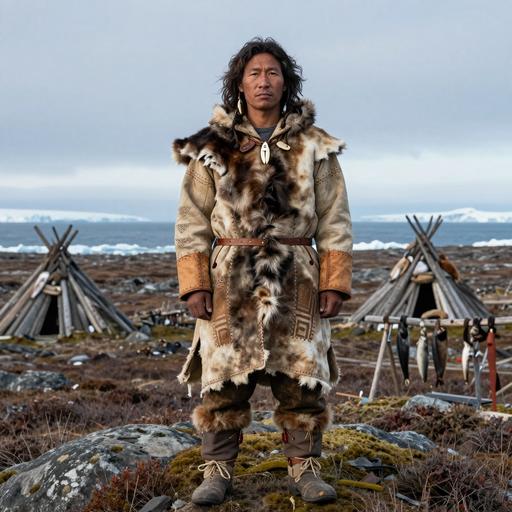
Portrait reconstruction of I10427
Ancient Individual

A man buried in Canada in the Pre-Columbian North America era

I10427
50 CE - 340 CE
Male
Middle Dorset Culture, Canada
Canada
Scroll to begin
Chapter I

Identity

The biological and cultural markers that define this ancient individual

Sample ID

I10427

Date Range

50 CE - 340 CE

Biological Sex

Male

mtDNA Haplogroup

D2a1

Y-DNA Haplogroup

Q-B143

Cultural Period

Middle Dorset Culture, Canada

Chapter II

Place

Where this individual was discovered

Country Canada
Locality Victoria Island
Chapter III

Time

When this individual lived in the broader context of human history

I10427 50 CE - 340 CE
Chapter IV

Story

The narrative of this ancient life

The Middle Dorset culture, flourishing approximately between 500 and 1000 AD, represents a distinctive era within the broader Dorset cultural tradition, which occupied the Arctic regions of Canada. This indigenous culture was part of the Arctic Small Tool tradition and has been identified primarily through archaeological evidence found across the eastern Canadian Arctic and Greenland.

Geographic Distribution:

The Middle Dorset culture was widely spread across the Canadian Arctic, with significant sites found in areas such as Labrador, Newfoundland, the Ungava Peninsula, Hudson Bay, and the High Arctic islands. Their presence extended as far as the eastern Canadian coastlines and sometimes inland, indicating their adaptability to different Arctic environments.

Environmental Context:

The landscape inhabited by the Middle Dorset people was characterized by harsh Arctic conditions, including tundra plains, icy waters, and a predominantly cold climate. Despite these challenges, the vast sea ice and coastal areas supported a bio-diverse environment which included marine mammals like seals, walrus, and whales, as well as terrestrial animals such as caribou.

Subsistence and Economy:

The Middle Dorset culture maintained a robust subsistence strategy primarily focused on hunting sea mammals. The presence of seal bones in many Dorset archaeological sites underscores their reliance on these animals for food, materials, and possibly even the structuring of social life. They utilized ingenious hunting techniques, including ice-edge hunting and seal-breathing hole tactics, to efficiently harvest marine resources.

In addition to marine hunting, the Dorset people also pursued caribou during its seasonal migrations. The diversity in diet is evident in their remains, showcasing their adaptability to both marine and terrestrial ecosystems.

Tools and Technology:

Innovative tool-making is a hallmark of the Middle Dorset culture. Skilled in working with available materials like bone, ivory, and stone, the Dorset people created a variety of tools and artifacts. Their toolkit included harpoons, knives, scrapers, and needles. Particularly notable is their crafting of burins, a type of chisel, essential in the manufacturing of various implements.

Interestingly, the Dorset people lacked the bow and arrow, which was common in other contemporary cultures, relying instead on lances or spears for hunting. Their artistic expressions included carved ivory items, many of which had intricate and stylized animal forms that might have had spiritual or symbolic significance.

Housing and Settlement:

The Middle Dorset typically settled in semi-permanent communities, living in sod houses with stone foundations or temporary structures like skin tents depending on the season and hunting travel needs. Archaeological evidence suggests that Dorset groups could have assembled in sizable gatherings, possibly driven by collective hunting or social purposes.

Social Structure and Beliefs:

While specific details of their social organization remain obscure, it is presumed that the Dorset society was organized at the family or small community level. Artifacts such as carved masks and drumming platforms hint at a rich ceremonial life possibly involving shamanistic practices and ancestral worship, though these interpretations are speculative.

Decline and Legacy:

By around 1000 AD, the Middle Dorset culture began to decline, likely due to several factors including climatic changes, diminishing sea ice, and the arrival of new cultural groups such as the Thule people, who migrated from Alaska and brought with them new technologies like dog sleds and more advanced hunting methods.

The legacy of the Middle Dorset culture is preserved in the archaeological record and continues to be a significant focus of Arctic anthropological study, offering valuable insights into the adaptability and ingenuity of indigenous cultures in extreme environments. Artifacts, settlement patterns, and ecological adaptations all contribute to our understanding of how the Dorset people survived and thrived in Canada's Arctic regions.

Chapter V

Genetics

The genetic ancestry of this ancient individual

Ancient Genetic Admixture

This analysis compares the DNA profile of I10427 with ancient reference populations, showing the genetic composition in terms of prehistoric ancestral groups.

Ancient Asians 97.9%
Neolithic Farmers 2.1%

Modern Genetic Admixture

This analysis compares the DNA profile with present-day reference populations, showing what percentage of genetic makeup resembles modern populations from different regions.

Asia 90.3%
Northern Asian 73.0%
Siberian 54.5%
Mongolian 18.5%
Japanese & Korean 9.0%
Japanese 9.0%
Chinese & Southeast Asian 6.9%
Chinese 6.9%
Central Asian, Northern Indian & Pakistani 1.4%
Central Asian 1.4%
America 9.7%
America 9.7%
Native American 9.7%

Closest Modern Populations

These are the modern populations showing the closest statistical alignment to A man buried in Canada in the Pre-Columbian North America era, ranked by genetic distance. Lower distance values indicate closer statistical similarity.

1
Evenk O
6.8794
2
Mogush
7.3431
3
Tuvinian
7.3727
4
Todzin
8.0310
5
Khamnegan
8.8373
6
Dolgan
8.8891
7
Itelmen
9.5698
8
Khakass Kachins
9.8559
9
Altaian Kizhi
9.9073
10
Koryak
9.9687
Chapter VI

Context

Other ancient individuals connected to this sample

Sources

References

Scientific publications and genetic data

Scientific Publication

Palaeo-Eskimo genetic ancestry and the peopling of Chukotka and North America

Authors Flegontov P, Altınışık NE, Changmai P
Abstract

Much of the American Arctic was first settled 5,000 years ago, by groups of people known as Palaeo-Eskimos. They were subsequently joined and largely displaced around 1,000 years ago by ancestors of the present-day Inuit and Yup'ik1-3. The genetic relationship between Palaeo-Eskimos and Native American, Inuit, Yup'ik and Aleut populations remains uncertain4-6. Here we present genomic data for 48 ancient individuals from Chukotka, East Siberia, the Aleutian Islands, Alaska, and the Canadian Arctic. We co-analyse these data with data from present-day Alaskan Iñupiat and West Siberian populations and published genomes. Using methods based on rare-allele and haplotype sharing, as well as established techniques4,7-9, we show that Palaeo-Eskimo-related ancestry is ubiquitous among people who speak Na-Dene and Eskimo-Aleut languages. We develop a comprehensive model for the Holocene peopling events of Chukotka and North America, and show that Na-Dene-speaking peoples, people of the Aleutian Islands, and Yup'ik and Inuit across the Arctic region all share ancestry from a single Palaeo-Eskimo-related Siberian source.

G25 Coordinates

The G25 coordinates for sample I10427 can be used for detailed admixture analysis in our G25 Studio tool.

I10427,0.0519828,-0.33859582,0.10112806,0.00628606,-0.08232682,-0.04681264,0.00240508,0.00513318,0.00953346,0.00377586,0.02319078,0.0008554,0.00025764,-0.0151515,-0.01687,-0.01735326,-0.00857182,0.01009026,0.0201014,0.01104864,0.01885094,-0.02563608,0.008042,0.0069049,0.01379232
Analyze in G25 Studio
Use code for 40% off Expires Feb 27