Menu
Store
Blog
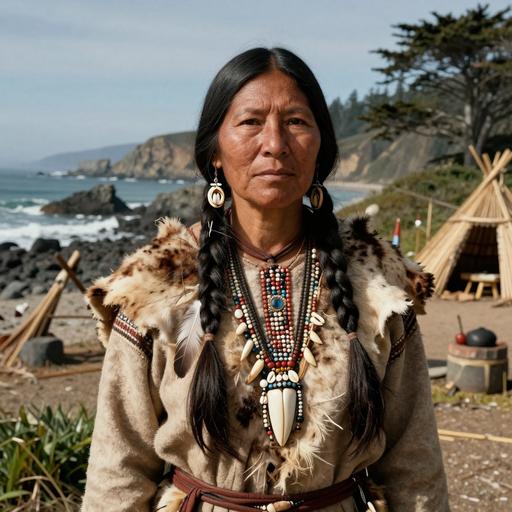
Portrait reconstruction of I11553
Ancient Individual

A woman buried in USA in the Native American era

I11553
1200 CE - 1700 CE
Female
Native American California Coast
USA
Scroll to begin
Chapter I

Identity

The biological and cultural markers that define this ancient individual

Sample ID

I11553

Date Range

1200 CE - 1700 CE

Biological Sex

Female

mtDNA Haplogroup

C1b+16311

Cultural Period

Native American California Coast

Chapter II

Place

Where this individual was discovered

Country USA
Locality Pebble Beach (California)
Chapter III

Time

When this individual lived in the broader context of human history

I11553 1200 CE - 1700 CE
Chapter IV

Story

The narrative of this ancient life

The Native American cultures of the California coast are as diverse and rich as the geographical expanse they inhabit. The region stretches from the north near the Oregon border to the southern reaches adjoining modern-day Mexico. It's home to a multitude of indigenous groups, each with unique cultural practices, languages, and traditions tied intimately to the diverse landscapes of coastal California.

Geographic Landscape

The California coast is characterized by its rugged coastline, rolling hills, dense forests, and fertile valleys. This dynamic environment, with its Mediterranean climate, offers a bounty of resources, including marine life, plant species, and wildlife, which have been carefully managed and utilized by Native American groups for thousands of years.

Cultural Groups

Key groups of the coastal regions include the Chumash, Ohlone, Pomo, Miwok, Tongva (Gabrielino), and Yurok, among others. Each of these groups has developed complex societies with distinctive languages, social structures, and spiritual beliefs. Their territories often extend inland, but their cultures are profoundly shaped by proximity to the Pacific Ocean.

Chumash

Located primarily along the central coast from Malibu to the northern part of San Luis Obispo County, the Chumash people are renowned for their maritime lifestyle. They are master canoe builders, known for their plank-built tomols, which facilitated trade and communication along the coast and with the Channel Islands. The Chumash have a sophisticated cosmology, elaborate rock art, and a rich oral tradition.

Ohlone

The Ohlone once inhabited the coastal lands around the San Francisco Bay. They lived in extended family units and were skilled in crafting baskets and nets. The Ohlone diet consisted of acorns, seeds, and seafood. Known for their dance ceremonies and ceremonies tied to the seasonal cycles, their spirituality involved a deep connection to the land and its resources.

Pomo

Further north, the Pomo people are famed for their intricate basketry, which is considered some of the finest in the world. They utilized a wide range of materials, including feathers and shells, to create these functional and artistic items. The Pomo managed the land through sophisticated hunting and gathering techniques that ensured sustainability of resources.

Miwok

The Coast Miwok traditionally resided in the Marin and southern Sonoma Counties. They lived in semi-subterranean houses and relied heavily on the oak woodlands and the rich coastal estuaries for food. Like other San Francisco Bay Area tribes, the Miwok were adept at basket weaving and acorn processing and followed elaborate religious rituals connected to their environment.

Tongva

Farther south, the Tongva people, also known as the Gabrielino, lived in permanent, well-structured villages from the Los Angeles Basin to the Channel Islands. They engaged in both terrestrial and marine harvesting. Their social structure was notably complex and their culture featured a rich system of governance and trade. The Tongva are recognized for their beautiful shell bead currency and elaborate ceremonial practices.

Yurok

In the northwestern corner of modern-day California, the Yurok tribes lived along the Klamath River and its estuary. Their culture revolved around the river, which provided salmon, their primary food source. The Yurok are known for their woodworking skills, particularly in canoe and house building, as well as their traditional fishing methods and ceremonial dances.

Society and Lifestyle

Economy and Trade: The coastal tribes engaged in extensive trade networks, exchanging goods like shells, fish, seeds, acorns, and crafted items across vast distances. Their economies were typically based on a mixture of hunting, fishing, and gathering, augmented by intricate systems of trade.

Social Structure: Native Californian social structures varied, with some groups practicing more hierarchical forms of organization and others having more egalitarian societies. Leadership roles often revolved around kinship ties and spiritual authority rather than centralized power.

Spiritual Life: Spirituality among these tribes was deeply rooted in nature, with numerous animistic beliefs emphasizing harmony and balance with the environment. Rituals, dances, and ceremonies often marked seasonal cycles and life events, reinforcing community ties and cultural identity.

Art and Culture: Art played a significant role in these cultures, with an emphasis on functionality and aesthetics, as seen in basketry, beadwork, and rock art. Oral traditions were pivotal, with stories and songs passed down through generations, keeping history and myth alive.

Impact of European Contact

The arrival of Spanish missionaries and settlers brought significant changes, including disruptions to the traditional ways of life. The establishment of missions, beginning in the late 18th century, led to cultural erosion and population decline due to disease, forced labor, and colonization pressures. Despite these challenges, many Native American communities have persevered, striving to revitalize and sustain their cultural heritage in contemporary times.

In summary, the Native American groups of the California coast represent a tapestry of cultures with rich traditions and deep connections to the land and sea. Their legacy is a testament to human resilience and adaptation in one of North America's most diverse natural environments. Understanding and appreciating these cultures provides a broader perspective on the history and ongoing story of this storied coastline.

Chapter V

Context

Other ancient individuals connected to this sample

Sources

References

Scientific publications and genetic data

Scientific Publication

Genetic continuity and change among the Indigenous peoples of California

Authors Nakatsuka N, Holguin B, Sedig J
Abstract

Before the colonial period, California harboured more language variation than all of Europe, and linguistic and archaeological analyses have led to many hypotheses to explain this diversity1. We report genome-wide data from 79 ancient individuals from California and 40 ancient individuals from Northern Mexico dating to 7,400-200 years before present (BP). Our analyses document long-term genetic continuity between people living on the Northern Channel Islands of California and the adjacent Santa Barbara mainland coast from 7,400 years BP to modern Chumash groups represented by individuals who lived around 200 years BP. The distinctive genetic lineages that characterize present-day and ancient people from Northwest Mexico increased in frequency in Southern and Central California by 5,200 years BP, providing evidence for northward migrations that are candidates for spreading Uto-Aztecan languages before the dispersal of maize agriculture from Mexico2-4. Individuals from Baja California share more alleles with the earliest individual from Central California in the dataset than with later individuals from Central California, potentially reflecting an earlier linguistic substrate, whose impact on local ancestry was diluted by later migrations from inland regions1,5. After 1,600 years BP, ancient individuals from the Channel Islands lived in communities with effective sizes similar to those in pre-agricultural Caribbean and Patagonia, and smaller than those on the California mainland and in sampled regions of Mexico.

Use code for 40% off Expires Feb 26