Menu
Store
Blog
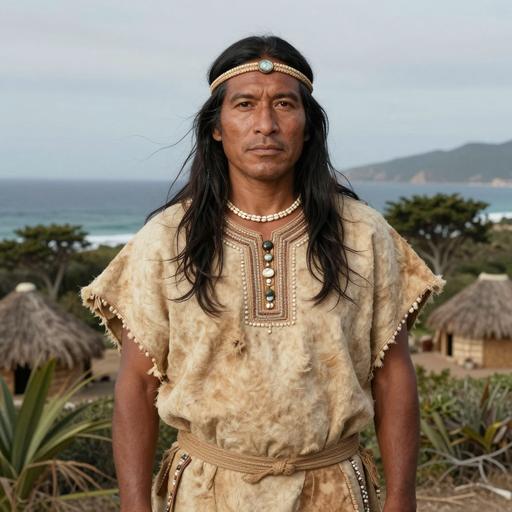
Portrait reconstruction of I15479
Ancient Individual

A man buried in USA in the Native American era

I15479
1400 BCE - 800 BCE
Male
Chumash Culture
USA
Scroll to begin
Chapter I

Identity

The biological and cultural markers that define this ancient individual

Sample ID

I15479

Date Range

1400 BCE - 800 BCE

Biological Sex

Male

mtDNA Haplogroup

A2+(64)

Y-DNA Haplogroup

Q-Z781

Cultural Period

Chumash Culture

Chapter II

Place

Where this individual was discovered

Country USA
Locality Santa Barbara (California)
Chapter III

Time

When this individual lived in the broader context of human history

I15479 1400 BCE - 800 BCE
Chapter IV

Story

The narrative of this ancient life

The Chumash people are Indigenous inhabitants of the central and southern coastal regions of California, their historical territory extending from present-day Malibu northward to San Luis Obispo, and inland to the western edge of the San Joaquin Valley. The Chumash culture is noted for its rich maritime heritage, sophisticated basketry, and vibrant rock art, showcasing a deep connection to both land and sea.

Geographic and Historical Context

The Chumash traditionally occupied a region that includes various ecosystems ranging from coastal plains and interior valleys to mountains and islands. This diverse landscape provided abundant resources, allowing the Chumash to develop a complex and prosperous society. Their territory includes the Northern Channel Islands—Anacapa, Santa Cruz, Santa Rosa, and San Miguel—which played a critical role in their development as a seafaring culture.

Archaeological evidence suggests that the Chumash have been in the area for thousands of years, with some estimates suggesting a presence as far back as 10,000 to 13,000 years. Over these millennia, the Chumash developed intricate cultural practices adapted to their environment, from innovative fishing and hunting techniques to advanced basketry and tool-making skills.

Social Structure and Society

The Chumash society was organized into numerous independent village communities, each with its hereditary chief known as a \wot." These communities often engaged in trade and social exchanges, fostering a network of economic and cultural relationships. The society was stratified, with social roles often determined by lineage, and it included skilled artisans, tradespeople, and religious leaders known as "antap."

The religious and spiritual life of the Chumash was rich and varied, centered around a belief system that included a creator deity, various nature spirits, and an emphasis on the interconnectedness of all life. Shamans, who held significant influence within the community, conducted rituals and maintained this spiritual balance, serving as intermediaries between the physical and spiritual worlds.

Maritime Expertise and Trade

The Chumash are renowned for their maritime prowess, particularly their use of plank-built canoes known as "tomols." These canoes were advanced for their time and allowed the Chumash to navigate the rough waters of the Pacific Ocean, facilitating trade and interaction with peoples on the mainland and the Channel Islands. The tomol construction involved intricate woodworking techniques, using redwood and other native materials, and was often a communal activity that reinforced social bonds and cooperation.

Trade enabled the exchange of goods like shell beads, fish, animal pelts, and pigments, and extended beyond their immediate territory to include other Indigenous groups in California. The shell beads, in particular, served as a form of currency that underscored the Chumash's role in regional trade networks.

Artistic and Cultural Expressions

Chumash art is characterized by its vibrant and symbolic rock paintings, which represent one of the most significant aspects of their cultural expression. These paintings, often found in caves and on rock faces, display intricate geometric designs and anthropomorphic figures believed to be connected to Chumash cosmology and shamanic practices. The use of natural pigments highlights their deep understanding of and relationship with their environment.

Basketry is another notable art form, showcasing the Chumash's high level of craftsmanship and their ability to create functional yet beautifully intricate designs. Baskets served multiple purposes, from food storage and preparation to ceremonial uses, and were often adorned with complex patterns and dyed with natural colors.

Challenges and Resilience

The arrival of Spanish missionaries and settlers in the late 18th century marked a period of significant upheaval for the Chumash. The establishment of missions attempted to convert the Chumash to Christianity and integrate them into a European agricultural system, disrupting their traditional way of life. Many Chumash were relocated, faced with diseases brought by the Europeans, and subjected to forced labor.

Despite these challenges, the Chumash communities have shown remarkable resilience, maintaining and revitalizing their cultural practices today. There is a growing movement to reclaim and teach the Chumash language, as well as efforts to preserve their cultural heritage through education and the establishment of cultural centers and programs.

Contemporary Chumash People

Today, the Chumash descendants continue to live in their ancestral territories and contribute to the rich cultural tapestry of California. They are actively involved in cultural and environmental preservation, advocating for the protection of their traditional lands and marine environments. Through various tribal organizations and government recognition, the Chumash strive to protect their heritage, restore their language, and ensure that their vibrant culture thrives for future generations."

Chapter V

Context

Other ancient individuals connected to this sample

Sources

References

Scientific publications and genetic data

Scientific Publication

Genetic continuity and change among the Indigenous peoples of California

Authors Nakatsuka N, Holguin B, Sedig J
Abstract

Before the colonial period, California harboured more language variation than all of Europe, and linguistic and archaeological analyses have led to many hypotheses to explain this diversity1. We report genome-wide data from 79 ancient individuals from California and 40 ancient individuals from Northern Mexico dating to 7,400-200 years before present (BP). Our analyses document long-term genetic continuity between people living on the Northern Channel Islands of California and the adjacent Santa Barbara mainland coast from 7,400 years BP to modern Chumash groups represented by individuals who lived around 200 years BP. The distinctive genetic lineages that characterize present-day and ancient people from Northwest Mexico increased in frequency in Southern and Central California by 5,200 years BP, providing evidence for northward migrations that are candidates for spreading Uto-Aztecan languages before the dispersal of maize agriculture from Mexico2-4. Individuals from Baja California share more alleles with the earliest individual from Central California in the dataset than with later individuals from Central California, potentially reflecting an earlier linguistic substrate, whose impact on local ancestry was diluted by later migrations from inland regions1,5. After 1,600 years BP, ancient individuals from the Channel Islands lived in communities with effective sizes similar to those in pre-agricultural Caribbean and Patagonia, and smaller than those on the California mainland and in sampled regions of Mexico.

Use code for 40% off Expires Feb 26