


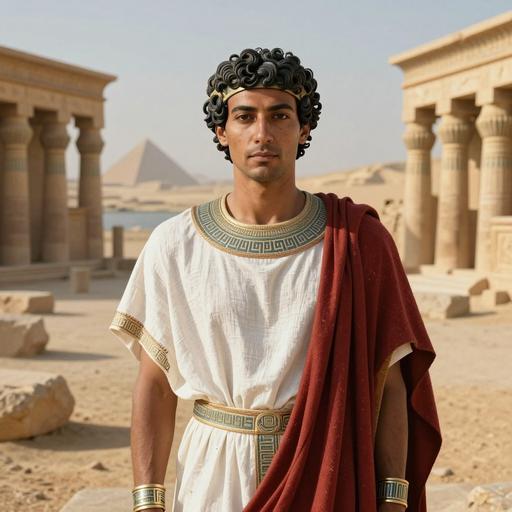
| Sample ID | Culture/Period | Date | Location | Action |
|---|---|---|---|---|
| JK2888 | The Ptolemaic Dynasty | 151 BCE | Abusir-el Meleq, Egypt | View |
Chapter IV
Story
The narrative of this ancient life
The Ptolemaic Dynasty was a fascinating era in ancient Egyptian history that marked significant cultural and political transformations. Spanning from 305 BCE to 30 BCE, this dynasty was characterized by the fusion of Greek and Egyptian cultures under the rule of Greek Macedonian leaders, starting with Ptolemy I Soter and ending with the iconic Cleopatra VII. This era is often considered part of the larger Hellenistic period following the conquests of Alexander the Great.
Origins and Establishment
The Ptolemaic Dynasty commenced when Ptolemy I Soter, one of Alexander the Great's trusted generals, declared himself Pharaoh of Egypt after Alexander's death in 323 BCE. Initially serving as satrap, Ptolemy solidified his power and founded the dynasty in 305 BCE. Alexandria, the city established by Alexander, became the capital and a thriving cultural and economic hub, symbolizing the fusion of Greek and Egyptian influences.
Governance and Administration
The Ptolemaic rulers retained much of the existing Egyptian administrative structure but introduced Greek elements. The government was a dual system where Greek and Egyptian bureaucracies coexisted. Ptolemaic rulers embraced the title of Pharaoh, presenting themselves as traditional Egyptian leaders to gain acceptance. However, they also maintained their Greek heritage and culture, creating a unique blend of customs and traditions.
Culture and Society
The Ptolemaic period was remarkable for its cultural synthesis. Alexandria emerged as a center of learning and culture, home to the famous Library of Alexandria and the Mouseion, attracting scholars, poets, and scientists from across the Hellenistic world. This era witnessed significant advancements in sciences, such as astronomy and medicine, and produced notable scholars like Euclid and Archimedes.
Art and architecture during the Ptolemaic era reflected the duality of influences. Egyptian art forms persisted, but elements of Greek artistic styles were incorporated, resulting in unique hybrid art. Temples built during this period, such as the Temple of Horus at Edfu, combined traditional Egyptian architecture with Greek architectural elements.
Religion
Religion was a critical component of Ptolemaic society, serving as a means to legitimize their rule. The Ptolemies practiced the traditional Egyptian religion but adapted it to include Greek elements. They supported the Egyptian priesthoods and were involved in temple building and restoration projects. One notable religious development was the creation of the syncretic deity Serapis, combining aspects of Osiris and Apis with Greek influences, symbolizing cultural integration.
Economy
The economy under the Ptolemaic Dynasty was vibrant and diverse, benefiting from Egypt's agricultural fertility and strategic position for trade. The Ptolemies introduced new agricultural techniques and crops, increasing productivity. Commerce flourished, especially in Alexandria, which became a central trading port connecting Africa, Asia, and Europe. The economy was supported by a well-developed monetary system, with coinage reflecting both Egyptian and Greek imagery.
Decline and Legacy
The Ptolemaic Dynasty faced internal strife, court intrigue, and external pressures, leading to its eventual decline. The increasing power struggles, economic difficulties, and challenges from the rising Roman Republic weakened the dynasty. Cleopatra VII, the last of the Ptolemaic rulers, sought to restore the kingdom's former glory through alliances with Roman leaders Julius Caesar and Mark Antony. However, following her defeat and suicide in 30 BCE, Egypt became a province of the Roman Empire.
Despite its fall, the legacy of the Ptolemaic Dynasty endured, particularly in the cultural and scientific contributions that influenced subsequent civilizations. The period is a testament to the dynamic interactions between different cultures, creating a vibrant era where Egyptian and Greek worlds converged, leaving an indelible mark on history.