Menu
Store
Blog
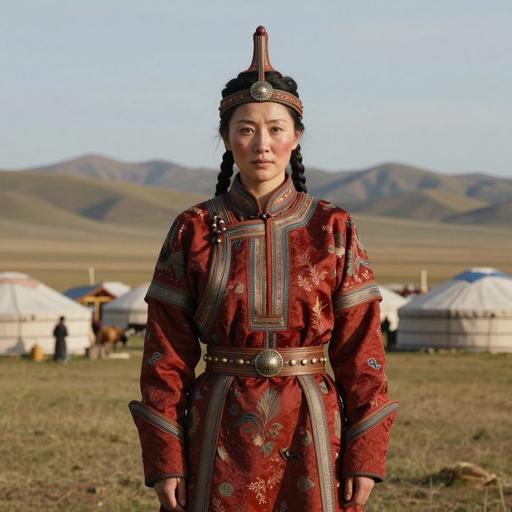
Portrait reconstruction of KHL001
Ancient Individual

A woman buried in Mongolia in the Middle Ages era

KHL001
1000 CE - 1500 CE
Female
Late Medieval Khovd, Mongolia
Mongolia
Scroll to begin
Chapter I

Identity

The biological and cultural markers that define this ancient individual

Sample ID

KHL001

Date Range

1000 CE - 1500 CE

Biological Sex

Female

mtDNA Haplogroup

F1b1b

Cultural Period

Late Medieval Khovd, Mongolia

Chapter II

Place

Where this individual was discovered

Country Mongolia
Locality Khovd. Khalzan Khoshuu. Bodonch Gol
Coordinates 46.6912, 92.7943
Chapter III

Time

When this individual lived in the broader context of human history

KHL001 1000 CE - 1500 CE
Chapter IV

Story

The narrative of this ancient life

The Late Medieval period in Khovd, Mongolia, during the dominance of the Mongol Empire, represents a fascinating intersection of culture, politics, and trade. This era, roughly spanning the 13th to 15th centuries, saw the Khovd region influenced heavily by the expansive reach of the Mongol Empire, which at its height stretched from Eastern Europe to the Sea of Japan. Khovd, situated in western Mongolia, served as both a strategic and cultural hub within this vast empire.

Historical Context

Political Influence: During the reign of Genghis Khan and his successors, Khovd and surrounding regions were integrated into the Mongol Empire's administrative and military networks. The local governance structure was incorporated into the empire's broader administrative framework, which emphasized efficient communication and control across vast distances. Mongol rulers installed a yam system, providing relay stations for swift horseback communication, typically found along major trade and military routes that crisscrossed the region.

Military Role: Khovd, like many parts of Mongolia, contributed to the Mongol Empire's fearsome military machine. Local populations were often involved in conscription into the Khan’s armies, which were renowned for their mobility, discipline, and innovative tactics. This military inclusion fostered a society highly attuned to martial culture, with skills in horseback riding and archery remaining central to local life and identity.

Cultural Aspects

Nomadic Lifestyle: The Mongol influence did not significantly alter the traditional nomadic lifestyle of Khovd's inhabitants. The people continued to live in yurts, move seasonally with their herds, and maintain a social structure organized around family and clan ties. This lifestyle provided the flexibility and resilience needed in both the harsh climate and the volatile political landscape of the era.

Religious Practices: Religion in Late Medieval Khovd was diverse, reflecting the broader religious pluralism that characterized the Mongol Empire. While Tengriism remained a dominant force—a shamanistic practice centered around the worship of the sky god Tengri—Buddhism began to make deeper inroads into the region during this period. There was also an exposure to Christianity, Manichaeism, and Islam, as the Mongol Empire's religious tolerance encouraged the spread of multiple faiths along its trade routes.

Art and Literature: The cultural landscape of Khovd was marked by an interchange of artistic and literary traditions due to its place within the Mongol Empire. Oral traditions remained vibrant, with epic tales and poetry playing a crucial role in preserving history and customs. Artisans absorbed influences from Persian, Chinese, and Russian cultures, incorporating diverse motifs and techniques into their work, from textiles to metalwork.

Economic Activity

Trade and Commerce: Khovd sat along key trade corridors connecting China with Central Asia and Europe. The Silk Road, under the Pax Mongolica, flourished during this period, allowing for a dramatic increase in trade and the flow of goods, ideas, and cultural practices. Khovd served as a critical node where traders exchanged silk, spices, furs, and textiles. The region's economy was bolstered by this vibrant trade, which also introduced new technologies and stimulated economic activity.

Local Economy: Despite the prominence of trade, the local economy remained predominantly pastoral and agrarian. The Mongol administration often levied taxes in the form of labor or livestock, requiring families to contribute to the empire's logistics network or its agricultural output. The traditional barter system was also enhanced by the circulation of wealth through trade, with silver and other currency gradually integrating into local economies.

Conclusion

Late Medieval Khovd under the Mongol Empire was a dynamic region at a crossroads of cultural and economic exchange. While anchored in its traditional nomadic roots, Khovd's people were actors in a larger imperial story that connected them to continental currents of commerce, communication, and cultural diffusion. The legacy of this era is still palpable in modern Mongolia, as the region's blend of tradition and adaptation during the Mongol Empire's zenith set the stage for future developments in Mongolian history and culture.

Chapter V

Genetics

The genetic ancestry of this ancient individual

Ancient Genetic Admixture

This analysis compares the DNA profile of KHL001 with ancient reference populations, showing the genetic composition in terms of prehistoric ancestral groups.

Ancient Asians 78.9%
Western Steppe Pastoralists 11.0%
Neolithic Farmers 6.1%
Ancient Native Americans 4.0%

Modern Genetic Admixture

This analysis compares the DNA profile with present-day reference populations, showing what percentage of genetic makeup resembles modern populations from different regions.

Asia 91.5%
Northern Asian 46.7%
Siberian 40.1%
Mongolian 6.6%
Central Asian, Northern Indian & Pakistani 28.0%
Central Asian 25.9%
Indian 2.1%
Chinese & Southeast Asian 12.3%
Chinese 8.9%
Tibetan 3.4%
Japanese & Korean 4.5%
Japanese 4.5%
America 6.4%
America 6.4%
Native American 6.4%
Oceania 1.1%
Melanesian 1.1%
Papuan 1.1%
Africa 0.5%

Closest Modern Populations

These are the modern populations showing the closest statistical alignment to A woman buried in Mongolia in the Middle Ages era, ranked by genetic distance. Lower distance values indicate closer statistical similarity.

1
Khakass
5.2627
2
Teleut
5.4643
3
Tubalar
6.1652
4
Shor
6.1943
5
Shor Khakassia
6.3648
6
Shor Mountain
6.5501
7
Kazakh
7.3990
8
Kazakh Xinjiang
7.4563
9
Kirghiz
7.7511
10
Altaian Kizhi O
7.7704
Chapter VI

Context

Other ancient individuals connected to this sample

Sources

References

Scientific publications and genetic data

Scientific Publication

A Dynamic 6,000-Year Genetic History of Eurasia's Eastern Steppe

Authors Jeong C, Wang K, Wilkin S
Abstract

The Eastern Eurasian Steppe was home to historic empires of nomadic pastoralists, including the Xiongnu and the Mongols. However, little is known about the region's population history. Here, we reveal its dynamic genetic history by analyzing new genome-wide data for 214 ancient individuals spanning 6,000 years. We identify a pastoralist expansion into Mongolia ca. 3000 BCE, and by the Late Bronze Age, Mongolian populations were biogeographically structured into three distinct groups, all practicing dairy pastoralism regardless of ancestry. The Xiongnu emerged from the mixing of these populations and those from surrounding regions. By comparison, the Mongols exhibit much higher eastern Eurasian ancestry, resembling present-day Mongolic-speaking populations. Our results illuminate the complex interplay between genetic, sociopolitical, and cultural changes on the Eastern Steppe.

G25 Coordinates

The G25 coordinates for sample KHL001 can be used for detailed admixture analysis in our G25 Studio tool.

KHL001,0.0643769,-0.2390568,0.07503166,0.02589872,-0.04584052,-0.01277804,-0.00749054,-0.00624792,0.00369374,-0.0079317,0.00644514,-0.00426424,0.01090332,-0.01875386,-0.01132762,-0.01049062,-0.00953234,0.00332798,0.00837418,0.00661934,-0.0056633,-0.00170608,0.01199664,-0.00404378,0.00666707
Analyze in G25 Studio
Use code for 40% off Expires Feb 26