Menu
Store
Blog
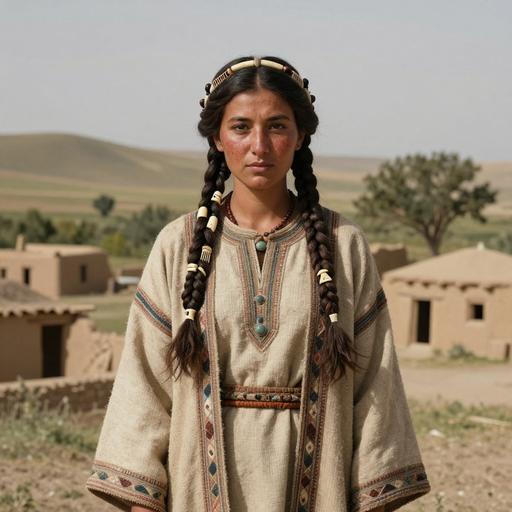
Portrait reconstruction of L8666
Ancient Individual

A woman buried in Uzbekistan in the Iron Age era

L8666
150 BCE - 50 CE
Female
Iron Age Dehkan Culture of Surkhandaryo
Uzbekistan
Scroll to begin
Chapter I

Identity

The biological and cultural markers that define this ancient individual

Sample ID

L8666

Date Range

150 BCE - 50 CE

Biological Sex

Female

mtDNA Haplogroup

J1b1b1

Cultural Period

Iron Age Dehkan Culture of Surkhandaryo

Chapter II

Place

Where this individual was discovered

Country Uzbekistan
Locality Dehkan (Surxondaryo Region)
Coordinates 38.4060, 68.1150
Chapter III

Time

When this individual lived in the broader context of human history

L8666 150 BCE - 50 CE
Chapter IV

Story

The narrative of this ancient life

The Iron Age Dehkan Culture of the Surkhandaryo region, nestled within the larger historical context of Bactria, represents a fascinating and intricate period marked by significant cultural, technological, and social developments. This era, part of the broader Iron Age timeline that unfolded approximately from 1200 BCE to 500 BCE, is characterized by the emergence and proliferation of iron metallurgy, which played a crucial role in transforming societies through improved agricultural practices, military capabilities, and craftsmanship.

Geographical and Historical Context:

The region of Surkhandaryo is located in Southern Uzbekistan, forming part of the ancient Bactrian territories, known for its rich historical significance and strategic position along the Silk Road. This confluence of cultures and trading routes facilitated a melting pot of interactions, leading to the unique evolution of the Dehkan culture.

Socio-Political Structure:

The Dehkan culture was primarily agrarian, with societies organized around small villages and settlements. The political landscape likely consisted of tribal structures or petty kingdoms, where local chieftains or kings wielded power. These leaders were often seen as intermediaries between the gods and the people, playing vital roles in both governance and religious practices.

Economic Activities:

The economy of the Dehkan culture in Surkhandaryo was predominantly based on agriculture, enhanced significantly by the advent of iron tools. These advancements in metallurgy allowed for more efficient farming techniques, resulting in increased crop yields and variety. The fertile lands of the Surkhandaryo River Valley supported the cultivation of wheat, barley, and other essential crops, alongside livestock rearing.

Metallurgy and Craftsmanship:

Iron became the cornerstone of technological innovation during this era. Blacksmiths in the region achieved remarkable proficiency in ironworking, producing robust tools and weapons that gave the culture a military and economic advantage. Artisans also excelled in pottery, textile production, and jewelry making, with techniques and designs that likely featured both utilitarian and decorative purposes, often reflecting the syncretic artistic influences from neighboring cultures.

Trade and Interaction:

The strategic placement of Surkhandaryo along the Silk Road facilitated extensive trade networks. The Dehkan culture engaged in the exchange of goods with neighboring regions, including Central Asia, Persia, and the Indian subcontinent. This interaction not only brought material wealth but also led to an exchange of ideas, religious beliefs, and technological innovations, contributing to the cultural dynamism of the region.

Religion and Beliefs:

Religious life in the Dehkan culture was polytheistic, with beliefs likely centered around natural deities and ancestor worship, a common trait in many early Indo-Iranian cultures. Ritual practices possibly included elaborate ceremonies and offerings to appease the gods and ensure agricultural prosperity. Archaeological findings, such as altars or religious artifacts, suggest that religion played a significant role in daily life and governance.

Art and Architecture:

Artistic expression in the Dehkan culture was vibrant, reflecting both local traditions and external influences. Pottery, often decorated with geometric patterns or motifs inspired by nature, was a staple of archeological findings. Architecture varied from simple, functional dwellings to more complex structures, perhaps serving communal or religious purposes, indicating a society capable of organizing large-scale construction projects.

Legacy:

The Iron Age Dehkan Culture of Surkhandaryo was instrumental in shaping the cultural and historical landscape of ancient Bactria. It laid the foundation for subsequent cultures and civilizations in the region, such as the Achaemenid Empire, which later incorporated Bactria into its vast domain. The technological and cultural advancements of this era had lasting impacts, influencing not only regional developments but also contributing to the broader narrative of human civilization's progress during the Iron Age.

Overall, the Dehkan culture symbolizes a period of significant transition and growth, marked by the adept use of new technologies and the flourishing of an interconnected world.

Chapter V

Context

Other ancient individuals connected to this sample

Sources

References

Scientific publications and genetic data

Scientific Publication

Genetic Continuity of Bronze Age Ancestry with Increased Steppe-Related Ancestry in Late Iron Age Uzbekistan

Authors Kumar V, Bennett EA, Zhao D
Abstract

Although Uzbekistan and Central Asia are known for the well-studied Bronze Age civilization of the Bactria-Margiana Archaeological Complex (BMAC), the lesser-known Iron Age was also a dynamic period that resulted in increased interaction and admixture among different cultures from this region. To broaden our understanding of events that impacted the demography and population structure of this region, we generated 27 genome-wide single-nucleotide polymorphism capture data sets of Late Iron Age individuals around the Historical Kushan time period (∼2100-1500 BP) from three sites in South Uzbekistan. Overall, Bronze Age ancestry persists into the Iron Age in Uzbekistan, with no major replacements of populations with Steppe-related ancestry. However, these individuals suggest diverse ancestries related to Iranian farmers, Anatolian farmers, and Steppe herders, with a small amount of West European Hunter Gatherer, East Asian, and South Asian Hunter Gatherer ancestry as well. Genetic affinity toward the Late Bronze Age Steppe herders and a higher Steppe-related ancestry than that found in BMAC populations suggest an increased mobility and interaction of individuals from the Northern Steppe in a Southward direction. In addition, a decrease of Iranian and an increase of Anatolian farmer-like ancestry in Uzbekistan Iron Age individuals were observed compared with the BMAC populations from Uzbekistan. Thus, despite continuity from the Bronze Age, increased admixture played a major role in the shift from the Bronze to the Iron Age in southern Uzbekistan. This mixed ancestry is also observed in other parts of the Steppe and Central Asia, suggesting more widespread admixture among local populations.

Use code for 40% off Expires Mar 01