Menu
Store
Blog
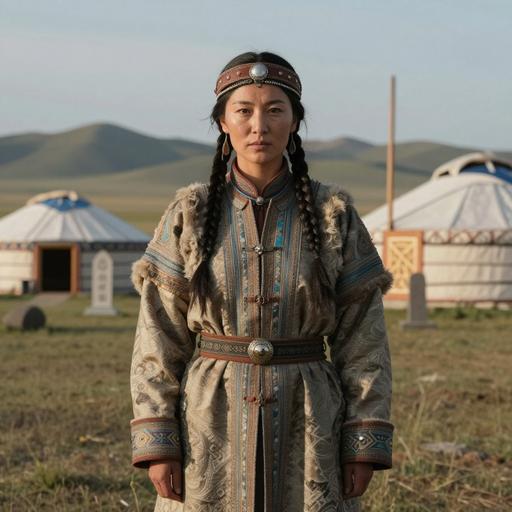
Portrait reconstruction of NRC001
Ancient Individual

A woman buried in Mongolia in the Middle Ages era

NRC001
1000 CE - 1500 CE
Female
Late Medieval Uvurkhangai, Mongolia
Mongolia
Scroll to begin
Chapter I

Identity

The biological and cultural markers that define this ancient individual

Sample ID

NRC001

Date Range

1000 CE - 1500 CE

Biological Sex

Female

mtDNA Haplogroup

A

Cultural Period

Late Medieval Uvurkhangai, Mongolia

Chapter II

Place

Where this individual was discovered

Country Mongolia
Locality Uvurkhangai. Baga Artsatyn Am. NW cemetery
Chapter III

Time

When this individual lived in the broader context of human history

NRC001 1000 CE - 1500 CE
Chapter IV

Story

The narrative of this ancient life

Uvurkhangai, a province in modern-day Mongolia, played a significant role during the Late Medieval period, particularly as part of the Mongol Empire. This era, stretching roughly from the 13th to 15th centuries, was marked by the expansive reach and influence of the Mongol Empire, initially established by Genghis Khan in 1206. The empire became one of the largest contiguous empires in history, and its cultural, economic, and political impacts were far-reaching, with many reverberating through the region of Uvurkhangai.

Geographical and Strategic Importance

Uvurkhangai, located in central Mongolia, is characterized by a diverse landscape of steppes, mountains, and rivers. This geographic diversity made it strategically significant. The area's position allowed for control over important trade routes and communication lines across the empire, facilitating the movement of goods, people, and ideas. It acted as a conduit between the heartland of Mongolia and the broader territories under Mongolian influence, such as China and Central Asia.

Political Structure

During the late medieval period, Uvurkhangai, like much of Mongolia, was under the suzerainty of the Great Khans. The Mongol Empire was highly organized, with a centralized administration, although it allowed for significant autonomy among its various regions. Local leaders, or noyans, governed over their territories yet remained loyal to the Khans, maintaining the empire's integrity. This arrangement enabled regions like Uvurkhangai to assert some local governance while contributing to imperial ambitions.

Economy and Trade

The economy of late medieval Uvurkhangai was heavily influenced by the empire's emphasis on trade and commerce. The Mongol Empire famously established and maintained the Silk Road network, which connected Asia with Europe and facilitated the exchange of goods, culture, and technology. Uvurkhangai benefited from this trade, accessing goods such as silk, spices, and precious metals, and incorporating these materials into local artistry and craft. Livestock farming remained a staple of the economy, with horses, sheep, and other animals as integral elements to both daily life and military campaigns.

Society and Culture

The culture of Uvurkhangai during this era bore the hallmark influences of nomadic traditions blended with the diversity of ideas brought in via the Silk Road. The Mongols' nomadic heritage was evident in their lifestyle, housing, and social structure. The yurt (ger), a portable round tent, remained the primary form of housing, symbolizing both the mobility and unity of nomadic society.

The Mongol Empire was notable for its religious tolerance and the assimilation of diverse cultural practices. Shamanism, Buddhism, and even Christianity found a place within the societal framework, existing side by side harmoniously. This eclectic religious landscape influenced art, with motifs and designs reflecting a variety of spiritual ideals.

Art and Architecture

Art and architecture in late medieval Uvurkhangai bore the marks of the era's cultural exchanges. While the nomadic lifestyle limited permanent structures, the spread of Buddhism led to the establishment of monasteries and stupas, often showcasing intricate carvings and decorations. These religious structures became centers of learning and artistry, with local craftsmen absorbing and adapting techniques from neighboring regions.

Military Influence

Uvurkhangai's contribution to the military prowess of the Mongol Empire was significant. Its nomadic warrior tradition was well-suited to the Mongols' cavalry-based military system. The ability of Mongol forces to move quickly and effectively across vast distances was partly attributed to the horse-breeding practices in regions like Uvurkhangai, which maintained a steady supply of hardy and agile horses for the empire's campaigns.

Decline and Transition

By the end of the 15th century, the might of the Mongol Empire was waning, fragmented into a series of smaller khanates. Regions like Uvurkhangai experienced a gradual transition as centralized power diminished, leading to more localized rule and the resurgence of traditional practices. However, the legacy of the empire's cultural and economic contributions endured, echoing in the practices and traditions that continued well into the modern era.

In summary, Uvurkhangai during the Late Medieval period was a region deeply intertwined with the broader dynamics of the Mongol Empire. From strategic geographic importance to rich cultural and economic exchanges, this era laid a foundation that would influence the historical trajectory of Mongolia and its neighboring regions.

Chapter V

Genetics

The genetic ancestry of this ancient individual

Ancient Genetic Admixture

This analysis compares the DNA profile of NRC001 with ancient reference populations, showing the genetic composition in terms of prehistoric ancestral groups.

Ancient Asians 74.5%
Neolithic Farmers 19.6%
Western Steppe Pastoralists 3.8%
Ancient Native Americans 2.1%

Modern Genetic Admixture

This analysis compares the DNA profile with present-day reference populations, showing what percentage of genetic makeup resembles modern populations from different regions.

Asia 86.8%
Japanese & Korean 25.6%
Japanese 25.6%
Northern Asian 24.9%
Mongolian 17.2%
Siberian 7.7%
Chinese & Southeast Asian 23.4%
Chinese 23.4%
Central Asian, Northern Indian & Pakistani 7.0%
Indian 7.0%
Northern West Asian 4.7%
Mesopotamian 3.0%
Cypriot 1.6%
Arab, Egyptian & Levantine 1.2%
Levantine 1.2%
Europe 10.8%
Southern European 6.9%
Iberian 6.9%
Northwestern European 2.0%
Scandinavian 2.0%
Eastern European 1.9%
America 1.6%
America 1.6%
Native American 1.6%
Africa 0.8%
North African 0.8%
North African 0.8%

Closest Modern Populations

These are the modern populations showing the closest statistical alignment to A woman buried in Mongolia in the Middle Ages era, ranked by genetic distance. Lower distance values indicate closer statistical similarity.

1
Kazakh China
6.5425
2
Mongol Inner Mongolia
7.3438
3
Dongxiang
7.3830
4
Mongol Xinjiang
7.3840
5
Yuku
7.4573
6
Kirghiz China
7.7814
7
Salar
8.0471
8
Kirghiz
8.1793
9
Kalmyk
8.2964
10
Mongolian
8.4410
Chapter VI

Context

Other ancient individuals connected to this sample

Sources

References

Scientific publications and genetic data

Scientific Publication

A Dynamic 6,000-Year Genetic History of Eurasia's Eastern Steppe

Authors Jeong C, Wang K, Wilkin S
Abstract

The Eastern Eurasian Steppe was home to historic empires of nomadic pastoralists, including the Xiongnu and the Mongols. However, little is known about the region's population history. Here, we reveal its dynamic genetic history by analyzing new genome-wide data for 214 ancient individuals spanning 6,000 years. We identify a pastoralist expansion into Mongolia ca. 3000 BCE, and by the Late Bronze Age, Mongolian populations were biogeographically structured into three distinct groups, all practicing dairy pastoralism regardless of ancestry. The Xiongnu emerged from the mixing of these populations and those from surrounding regions. By comparison, the Mongols exhibit much higher eastern Eurasian ancestry, resembling present-day Mongolic-speaking populations. Our results illuminate the complex interplay between genetic, sociopolitical, and cultural changes on the Eastern Steppe.

G25 Coordinates

The G25 coordinates for sample NRC001 can be used for detailed admixture analysis in our G25 Studio tool.

NRC001,0.04222346,-0.31083166,0.02917636,-0.01878194,0.00322366,0.00258862,0.00224536,0.0019133,-0.00516816,0.00027066,-0.04451156,-0.00484132,0.00636164,-0.01109798,-0.0009699,0.0007595,-0.00466608,-0.0006838,0.00067044,-0.00044762,-0.00340664,0.0029564,0.00548938,0.00275636,-0.00479556
Analyze in G25 Studio
Use code for 40% off Expires Feb 27