Menu
Store
Blog
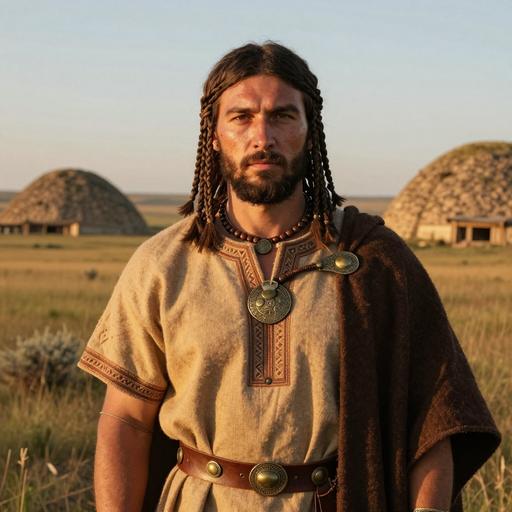
Portrait reconstruction of Pr10
Ancient Individual

A man buried in Russia in the Iron Age era

Pr10
400 BCE - 100 BCE
Male
Early Sarmatian Culture, Russia
Russia
Scroll to begin
Chapter I

Identity

The biological and cultural markers that define this ancient individual

Sample ID

Pr10

Date Range

400 BCE - 100 BCE

Biological Sex

Male

mtDNA Haplogroup

H2a1f

Y-DNA Haplogroup

R-Z2124

Cultural Period

Early Sarmatian Culture, Russia

Chapter II

Place

Where this individual was discovered

Country Russia
Locality Orenburg. Pokrovka cemetery
Coordinates 51.7630, 55.1270
Chapter III

Time

When this individual lived in the broader context of human history

Pr10 400 BCE - 100 BCE
Chapter IV

Story

The narrative of this ancient life

The Early Sarmatian culture, flourishing approximately from the 4th to the 1st century BCE, represents a significant part of the early nomadic history on the Eurasian Steppe, primarily in what is now southern Russia, Ukraine, and Kazakhstan. It is important to note that the Sarmatians were a confederation of Iranian-speaking tribes known for their influence and interactions with other contemporary civilizations.

Geographic and Temporal Context

The geographical heartland of the Early Sarmatians was the expansive Pontic-Caspian steppe region. This vast area, characterized by its grasslands and open plains, provided the ideal environment for nomadic lifestyle and horseback culture. It allowed for mobility, which was essential for herding livestock, trading, and military activities. The Sarmatians were contemporaneous with various other cultural groups, including the Scythians, with whom they shared many similarities and interactions.

Social Structure and Lifestyle

The Sarmatian society was predominantly organized into tribal structures, which were fluid and often governed by warrior aristocracies. The mobility required by their nomadic lifestyle dictated a socio-economic system deeply rooted in pastoralism, with horse breeding and herding of cattle, sheep, and goats at its core.

Women in Sarmatian culture held a remarkably high status. Archaeological evidence, including the excavation of richly furnished female graves, suggests that women could be warriors and wield influence comparable to men. This societal norm likely influenced the Greek myths of Amazons, which encapsulate the image of formidable warrior women reputed to have hailed from Scythian and Sarmatian tribes.

Material Culture

The Sarmatians are noted for their distinctive material culture, which evolved through interactions and trade with their neighbors, including the Scythians, Greeks, and later, the Romans. Their craftsmanship is evident in their metalwork, with gold being a particularly favored medium. Artifacts include intricately designed jewelry, weaponry, and horse trappings, often embellished with animal motifs and reflecting the animal style art of the steppe.

Warfare and Military Prowess

Sarmatian military tactics and prowess contributed significantly to their historical legacy. They are credited with popularizing the use of heavy cavalry, known as cataphracts, who were heavily armored horsemen wielding long lances. Their cavalry units were highly mobile and effective in both raids and formal battles, a factor that allowed them to exert influence over vast territories and challenge established powers like the early Roman Empire and Hellenistic states.

Religion and Beliefs

The religious beliefs of the Early Sarmatians were rooted in animistic and shamanistic practices, with a pantheon of deities possibly related to the natural world and their nomadic lifestyle. Burial practices and rituals, such as in the rich kurgan (burial mound) sites, suggest a belief in an afterlife. They often buried the dead with grave goods, including weapons, jewelry, and personal items, indicative of their status in life and preparation for their journey in the afterlife.

Interaction with Other Cultures

The Early Sarmatian culture was marked by dynamic interactions with neighboring peoples. Their westward expansion in the late 2nd century BCE led them to displace the Scythians from the Pontic Steppe and to establish dominance in the region. They had ongoing relationships with Classical Greek colonies along the Black Sea coast, where they traded goods like grain, furs, and slaves.

Their subsequent interactions with the burgeoning Roman Empire often led to both conflict and assimilation. As Rome expanded northwards, many Sarmatians were recruited as mercenaries and some were settled within Roman territories, blending their traditions with those of the Romanized populations.

Legacy

The Sarmatian influence on the historical and cultural landscape of the Eurasian steppe is profound. Their military innovations, particularly in cavalry tactics, left a lasting mark on warfare in antiquity and beyond. Cultural interchange facilitated by their nomadic movements contributed to the diffusion of ideas, technologies, and customs across vast distances.

In summation, the Early Sarmatian culture is a testament to the vibrancy and complexity of nomadic societies in ancient history. It offers critical insights into how such societies adapted to and shaped the geopolitical landscapes of their time.

Chapter V

Genetics

The genetic ancestry of this ancient individual

Ancient Genetic Admixture

This analysis compares the DNA profile of Pr10 with ancient reference populations, showing the genetic composition in terms of prehistoric ancestral groups.

Western Steppe Pastoralists 35.2%
European Hunter-Gatherers 32.4%
Ancient Asians 17.8%
Neolithic Farmers 12.0%
Ancient Oceanians 2.6%

Modern Genetic Admixture

This analysis compares the DNA profile with present-day reference populations, showing what percentage of genetic makeup resembles modern populations from different regions.

Europe 62.7%
Northwestern European 41.9%
English 27.7%
Northwestern European 10.8%
Finnish 3.5%
Eastern European 20.8%
Asia 35.4%
Central Asian, Northern Indian & Pakistani 28.6%
Pakistan 19.9%
Indian 7.4%
Central Asian 1.3%
Northern Asian 6.8%
Siberian 6.8%
America 1.0%
America 1.0%
Native American 1.0%
Oceania 0.9%
Melanesian 0.9%
Papuan 0.9%

Closest Modern Populations

These are the modern populations showing the closest statistical alignment to A man buried in Russia in the Iron Age era, ranked by genetic distance. Lower distance values indicate closer statistical similarity.

1
Tatar Kazan
6.4196
2
Pamiri Rushan
6.6288
3
Tatar Mishar
6.6708
4
Pamiri Shugnan
7.2081
5
Tajik Yaghnobi
7.5730
6
Pamiri Badakhshan
7.7786
7
Tajik Tajikistan Kulob
7.9789
8
Tajik Tajikistan Hisor
7.9890
9
Besermyan
8.0241
10
Tajik Tajikistan Ayni
8.0422
Chapter VI

Context

Other ancient individuals connected to this sample

Sources

References

Scientific publications and genetic data

Scientific Publication

Population genomic analysis of elongated skulls reveals extensive female-biased immigration in Early Medieval Bavaria

Authors Veeramah KR, Rott A, Groß M
Abstract

Modern European genetic structure demonstrates strong correlations with geography, while genetic analysis of prehistoric humans has indicated at least two major waves of immigration from outside the continent during periods of cultural change. However, population-level genome data that could shed light on the demographic processes occurring during the intervening periods have been absent. Therefore, we generated genomic data from 41 individuals dating mostly to the late 5th/early 6th century AD from present-day Bavaria in southern Germany, including 11 whole genomes (mean depth 5.56×). In addition we developed a capture array to sequence neutral regions spanning a total of 5 Mb and 486 functional polymorphic sites to high depth (mean 72×) in all individuals. Our data indicate that while men generally had ancestry that closely resembles modern northern and central Europeans, women exhibit a very high genetic heterogeneity; this includes signals of genetic ancestry ranging from western Europe to East Asia. Particularly striking are women with artificial skull deformations; the analysis of their collective genetic ancestry suggests an origin in southeastern Europe. In addition, functional variants indicate that they also differed in visible characteristics. This example of female-biased migration indicates that complex demographic processes during the Early Medieval period may have contributed in an unexpected way to shape the modern European genetic landscape. Examination of the panel of functional loci also revealed that many alleles associated with recent positive selection were already at modern-like frequencies in European populations ∼1,500 years ago.

G25 Coordinates

The G25 coordinates for sample Pr10 can be used for detailed admixture analysis in our G25 Studio tool.

Pr10,0.10677594,0.04337532,0.01840028,0.05346202,-0.02448782,0.01659612,0.01142854,0.0097673,-0.01779072,-0.0278442,0.00444456,-0.00308168,0.00580436,-0.0115219,0.0006732,-0.0071899,-0.01284422,-0.00278448,-0.008493,-0.01206594,-0.00289976,0.00358702,-0.01115398,0.00422204,-0.00580338
Analyze in G25 Studio
Use code for 40% off Expires Feb 27