Menu
Store
Blog
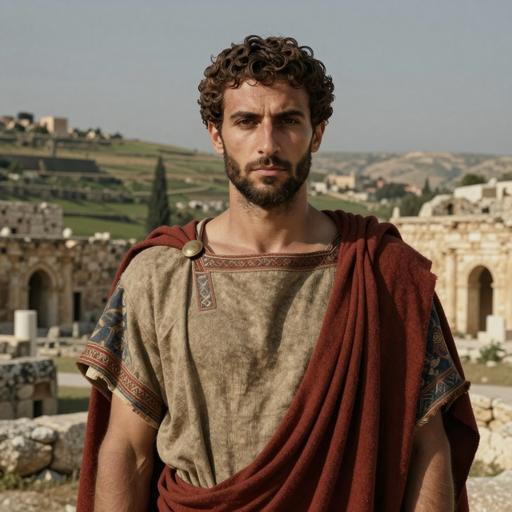
Portrait reconstruction of QED-2
Ancient Individual

A man buried in Lebanon in the Iron Age era

QED-2
250 CE - 416 CE
Male
Roman Lebanon
Lebanon
Scroll to begin
Chapter I

Identity

The biological and cultural markers that define this ancient individual

Sample ID

QED-2

Date Range

250 CE - 416 CE

Biological Sex

Male

mtDNA Haplogroup

T1a-a*

Y-DNA Haplogroup

T-CTS9882

Cultural Period

Roman Lebanon

Chapter II

Place

Where this individual was discovered

Country Lebanon
Locality Qornet ed-Deir
Coordinates 34.0522, 35.7758
Chapter III

Time

When this individual lived in the broader context of human history

QED-2 250 CE - 416 CE
Chapter IV

Story

The narrative of this ancient life

The era of Roman Lebanon, spanning from the 1st century BCE to the 7th century CE, was a period of significant transformation and development, marked by the integration of Lebanese territories into the Roman Empire. This era brought about profound changes in the social, economic, architectural, and cultural landscapes of the region. Below is an extensive and detailed description of this era and culture.

Historical Context

Roman Lebanon falls within the broader narrative of the Roman Empire's expansion after the defeat of the Hellenistic Seleucid Empire, which previously controlled the Levant. From around 64 BCE, when the Roman general Pompey annexed the region, until the early 7th century CE, Roman Lebanon was an integral part of the Roman provinces of Syria and Phoenicia. The region, characterized by its strategic position on the eastern Mediterranean coast, served as a bridge between Asia and Europe, facilitating trade and cultural exchanges.

Political and Administrative Structure

Roman governance was characterized by the establishment of Roman provinces, with Phoenicia and parts of modern-day Lebanon being organized into the provinces of Syria and later Phoenice. The Romans implemented their administrative systems, which included Roman law, tax collection, and local governance through city councils. Prominent cities like Tyre, Sidon, and Heliopolis (modern-day Baalbek) became centers of Roman administration and culture.

Economic Development

Under Roman rule, Lebanon witnessed economic prosperity. The region's economy was bolstered by its prime location along trade routes linking the Roman Empire with the East. Agricultural production flourished, with olive oil, wine, and grain being significant exports. Roman Lebanon also thrived in the production of purple dye, derived from the murex mollusk, which was a luxury item sought throughout the empire.

Urbanization and Architecture

One of the most remarkable aspects of Roman Lebanon was the urbanization of its cities and the construction of monumental architecture. Roman engineering and architectural techniques dominated the landscape, leaving behind impressive structures that stand to this day.

  • Baalbek: Known for the Temple of Jupiter, one of the largest Roman temple complexes in the world, Baalbek became an emblem of Roman architectural ambition and religious syncretism.

  • Tyre and Sidon: These coastal cities were expanded and further fortified. Roman roads, aqueducts, and public buildings such as bathhouses, forums, and theaters were built, symbolizing Roman urban life.

  • Byblos and Beirut: These cities became important centers of Roman culture and learning, with Beirut hosting a renowned law school that attracted students from across the Roman Empire.

Cultural Exchange and Religion

The Roman period in Lebanon was marked by a blend of Roman, Greek, and indigenous Phoenician influences. The cultural assimilation led to the creation of a distinct local identity.

  • Religious Syncretism: The fusion of Roman and native religions was common, with local deities being identified with Roman gods. Jupiter, Mercury, and Venus were worshipped alongside indigenous deities, sometimes resulting in unique composite figures.

  • Arts and Literature: Roman influence was evident in the arts, with local artisans producing mosaics, sculptures, and pottery in Roman styles. The region's incorporation into the Roman world also facilitated an exchange of philosophical and literary ideas, contributing to a vibrant intellectual climate.

Society and Daily Life

Roman Lebanon was characterized by a diverse societal makeup, with Roman citizens, local Phoenicians, and a mix of Greeks, Jews, and other ethnic groups living side by side. Roman citizenship granted specific legal privileges and was highly coveted, influencing social dynamics and mobility.

  • Urban and Rural Life: While urban centers thrived with Roman amenities and leisure activities, the rural areas continued traditional agricultural practices. The Roman system of roads enhanced connectivity and the integration of these diverse communities.

  • Language and Education: Latin was the official language of administration, though Greek remained the lingua franca for commerce and scholarly activities. Latin and Greek education systems coexisted and contributed to a high degree of literacy among the elite.

Decline and Legacy

The decline of Roman Lebanon began in the early 7th century as the Eastern Roman (Byzantine) Empire faced internal strife and external pressures. The rise of the Sassanid Empire and later the advent of Islam in the region marked the end of the Roman era in Lebanon.

Despite this decline, the Roman legacy in Lebanon is profound. The ruins of temples, roads, and cities continue to bear witness to the profound influence of Roman culture and engineering. The fusion of Roman and local traditions created a rich cultural tapestry that persisted well into the Byzantine period and beyond.

In summary, Roman Lebanon was a vibrant period characterized by economic prosperity, cultural syncretism, and monumental architectural achievements, all of which left an enduring impact on the region's cultural heritage.

Chapter V

Genetics

The genetic ancestry of this ancient individual

Ancient Genetic Admixture

This analysis compares the DNA profile of QED-2 with ancient reference populations, showing the genetic composition in terms of prehistoric ancestral groups.

Neolithic Farmers 77.5%
European Hunter-Gatherers 20.0%
Ancient Asians 2.5%

Modern Genetic Admixture

This analysis compares the DNA profile with present-day reference populations, showing what percentage of genetic makeup resembles modern populations from different regions.

Asia 75.9%
Arab, Egyptian & Levantine 45.9%
Levantine 30.6%
Arabian 15.3%
Northern West Asian 29.6%
Mesopotamian 14.9%
Anatolian 7.8%
Cypriot 6.9%
Europe 14.3%
Southern European 10.7%
Italian 7.0%
Sardinian 3.7%
Northwestern European 3.6%
Africa 9.8%
North African 9.8%
North African 7.4%
Egyptian 2.4%

Closest Modern Populations

These are the modern populations showing the closest statistical alignment to A man buried in Lebanon in the Iron Age era, ranked by genetic distance. Lower distance values indicate closer statistical similarity.

1
Lebanese Christian
1.6071
2
Lebanese Druze
2.1604
3
Druze
2.2159
4
Alawite
2.3893
5
Karaite Egypt
2.4971
6
Palestinian Beit Sahour
2.6011
7
Lebanese Muslim
2.6648
8
Syrian Jew
2.7396
9
Samaritan
3.1013
10
Cochin Jews Paradesi
3.1569
Chapter VI

Context

Other ancient individuals connected to this sample

Sources

References

Scientific publications and genetic data

Scientific Publication

A Transient Pulse of Genetic Admixture from the Crusaders in the Near East Identified from Ancient Genome Sequences

Authors Haber M, Doumet-Serhal C, Scheib CL
Abstract

During the medieval period, hundreds of thousands of Europeans migrated to the Near East to take part in the Crusades, and many of them settled in the newly established Christian states along the Eastern Mediterranean coast. Here, we present a genetic snapshot of these events and their aftermath by sequencing the whole genomes of 13 individuals who lived in what is today known as Lebanon between the 3rd and 13th centuries CE. These include nine individuals from the "Crusaders' pit" in Sidon, a mass burial in South Lebanon identified from the archaeology as the grave of Crusaders killed during a battle in the 13th century CE. We show that all of the Crusaders' pit individuals were males; some were Western Europeans from diverse origins, some were locals (genetically indistinguishable from present-day Lebanese), and two individuals were a mixture of European and Near Eastern ancestries, providing direct evidence that the Crusaders admixed with the local population. However, these mixtures appear to have had limited genetic consequences since signals of admixture with Europeans are not significant in any Lebanese group today-in particular, Lebanese Christians are today genetically similar to local people who lived during the Roman period which preceded the Crusades by more than four centuries.

G25 Coordinates

The G25 coordinates for sample QED-2 can be used for detailed admixture analysis in our G25 Studio tool.

QED-2,0.08249104,0.1419328,-0.04634408,-0.07782534,-0.00697728,-0.0305989,-0.00214206,-0.00966584,0.01017722,0.01161718,0.0072356,-0.00857404,0.00793344,-0.0019576,-0.00513184,0.00813128,-0.0046708,1.086E-05,-0.0013251,-0.00067144,0.00023112,0.0033684,0.0020285,-4.45E-05,-0.00045939
Analyze in G25 Studio
Use code for 40% off Expires Feb 27