Menu
Store
Blog
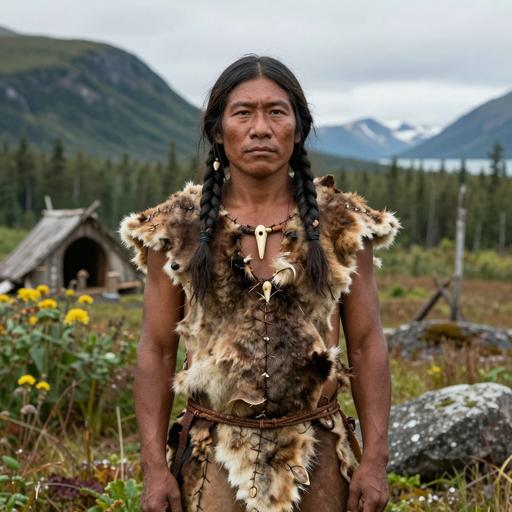
Portrait reconstruction of ShukaKaa
Ancient Individual

A man buried in USA in the Ancient North America era

ShukaKaa
8550 BCE - 8295 BCE
Male
Prehistoric Alaska, USA
USA
Scroll to begin
Chapter I

Identity

The biological and cultural markers that define this ancient individual

Sample ID

ShukaKaa

Date Range

8550 BCE - 8295 BCE

Biological Sex

Male

mtDNA Haplogroup

D4h3a

Y-DNA Haplogroup

Q-L53

Cultural Period

Prehistoric Alaska, USA

Chapter II

Place

Where this individual was discovered

Country USA
Locality Alaska. Prince of Wales Island. On Your Knees Cave
Chapter III

Time

When this individual lived in the broader context of human history

ShukaKaa 8550 BCE - 8295 BCE
Chapter IV

Story

The narrative of this ancient life

The Paleo-Arctic Tradition represents one of the earliest known cultural periods in the prehistoric timeline of Alaska, dating approximately from around 10,000 to 6,000 years ago. This era is particularly significant as it marks the occupation of Alaska by some of the first human inhabitants who arrived via the Bering Land Bridge, using what is now the Bering Strait during the late Pleistocene epoch when sea levels were much lower.

Environmental Context: During the Paleo-Arctic Tradition, the landscape was vastly different from today's. It was dominated by tundra and steppe environments with patches of forested areas, creating a challenging setting that required adaptive strategies for survival. The climate during this period was generally cold and arid, influenced by the remnants of the Ice Age. However, it gradually shifted towards a warmer and wetter climate as the Holocene epoch progressed.

Cultural Characteristics: The people of the Paleo-Arctic Tradition are believed to have been highly mobile hunter-gatherers, adapting to the harsh northern environment. The main subsistence strategies included hunting large mammals such as mammoth, bison, and caribou, along with fishing and gathering edible plants. Their social structures were likely organized into small, kin-based bands that were flexible enough to respond to the seasonal and spatial availability of resources.

Tool Technology: A defining feature of the Paleo-Arctic Tradition is its lithic technology, characterized by microblade tools. These small, elongated blades were produced using sophisticated pressure flaking techniques and were likely used as insets in composite tools and weapons like spears and arrows. This technology reflects not only a high degree of craftsmanship and innovation but also a deep understanding of the available resources.

The microblade tradition is seen as highly efficient and adaptable, suitable for the varied environments of prehistoric Alaska. Artifacts such as burins, scrapers, and bifacially worked points have also been discovered, indicating a complex toolkit used for a variety of functions, from processing animal skins and food to crafting other tools.

Sites and Archaeological Evidence: Several important archaeological sites across Alaska have provided insight into the lifeways of the Paleo-Arctic peoples. Notable sites include the Anangula site in the Aleutian Islands and the Trail Creek Caves in the Seward Peninsula. These sites have yielded crucial evidence of early human activity, providing a record of tool manufacturing processes and patterns of habitation.

Connections and Influence: The Paleo-Arctic Tradition is linked to broader cultural and technological trends seen in other parts of the Arctic and Subarctic regions, demonstrating connections and interactions across vast landscapes. This tradition is often associated with similar cultures in Siberia, indicating a shared heritage and migratory patterns across Beringia.

As the Paleo-Arctic Tradition transitioned into subsequent cultural phases, such as the Arctic Small Tool tradition, we see evidence of continued innovation and adaptation, reflecting an enduring human presence that would eventually give rise to the more recognized indigenous cultures of Alaska before contact with Europeans.

In summary, the Paleo-Arctic Tradition represents a significant chapter in the prehistory of Alaska, showcasing the resilience and ingenuity of early human populations as they adapted to the challenges of a changing landscape at the northernmost edge of North America.

Chapter V

Genetics

The genetic ancestry of this ancient individual

Ancient Genetic Admixture

This analysis compares the DNA profile of ShukaKaa with ancient reference populations, showing the genetic composition in terms of prehistoric ancestral groups.

Ancient Native Americans 48.8%
European Hunter-Gatherers 29.4%
Ancient Asians 8.6%
Western Steppe Pastoralists 7.5%
Ancient Africans 3.3%
Neolithic Farmers 2.4%

Modern Genetic Admixture

This analysis compares the DNA profile with present-day reference populations, showing what percentage of genetic makeup resembles modern populations from different regions.

America 47.2%
America 47.2%
Native American 47.2%
Asia 31.0%
Central Asian, Northern Indian & Pakistani 16.1%
Pakistan 8.5%
Central Asian 3.9%
Indian 3.8%
Northern West Asian 12.6%
Mesopotamian 8.8%
Caucasian 3.8%
Chinese & Southeast Asian 2.2%
Indonesian Khmer Thai Myanma 2.2%
Europe 21.8%
Northwestern European 21.8%
Scandinavian 15.3%
Northwestern European 6.5%

Closest Modern Populations

These are the modern populations showing the closest statistical alignment to A man buried in USA in the Ancient North America era, ranked by genetic distance. Lower distance values indicate closer statistical similarity.

1
Cree
6.5567
Chapter VI

Context

Other ancient individuals connected to this sample

Sources

References

Scientific publications and genetic data

Scientific Publication

Ancient individuals from the North American Northwest Coast reveal 10,000 years of regional genetic continuity

Authors Lindo J, Achilli A, Perego UA
Abstract

Recent genomic studies of both ancient and modern indigenous people of the Americas have shed light on the demographic processes involved during the first peopling. The Pacific Northwest Coast proves an intriguing focus for these studies because of its association with coastal migration models and genetic ancestral patterns that are difficult to reconcile with modern DNA alone. Here, we report the low-coverage genome sequence of an ancient individual known as "Shuká Káa" ("Man Ahead of Us") recovered from the On Your Knees Cave (OYKC) in southeastern Alaska (archaeological site 49-PET-408). The human remains date to ∼10,300 calendar (cal) y B.P. We also analyze low-coverage genomes of three more recent individuals from the nearby coast of British Columbia dating from ∼6,075 to 1,750 cal y B.P. From the resulting time series of genetic data, we show that the Pacific Northwest Coast exhibits genetic continuity for at least the past 10,300 cal y B.P. We also infer that population structure existed in the late Pleistocene of North America with Shuká Káa on a different ancestral line compared with other North American individuals from the late Pleistocene or early Holocene (i.e., Anzick-1 and Kennewick Man). Despite regional shifts in mtDNA haplogroups, we conclude from individuals sampled through time that people of the northern Northwest Coast belong to an early genetic lineage that may stem from a late Pleistocene coastal migration into the Americas.

G25 Coordinates

The G25 coordinates for sample ShukaKaa can be used for detailed admixture analysis in our G25 Studio tool.

ShukaKaa,0.08068428,-0.14429022,0.06814876,0.06070478,-0.07328362,-0.00508752,-0.14519612,-0.17563464,-0.02394964,-0.02452106,0.00616612,-0.00130958,0.00376936,0.00141476,-0.0068497,-0.00373658,0.00087528,-0.00069874,-0.00868064,-0.00881742,0.00195812,0.0044818,-0.00779962,0.00407652,-0.00371412
Analyze in G25 Studio
Use code for 40% off Expires Feb 27