Menu
Store
Blog
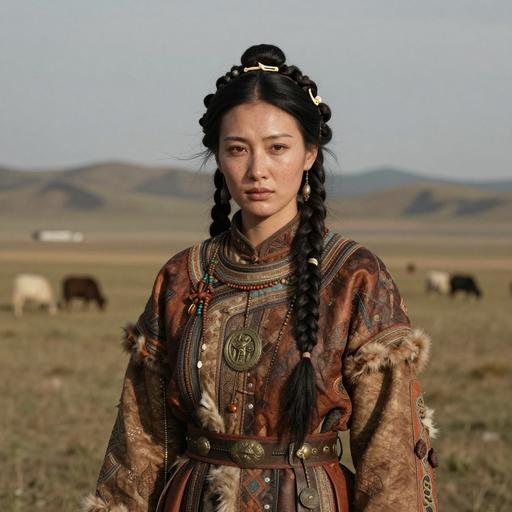
Portrait reconstruction of TEV002
Ancient Individual

A woman buried in Mongolia in the Iron Age era

TEV002
200 BCE - 100 CE
Female
Xiongnu Period Uvurkhangai, Mongolia
Mongolia
Scroll to begin
Chapter I

Identity

The biological and cultural markers that define this ancient individual

Sample ID

TEV002

Date Range

200 BCE - 100 CE

Biological Sex

Female

mtDNA Haplogroup

C5b

Cultural Period

Xiongnu Period Uvurkhangai, Mongolia

Chapter II

Place

Where this individual was discovered

Country Mongolia
Locality Uvurkhangai. Tevsh Mountain
Chapter III

Time

When this individual lived in the broader context of human history

TEV002 200 BCE - 100 CE
Chapter IV

Story

The narrative of this ancient life

The Xiongnu period, particularly in the region now known as Uvurkhangai in Mongolia, represents a significant era in the history of nomadic steppe cultures. The Xiongnu were a confederation of nomadic tribes that first emerged as a formidable force on the Mongolian Plateau around the late 3rd century BCE, and their influence continued well into the 1st century CE. This period marks a time of cultural, economic, and military development that impacted a vast region, influencing successive nomadic empires such as the Mongols.

Geographic and Environmental Context

Uvurkhangai, a province in central Mongolia, is characterized by its diverse landscape, which includes mountain ranges, rolling steppes, and river valleys. This geography was integral to the lifestyle of the Xiongnu, who were expert horsemen and pastoralists. The area's open plains provided ample pasture for their herds of horses, cattle, sheep, and camels, which were central to their economy and mobility.

Societal Structure

The Xiongnu society was highly stratified, with a hierarchical structure that included a ruling elite and a warrior aristocracy. The supreme ruler, or Chanyu, wielded considerable power and was supported by a network of subordinate leaders governing different tribes and clans. This system allowed for effective mobilization of resources and people, essential for maintaining their dominance on the steppes.

Nomadic Lifestyle and Economy

The Xiongnu were quintessential nomads, relying primarily on pastoralism for their subsistence. They practiced transhumance, moving with their herds according to the seasons to access the best grazing lands. Horse breeding and horsemanship were central to their way of life, playing a crucial role in both daily activities and military campaigns.

Trade was another vital component of the Xiongnu economy. They engaged in extensive trade networks with neighboring sedentary civilizations, such as Han China. The exchange of goods included horses, furs, and livestock from the Xiongnu in return for silk, grain, and luxury items. This trade was not just economic but also facilitated cultural exchanges and diplomatic relations.

Military Prowess

The Xiongnu are often remembered for their formidable military capabilities. Their armies were composed mainly of highly skilled cavalry, capable of executing rapid and flexible maneuvers that proved effective against more cumbersome infantry-led forces. The Xiongnu employed composite bows, a sophisticated weapon at the time, granting them a significant advantage in warfare.

Their military campaigns were both defensive and expansionist. They frequently clashed with the growing power of the Han dynasty, leading to prolonged conflicts known as the Han-Xiongnu Wars. Despite periods of intense warfare, these interactions also resulted in diplomatic treaties and exchanges.

Cultural and Religious Beliefs

The cultural framework of the Xiongnu was deeply intertwined with their environment and nomadic way of life. They practiced animism, venerating natural elements such as the sun, moon, and mountains. Shamanistic practices were a key part of their spiritual life, with shamans acting as intermediaries between the human and spiritual worlds.

Art and craftsmanship during the Xiongnu period reflected their nomadic lifestyle. Their material culture included intricate metalwork, such as bronze and gold artifacts, which often featured animal motifs.

Legacy and Influence

The decline of the Xiongnu power in the late 1st century CE did not diminish their legacy. Their organizational structure, military strategies, and economic models influenced later nomadic empires, including the Rouran, Göktürks, and eventually the Mongols under Genghis Khan. The Xiongnu set a precedent for the dynamics between nomadic and sedentary societies on the Eurasian steppe.

In summary, the Xiongnu period in Uvurkhangai and the broader Mongolian region exemplifies the strength and adaptability of nomadic cultures. Through their sophisticated social structure, economic exchanges, military tactics, and cultural expressions, the Xiongnu left an indelible mark on the history of steppe civilizations.

Chapter V

Genetics

The genetic ancestry of this ancient individual

Ancient Genetic Admixture

This analysis compares the DNA profile of TEV002 with ancient reference populations, showing the genetic composition in terms of prehistoric ancestral groups.

Ancient Asians 93.8%
Western Steppe Pastoralists 4.1%
Neolithic Farmers 2.1%

Modern Genetic Admixture

This analysis compares the DNA profile with present-day reference populations, showing what percentage of genetic makeup resembles modern populations from different regions.

Asia 99.0%
Northern Asian 76.6%
Mongolian 39.1%
Siberian 37.5%
Japanese & Korean 16.3%
Japanese 16.3%
Chinese & Southeast Asian 6.2%
Tibetan 5.3%
Chinese 0.9%
America 0.7%
America 0.7%
Native American 0.7%

Closest Modern Populations

These are the modern populations showing the closest statistical alignment to A woman buried in Mongolia in the Iron Age era, ranked by genetic distance. Lower distance values indicate closer statistical similarity.

1
Negidal
4.6346
2
Nanai
4.6736
3
Ulchi
4.8642
4
Oroqen
5.5544
5
Khamnegan
6.1083
6
Nivkh
7.0304
7
Buryat
8.4284
8
Evenk O
9.0456
9
Hezhen
9.6941
10
Todzin
9.8685
Chapter VI

Context

Other ancient individuals connected to this sample

Sources

References

Scientific publications and genetic data

Scientific Publication

A Dynamic 6,000-Year Genetic History of Eurasia's Eastern Steppe

Authors Jeong C, Wang K, Wilkin S
Abstract

The Eastern Eurasian Steppe was home to historic empires of nomadic pastoralists, including the Xiongnu and the Mongols. However, little is known about the region's population history. Here, we reveal its dynamic genetic history by analyzing new genome-wide data for 214 ancient individuals spanning 6,000 years. We identify a pastoralist expansion into Mongolia ca. 3000 BCE, and by the Late Bronze Age, Mongolian populations were biogeographically structured into three distinct groups, all practicing dairy pastoralism regardless of ancestry. The Xiongnu emerged from the mixing of these populations and those from surrounding regions. By comparison, the Mongols exhibit much higher eastern Eurasian ancestry, resembling present-day Mongolic-speaking populations. Our results illuminate the complex interplay between genetic, sociopolitical, and cultural changes on the Eastern Steppe.

G25 Coordinates

The G25 coordinates for sample TEV002 can be used for detailed admixture analysis in our G25 Studio tool.

TEV002,0.03690034,-0.42105284,0.09331584,-0.02826088,-0.07658116,-0.04692388,0.0168462,0.02017736,0.00981164,0.01309822,0.00114998,0.00166216,-0.00110002,0.00036742,-0.01073274,-0.01512058,-0.00815626,0.01013324,0.01763966,0.01063304,0.01579784,-0.02308026,-0.0003277,0.00361698,0.01095841
Analyze in G25 Studio
Use code for 40% off Expires Feb 27