Menu
Store
Blog
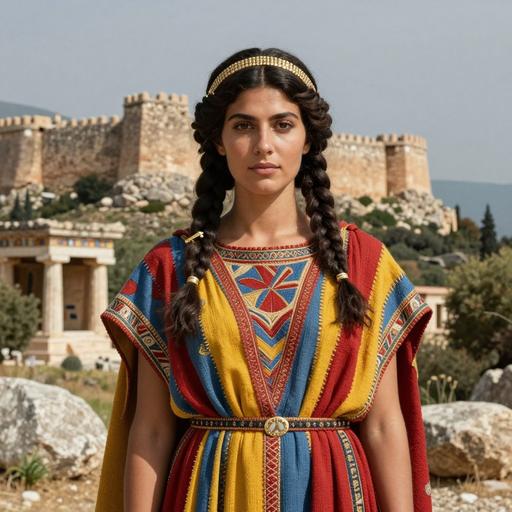
Portrait reconstruction of TIR002
Ancient Individual

A woman buried in Greece in the Bronze Age era

TIR002
1394 BCE - 1308 BCE
Female
Late Helladic Culture of Tiryns
Greece
Scroll to begin
Chapter I

Identity

The biological and cultural markers that define this ancient individual

Sample ID

TIR002

Date Range

1394 BCE - 1308 BCE

Biological Sex

Female

mtDNA Haplogroup

V

Cultural Period

Late Helladic Culture of Tiryns

Chapter II

Place

Where this individual was discovered

Country Greece
Locality Tiryns (Argolid)
Coordinates 37.5995, 22.7996
Chapter III

Time

When this individual lived in the broader context of human history

TIR002 1394 BCE - 1308 BCE
Chapter IV

Story

The narrative of this ancient life

The Late Helladic culture of Tiryns, a prominent period in Mycenaean Greece, is a fascinating and richly complex society that thrived approximately between 1600 to 1100 BCE. Tiryns, located in the Argolid region of the northeastern Peloponnese, was one of the major centers of Mycenaean civilization, alongside Mycenae, Pylos, and other significant sites. Its culture is noted for monumental architecture, advanced engineering, vibrant art, linear writing, and intricate social structures, all of which offer a substantial contribution to our understanding of ancient Greek and Aegean prehistory.

Architecture and Urban Design

The most defining feature of Tiryns during the Late Helladic period is its massive cyclopean walls, named so due to the sheer size of the limestone boulders used, which ancient Greeks believed were constructed by the Cyclopes, mythical giant beings. These walls are a testament to the advanced engineering skills of the Mycenaeans. The fortification of Tiryns includes several gates, bastions, and a complex system of tunnels, demonstrating both strategic military planning and advanced architectural knowledge.

The layout of the Tiryns citadel is indicative of a well-structured urban plan. At its heart lies the megaron, a grand architectural form that served as the great hall of the king. The megaron at Tiryns is particularly noteworthy for its elaborate design, which includes a ceremonial hearth and was richly decorated, suggesting it played a central role in both political and religious activities.

Art and Iconography

Art in Tiryns from this era is characterized by its highly skilled craftsmanship and thematic diversity. Wall frescoes, such as those in the megaron, depicted both religious ceremonies and possibly scenes of daily life, nature, and hunting, illustrating the societal values and customs of the Mycenaean elite. The pottery from Tiryns, like the rest of Mycenaean Greece, displayed intricate designs and motifs, often involving marine themes, floral patterns, and geometric shapes.

The use of Linear B script in administrative records further highlights the importance of written communication in maintaining the bureaucratic functions of the society. These tablets, mainly used for record-keeping and inventory, reflect a structured and hierarchical society with a significant level of complexity in economic transactions.

Society and Economy

The social structure of Tiryns during the Late Helladic period was hierarchical, with a king or “wanax” at the top, followed by a range of officials overseeing different aspects of the state. This hierarchy is reflected in the distribution of resources and the centralized control over agricultural, artisanal, and trade activities. The economy was primarily based on agriculture, with olives, grapes, and grains being staple products. Additionally, craft production in workshops within the citadel produced goods for both local use and long-distance trade, as indicated by the presence of imported materials such as ivory and precious metals.

The Mycenaeans of Tiryns were also engaged in extensive trade networks reaching Egypt, the Near East, and across the Mediterranean, helping to facilitate cultural exchange and the spread of Mycenaean influence. This trade was crucial in supplying the raw materials necessary for their artisans and helped sustain the wealth and power of the elite ruling class.

Religion and Belief Systems

Religious life in Tiryns, as in other Mycenaean centers, was intricate and intertwined with the state. The presence of sanctuaries and altars within the citadel suggests that religious rituals were regularly performed, possibly to legitimize the power of the ruling class and to invoke divine favor for the community's prosperity. Artifacts such as figurines and symbols found within Tiryns imply the worship of a pantheon of gods, some of which may have been precursors to the later Greek deities.

Decline and Legacy

The decline of Tiryns, along with other Mycenaean centers, began around 1200 BCE, marking the end of the Late Helladic period. Various theories have been posited for this decline, including internal strife, invasions by so-called \Sea Peoples," and natural disasters. Despite this decline, the legacy of Tiryns and Mycenaean culture was profound, influencing subsequent Greek civilizations in art, religious practices, and cultural myths, and leaving an indelible mark on the cultural history of Greece.

In summary, the Late Helladic culture of Tiryns represents a peak in Bronze Age civilization in mainland Greece, characterized by majestic architecture, artistic achievements, complex socio-political structures, and extensive trade networks, laying the groundwork for the classical Greek culture that would follow."

Chapter V

Context

Other ancient individuals connected to this sample

Sources

References

Scientific publications and genetic data

Scientific Publication

Ancient DNA reveals admixture history and endogamy in the prehistoric Aegean

Authors Skourtanioti E, Ringbauer H, Gnecchi Ruscone GA
Abstract

The Neolithic and Bronze Ages were highly transformative periods for the genetic history of Europe but for the Aegean-a region fundamental to Europe's prehistory-the biological dimensions of cultural transitions have been elucidated only to a limited extent so far. We have analysed newly generated genome-wide data from 102 ancient individuals from Crete, the Greek mainland and the Aegean Islands, spanning from the Neolithic to the Iron Age. We found that the early farmers from Crete shared the same ancestry as other contemporaneous Neolithic Aegeans. In contrast, the end of the Neolithic period and the following Early Bronze Age were marked by 'eastern' gene flow, which was predominantly of Anatolian origin in Crete. Confirming previous findings for additional Central/Eastern European ancestry in the Greek mainland by the Middle Bronze Age, we additionally show that such genetic signatures appeared in Crete gradually from the seventeenth to twelfth centuries BC, a period when the influence of the mainland over the island intensified. Biological and cultural connectedness within the Aegean is also supported by the finding of consanguineous endogamy practiced at high frequencies, unprecedented in the global ancient DNA record. Our results highlight the potential of archaeogenomic approaches in the Aegean for unravelling the interplay of genetic admixture, marital and other cultural practices.

Use code for 40% off Expires Mar 01