Menu
Store
Blog
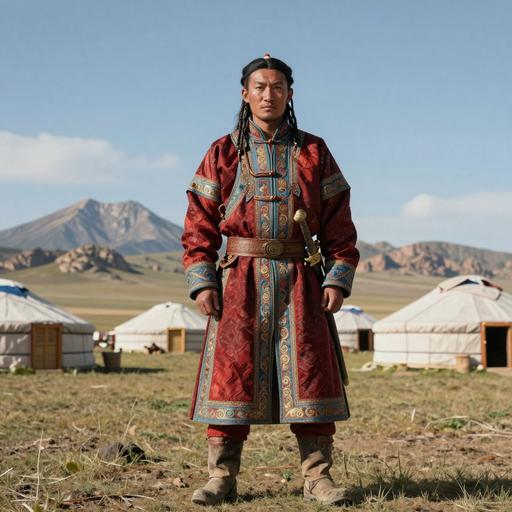
Portrait reconstruction of ZAM002
Ancient Individual

A man buried in Mongolia in the Middle Ages era

ZAM002
1000 CE - 1500 CE
Male
Late Medieval Dundgobi, Mongolia
Mongolia
Scroll to begin
Chapter I

Identity

The biological and cultural markers that define this ancient individual

Sample ID

ZAM002

Date Range

1000 CE - 1500 CE

Biological Sex

Male

mtDNA Haplogroup

B6a

Y-DNA Haplogroup

D-PH4

Cultural Period

Late Medieval Dundgobi, Mongolia

Chapter II

Place

Where this individual was discovered

Country Mongolia
Locality Dundgobi. Zambaga Khairkhan
Chapter III

Time

When this individual lived in the broader context of human history

ZAM002 1000 CE - 1500 CE
Chapter IV

Story

The narrative of this ancient life

The Late Medieval period in Dundgobi, part of the vast steppes of central Mongolia, was a time of significant transformation and cultural flourishing under the Mongol Empire, which was at its height during the 13th and 14th centuries. This era is marked by the Mongol Empire's expansive influence, characterized by monumental conquests, cultural exchanges, and the integration of various peoples and traditions.

Historical Context

During the Late Medieval period, Dundgobi, like much of Mongolia, was under the rule of the Mongol Empire, one of the largest and most powerful empires in history. Founded by Genghis Khan in the early 13th century, the empire rapidly expanded across Asia and into Europe, making it a melting pot of cultures and ideas. This period was marked by the imposition of Pax Mongolica—a time of relative peace which allowed for increased trade and communication across Eurasia.

Society and Culture

Social Structure

The Mongol society in Dundgobi was nomadic and highly hierarchical. The social structure was composed of nobility (comprising the descendants of Genghis Khan and other high-ranking families), commoners, and enslaved people. The nobility controlled vast herds of livestock and wielded significant political power, while the commoners were primarily herders or engaged in craftsmanship.

Nomadic Life

The nomadic lifestyle dictated by the harsh climatic conditions of the Gobi Desert and the surrounding steppes characterized how communities were organized. People lived in portable dwellings known as gers (yurts), which provided insulation against extreme temperatures. The economy was predominantly pastoral, with a focus on herding sheep, goats, horses, and camels, which were central not only to daily life but also to the Mongols' military prowess.

Religion

During this period, shamanism remained integral to Mongol cultural and spiritual life, focusing on the reverence of nature and ancestor worship. However, exposure to a variety of religions due to the Empire’s vast expanse—including Buddhism, Christianity, and Islam—also influenced local practices. Buddhism, in particular, began to gain a foothold during this period, setting the stage for its later prominence in Mongolian culture.

Economy and Trade

The Late Medieval period saw an increased emphasis on trade, facilitated by the stability brought by Mongol rule. Dundgobi, though remote, was part of the Silk Road network, which allowed for commerce in goods like silk, spices, textiles, and other valuables between East Asia, the Middle East, and Europe. Caravans crossing the region contributed to both economic prosperity and cultural exchange, bringing ideas, technology, and goods.

Military and Conquest

The Mongolian military was renowned for its adaptability and effectiveness, primarily due to the highly mobile cavalry. Dundgobi contributed to this military might by supplying well-bred horses essential for conquests and maintaining control over vast territories. The Mongol Empire's military campaigns extended the influence of Dundgobi far beyond its geographical confines.

Art and Culture

Art and cultural expression during this time were deeply intertwined with the nomadic lifestyle. The art of the period reflected themes of nature, daily life, and religious beliefs, often expressed through portable means such as textiles, decorated saddles, and intricate metalwork. Oral traditions flourished, with epic poetry and storytelling serving as the main methods of preserving history and culture.

Decline and Legacy

By the late 14th century, the Mongol Empire began to fragment, largely due to internal strife, overexpansion, and the inability to maintain control over such a vast territory. However, the legacy of the Mongol Empire in areas like Dundgobi remained significant, influencing later Mongolian culture, particularly in terms of administrative practices, trade routes, and cultural exchanges.

The Late Medieval period in Dundgobi thus represents a fascinating chapter in Mongolian history, characterized by dynamic cultural interactions, formidable military prowess, and the adaptability of its people in navigating the challenges of both geography and governance.

Chapter V

Genetics

The genetic ancestry of this ancient individual

Ancient Genetic Admixture

This analysis compares the DNA profile of ZAM002 with ancient reference populations, showing the genetic composition in terms of prehistoric ancestral groups.

Ancient Asians 90.2%
Neolithic Farmers 4.5%
Western Steppe Pastoralists 3.3%
Ancient Native Americans 2.0%

Modern Genetic Admixture

This analysis compares the DNA profile with present-day reference populations, showing what percentage of genetic makeup resembles modern populations from different regions.

Asia 99.5%
Chinese & Southeast Asian 41.2%
Chinese 33.2%
Tibetan 8.1%
Northern Asian 36.4%
Siberian 18.2%
Mongolian 18.2%
Central Asian, Northern Indian & Pakistani 11.7%
Central Asian 11.7%
Japanese & Korean 10.3%
Japanese 10.3%

Closest Modern Populations

These are the modern populations showing the closest statistical alignment to A man buried in Mongolia in the Middle Ages era, ranked by genetic distance. Lower distance values indicate closer statistical similarity.

1
Daur
3.0567
2
Hezhen
3.4155
3
Mongol IMAR
3.4414
4
Xibo
4.3868
5
Mongola
5.0362
6
Mongol Inner Mongolia
5.0965
7
Oroqen
6.1240
8
Yuku
6.7168
9
Tibetan Gangcha
7.1203
10
Mongol
7.1925
Chapter VI

Context

Other ancient individuals connected to this sample

Sources

References

Scientific publications and genetic data

Scientific Publication

A Dynamic 6,000-Year Genetic History of Eurasia's Eastern Steppe

Authors Jeong C, Wang K, Wilkin S
Abstract

The Eastern Eurasian Steppe was home to historic empires of nomadic pastoralists, including the Xiongnu and the Mongols. However, little is known about the region's population history. Here, we reveal its dynamic genetic history by analyzing new genome-wide data for 214 ancient individuals spanning 6,000 years. We identify a pastoralist expansion into Mongolia ca. 3000 BCE, and by the Late Bronze Age, Mongolian populations were biogeographically structured into three distinct groups, all practicing dairy pastoralism regardless of ancestry. The Xiongnu emerged from the mixing of these populations and those from surrounding regions. By comparison, the Mongols exhibit much higher eastern Eurasian ancestry, resembling present-day Mongolic-speaking populations. Our results illuminate the complex interplay between genetic, sociopolitical, and cultural changes on the Eastern Steppe.

G25 Coordinates

The G25 coordinates for sample ZAM002 can be used for detailed admixture analysis in our G25 Studio tool.

ZAM002,0.03395276,-0.41138164,0.04171754,-0.04645774,-0.01848038,-0.01430212,0.00856094,0.01058772,-0.00331776,0.00783508,-0.03967274,-0.00561002,0.007581,-0.0032182,-0.01179872,-0.0007372,-0.00170098,-0.00162816,0.01006108,0.0087658,0.01178554,-0.01014126,-0.00321806,0.0043855,0.00542337
Analyze in G25 Studio
Use code for 40% off Expires Feb 26