Préparation du rapport

Chargement des informations et références disponibles

Connexion au corpus archéologique…

Collecte des archives antiques

Aller au contenu principal
Amur River Mesolithic Dawn
Profil culturel

Amur River Mesolithic Dawn

Early riverine hunter-gatherers of northeastern China, 9442–8475 BCE

9442 CE - 8475 BCE
Amur River Basin, northeastern China
Faites défiler pour commencer
Chapitre I

Le récit

Comprendre la culture Amur River Mesolithic Dawn

Archaeological and ancient DNA evidence from five Mesolithic individuals in the Amur River Basin (9442–8475 BCE) reveals a riverine hunter-gatherer lifeway and a preliminary genetic profile dominated by Y haplogroups C, F, DE and mtDNA D. Interpretations remain tentative due to small sample size.

Time Period

9442–8475 BCE

Region

Amur River Basin, northeastern China

Common Y-DNA

C (2), F (1), DE (1)

Common mtDNA

D (1)

Chapitre II

Chronologie

Moments clés de l'histoire de cette culture

9442 BCE

Earliest dated individuals

Radiocarbon dates indicate human remains in the Amur Basin around 9442 BCE, marking early Holocene occupation.

8475 BCE

Latest dated individuals

Latest cluster of dates for the sampled individuals falls near 8475 BCE, spanning nearly a millennium of Mesolithic activity.

Chapitre III

Origins & Emergence

In the wake of the last glacial retreat, the Amur River Basin became a mosaic of braided channels, wetlands and boreal forests. Radiocarbon-dated human remains from the basin cluster between 9442 and 8475 BCE, placing these people firmly in the Mesolithic phase of northeastern China. Archaeological data indicates repeated seasonal use of river margins and islands, where fish, waterfowl and migratory game concentrated after deglaciation. Limited evidence suggests lithic assemblages characterized by small flaked tools and polished bone implements adapted to woodworking and fishing.

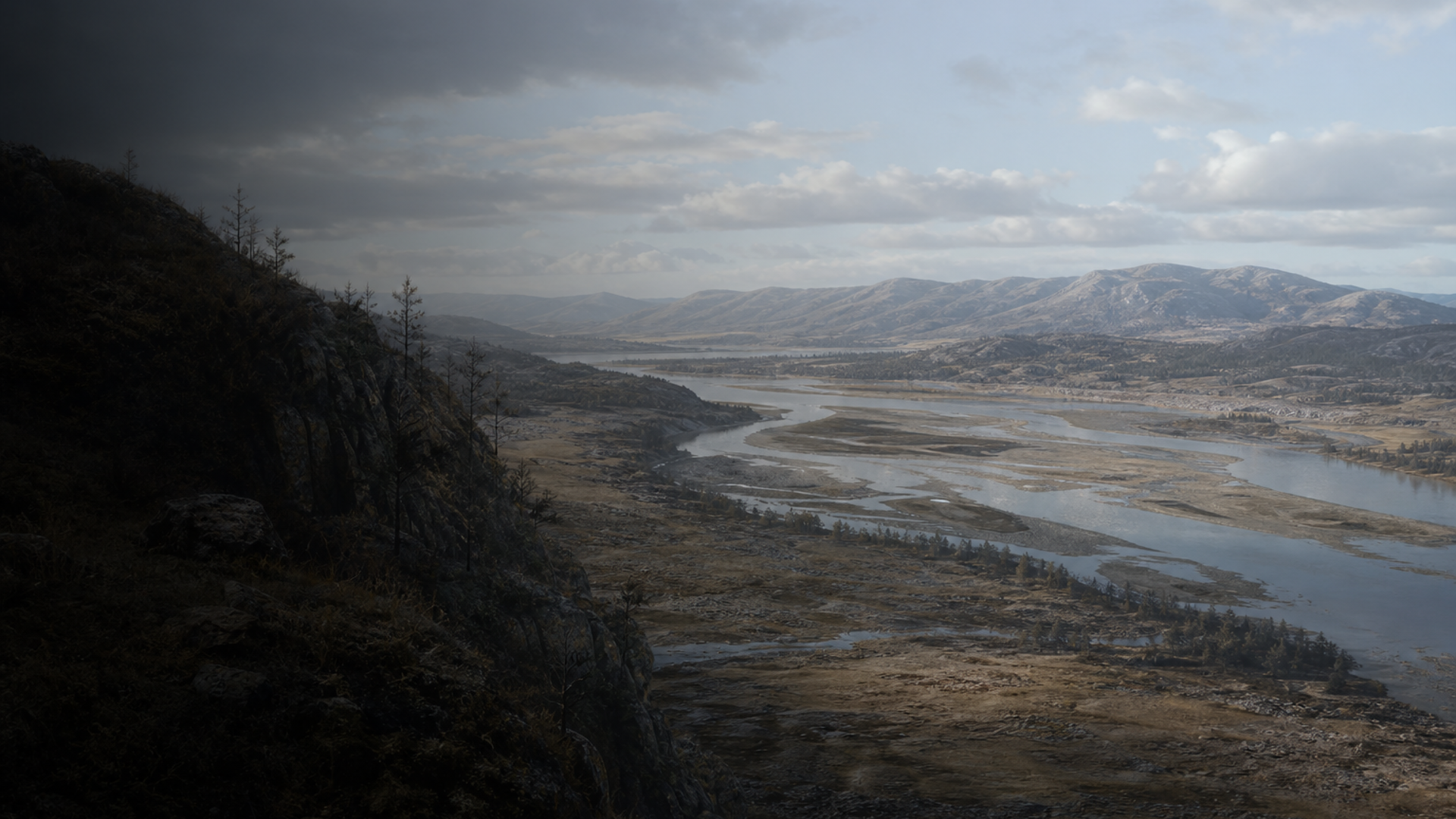
Cinematic landscapes of low-lying floodplains and fog-bound river mouths likely shaped mobility and social networks: camps clustered near tributaries, and resource-rich wintering spots supported small, flexible bands. While regional environmental reconstructions point to an expansion of wetland habitats around the Amur, direct stratified sequences tying technological changes to climatic shifts remain sparse. Genetic samples are few (n=5); therefore any model of population continuity or migration must be treated as provisional. Nevertheless, the convergence of riverine archaeology and new ancient-DNA results opens a window onto how early Holocene communities rooted themselves in northeastern Asia's waterways.

  • Post-glacial settlement of Amur River floodplains (9442–8475 BCE)
  • Riverine subsistence: fishing, waterfowl, seasonal game
  • Preliminary archaeological assemblage: microliths, bone tools
Chapitre IV

Daily Life & Society

Life along the Amur in the early Holocene would have been dominated by the river's rhythms. Archaeological evidence indicates camps sited on raised terraces and islands to exploit spawning fish runs and migratory birds. Bone and antler working, likely used for barbed points and fish hooks, points to a sophisticated toolkit for aquatic foraging. Hearth features and charcoal concentrations suggest repeated seasonal occupation rather than permanent dense settlements.

Social groups were probably small and mobile, organized around kin networks that tracked resource pulses across the floodplain. Exchange of raw materials and finished tools along the river corridor is plausible given the Amur's role as a natural transport route. Artistic expression is rare in the existing assemblage; when present, it appears minimal and functional. Burial practices associated with the sampled individuals are not yet well established in published descriptions; hence, social inference about ritual or status remains speculative. Overall, the archaeological picture is of resilient riverine hunter-gatherers who combined technological ingenuity with flexible mobility to thrive in a dynamic post-glacial environment.

  • Camps on terraces and islands focused on seasonal resources
  • Bone/antler tools and fishing technology indicate aquatic expertise
Chapitre V

Genetic Profile

Ancient DNA from five individuals recovered in the Amur River Basin provides an initial glimpse into the genetic landscape of northeastern Mesolithic China. Among the five Y-chromosome calls, haplogroups C (two individuals), F (one), and DE (one) are observed; mitochondrial calls include haplogroup D in at least one sample. These haplogroups are broadly associated with early East Asian lineages: C is frequently observed in ancient and some modern northern Asian populations; F is an upstream lineage ancestral to many Eurasian branches; DE is rarer and its deep split invites caution in interpretation.

Because sample count is very low (n=5), patterns of genetic diversity, population structure, and continuity with later groups cannot be robustly established. Archaeological contexts suggest long-term riverine occupation, and the genetic signals—while preliminary—are compatible with a picture of regional continuity and local differentiation in northeastern Asia. Future broader sampling across the Amur and neighboring Siberian regions will be essential to test whether these haplogroups reflect long-standing local lineages, episodic gene flow from neighboring zones, or both. All genetic inferences here are provisional and should be treated as hypotheses for further testing.

  • Y-DNA: C (2), F (1), DE (1) among five samples — very limited dataset
  • mtDNA: D detected; suggests links to broader East Asian maternal lineages
Chapitre VI

Legacy & Modern Connections

Archaeological and genetic glimpses of the Amur Mesolithic hint at deep roots for riverine lifeways in northeastern Asia. Modern populations of the Amur and adjacent Siberian regions carry genetic traces that may partially descend from early Holocene inhabitants, but the continuity is not yet firmly demonstrated. Haplogroups observed in the small sample set echo lineages found historically across northern Asia, suggesting the Amur corridor served as both a refuge and conduit for human groups.

Cautious interpretation is essential: with only five genomes, claims of direct ancestry to any modern group remain speculative. Instead, these remains help frame testable questions about how river systems shaped human mobility, how ecological change influenced social organization, and how ancient lineages contributed to later genetic mosaics. As more archaeological sites and ancient genomes are analyzed, the Amur's Mesolithic people will increasingly be placed within the broader story of East Asian population history.

  • Potential genetic continuity with later northeastern Asian populations is plausible but unproven
  • Amur River acted as a long-term ecological and cultural corridor
Propulsé par l'IA

Assistant IA

Posez des questions sur la culture Amur River Mesolithic Dawn

Assistant IA par DNAGENICS

Débloquer cette fonction
Posez des questions sur la culture Amur River Mesolithic Dawn. L'assistant IA peut expliquer les résultats génétiques, le contexte historique, les preuves archéologiques et les liens génétiques avec les populations actuelles, dans les limites de l'interprétation.
Exemple d'analyse IA

La culture Amur River Mesolithic Dawn représente un chapitre fascinant de l'histoire humaine…

L'analyse génétique met en évidence des similarités avec des populations antérieures et des signes d'adaptations propres. Les échantillons d'ADN ancien éclairent les schémas migratoires et les liens entre populations, avec des limites qui dépendent de l'étude et du contexte archéologique.

Il s'agit d'un aperçu de l'analyse IA. Accédez à l'assistant complet pour explorer :

  • Composition et similarité génétique
  • Schémas migratoires et origines
  • Vie quotidienne et pratiques culturelles
  • Contexte génétique actuel

Explorez d'autres cultures antiques

Découvrez les récits de civilisations issues du monde antique