Préparation du rapport

Chargement des informations et références disponibles

Connexion au corpus archéologique…

Collecte des archives antiques

Aller au contenu principal
Arkhangai Late Medieval Horizon
Profil culturel

Arkhangai Late Medieval Horizon

A fleeting glimpse of pastoral life in central Mongolia, 1000–1500 CE

1000 CE - 1500 CE
Arkhangai Province, Mongolia
Faites défiler pour commencer
Chapitre I

Le récit

Comprendre la culture Arkhangai Late Medieval Horizon

Archaeological and genetic snapshots from three Arkhangai sites (Delen Tolgoi, Khirgest Khooloi, Khanui) reveal maternal lineages B, D, F. Limited samples suggest continuity with East Asian maternal pools during the Late Medieval period; conclusions are preliminary.

Time Period

1000–1500 CE

Region

Arkhangai Province, Mongolia

Common Y-DNA

Undetermined (no reliable Y-DNA reported)

Common mtDNA

B, D, F (each observed once)

Chapitre II

Chronologie

Moments clés de l'histoire de cette culture

1000 CE

Regional occupation begins (archaeological horizon)

Earliest archaeological contexts in the Arkhangai sites date to around 1000 CE, marking sustained pastoral occupation of the uplands.

1206 CE

Mongol imperial expansion (contextual influence)

The rise of Mongol political unity (c. 1206) reshaped trade and mobility across Mongolia; Arkhangai communities were within this broader historical sphere.

1500 CE

Late Medieval endpoint for current samples

By 1500 CE the sampled archaeological assemblage reaches its upper chronological bound; later continuity remains to be tested.

Chapitre III

Origins & Emergence

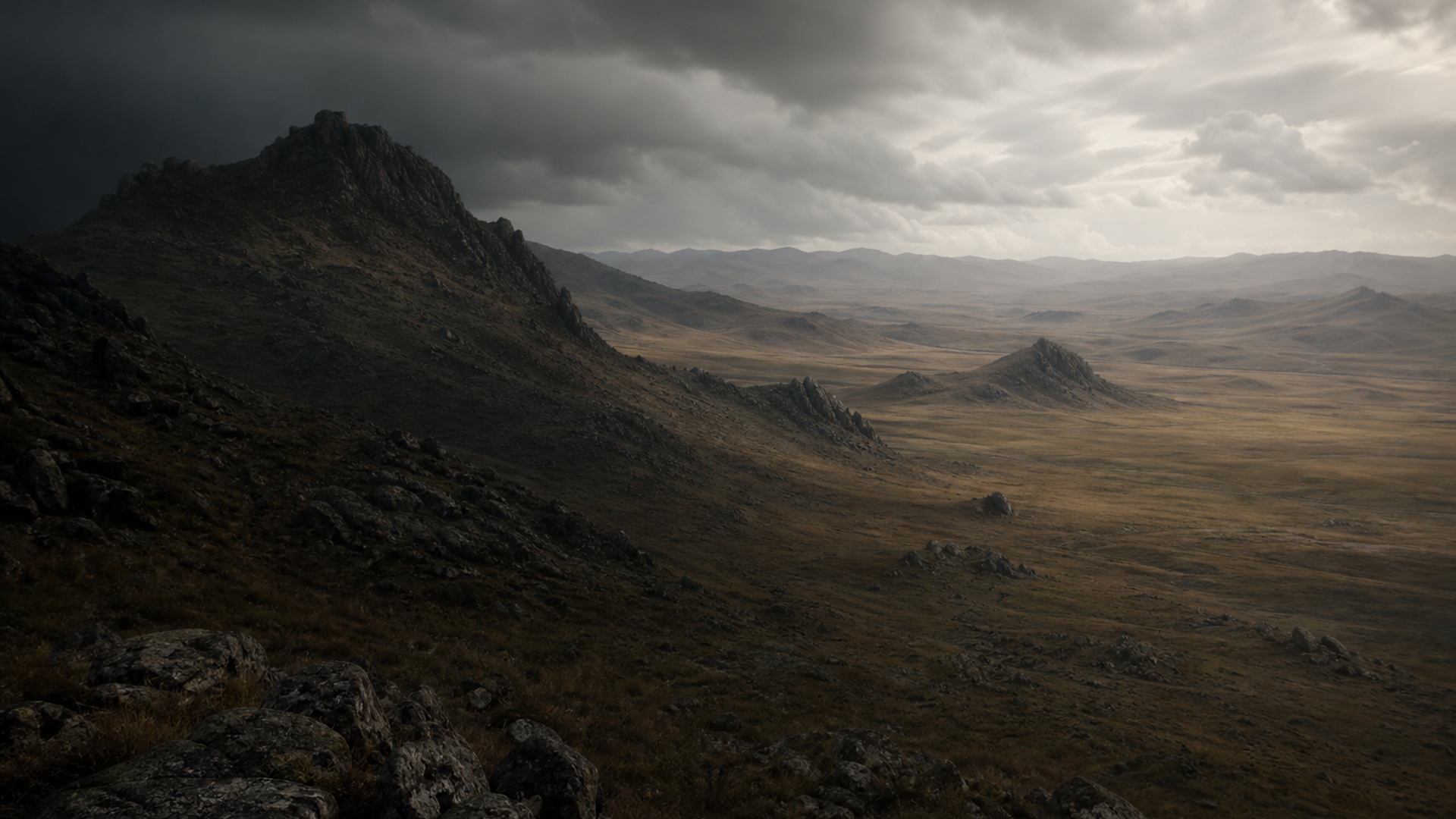
Set against the wind-sculpted ridges of central Mongolia, the Arkhangai Late Medieval assemblage occupies a temporal span from roughly 1000 to 1500 CE. Archaeological investigations at three discrete localities — Delen Tolgoi (Melkhii Chuluu), Khirgest Khooloi, and Khanui — record mortuary contexts and camp-like features that fit within a broader pattern of Late Medieval Mongolian pastoralism. Limited radiocarbon horizons and stratigraphic evidence place these human traces in the era straddling the rise and fragmentation of the Mongol imperial network.

Archaeological data indicates seasonal mobility, with ephemeral hearths and fenced enclosures reported in survey notes; however, preservation is uneven across rock-outcrop sites. Material culture from these loci is sparse, making cultural attribution primarily contextual rather than typological. Ethnohistoric records attest to vibrant pastoral economies in Arkhangai during the medieval centuries, and the sites likely reflect local agropastoral and transhumant lifeways rather than urbanized settlement.

Genetically, the small set of recovered mtDNA lineages resonates with broad East and Northeast Asian maternal pools known in adjacent regions. Because only three individuals were sampled, any inference about population formation, migration, or social structure must be framed as provisional. Ongoing fieldwork and targeted aDNA sampling will be needed to transform this evocative glimpse into a robust narrative.

  • Sites: Delen Tolgoi (Melkhii Chuluu), Khirgest Khooloi, Khanui
  • Era: Late Medieval Mongolia (c. 1000–1500 CE)
  • Evidence suggests seasonal pastoralism and local continuity
Chapitre IV

Daily Life & Society

Life in Arkhangai’s uplands during the Late Medieval centuries would have been dominated by movement — herds driven between summer highlands and sheltered wintering grounds, families living in lightweight dwellings, and a material economy organized around animals, wool, and mounted mobility. Archaeological traces at the named sites are consistent with camp sequences: concentrations of charcoal, hearth lenses, and fragmented bone suggesting butchery and food processing. Ornamental objects and small tools, when present, reflect practical, portable manufacture rather than sedentary industry.

Social organization is difficult to resolve from the current archaeological dataset. The cemeteries and isolated burials at Melkhii Chuluu and Khanui show variability in burial placement and goods, which may index household-level differentiation or ritual variation. Grave architecture tends to be modest, aligning with pastoralist funerary traditions across Mongolia. The period also overlaps historically with expansive political horizons — including the 13th-century Mongol unification — that would have affected trade routes, tribute networks, and movement of peoples. Yet archaeological data from these three sites points to resilient local lifeways: families adapting herding strategies to Arkhangai’s valleys and river corridors.

Given the limits of the material record, interpretations of social hierarchy, craft specialization, and long-distance exchange remain tentative pending further excavation and multi-proxy analyses.

  • Pastoral, mobile lifestyle inferred from hearths and faunal remains
  • Modest burials suggest household-level variability rather than pronounced elite display
Chapitre V

Genetic Profile

Ancient DNA recovered from three individuals across Arkhangai yields clear maternal signals but no reliable paternal haplogroup data were reported. The mtDNA results are B, D, and F — each observed once among the sampled population. These haplogroups are widely distributed across East and Northeast Asia and are also present in many modern Mongolian and neighboring populations, making them plausible constituents of a local Late Medieval gene pool.

Because the sample count is extremely small (n = 3), genetic conclusions must be framed as provisional. Limited sampling increases the risk that observed haplogroups represent individual variation rather than population-wide patterns. The absence of confirmed Y-DNA results may reflect preservation bias, low endogenous male DNA, or laboratory limitations; therefore, male-line continuity or diversity cannot be assessed from the current dataset.

Nevertheless, when integrated with archaeology, the maternal profiles support a model of regional continuity with broader East Asian maternal lineages during a period of social flux. Future aDNA work should prioritize increasing sample numbers, securing radiocarbon dates for each individual, and attempting deeper genomic sequencing to recover autosomal ancestry components and paternal haplogroups. Until then, genetic links between these Arkhangai individuals and later or contemporary populations remain suggestive rather than definitive.

  • mtDNA: B, D, F observed (each in one individual)
  • Y-DNA: undetermined — no reliable paternal haplogroup recovered
Chapitre VI

Legacy & Modern Connections

The Arkhangai Late Medieval samples are a faint but evocative thread connecting modern inhabitants of central Mongolia to their medieval predecessors. The maternal haplogroups align with lineages common across East and Northeast Asia and found in present-day Mongolian populations, suggesting some degree of maternal continuity in the region. Archaeological continuity in settlement patterns — seasonal camps, animal husbandry, and modest burial practices — reinforces a picture of deep-rooted pastoral lifeways.

Caveats are crucial: with only three genetic samples, it is not possible to map direct ancestry or demographic change. These remains should be seen as preliminary waypoints that encourage more intensive fieldwork and genomic sampling. When expanded, such datasets have the potential to illuminate migration, kinship, and the demographic impacts of medieval polities on Arkhangai’s human landscape.

  • Maternal lineages mirror broader East Asian distributions, suggesting possible continuity
  • Small sample size means connections to modern populations are preliminary
Propulsé par l'IA

Assistant IA

Posez des questions sur la culture Arkhangai Late Medieval Horizon

Assistant IA par DNAGENICS

Débloquer cette fonction
Posez des questions sur la culture Arkhangai Late Medieval Horizon. L'assistant IA peut expliquer les résultats génétiques, le contexte historique, les preuves archéologiques et les liens génétiques avec les populations actuelles, dans les limites de l'interprétation.
Exemple d'analyse IA

La culture Arkhangai Late Medieval Horizon représente un chapitre fascinant de l'histoire humaine…

L'analyse génétique met en évidence des similarités avec des populations antérieures et des signes d'adaptations propres. Les échantillons d'ADN ancien éclairent les schémas migratoires et les liens entre populations, avec des limites qui dépendent de l'étude et du contexte archéologique.

Il s'agit d'un aperçu de l'analyse IA. Accédez à l'assistant complet pour explorer :

  • Composition et similarité génétique
  • Schémas migratoires et origines
  • Vie quotidienne et pratiques culturelles
  • Contexte génétique actuel

Explorez d'autres cultures antiques

Découvrez les récits de civilisations issues du monde antique