Préparation du rapport

Chargement des informations et références disponibles

Connexion au corpus archéologique…

Collecte des archives antiques

Aller au contenu principal
Arkhangai Xiongnu: Steppe Lives Revealed
Profil culturel

Arkhangai Xiongnu: Steppe Lives Revealed

Five ancient genomes from Arkhangai portray a small, mixed frontier within the Xiongnu horizon.

200 BCE - 100 CE
Arkhangai, Mongolia
Faites défiler pour commencer
Chapitre I

Le récit

Comprendre la culture Arkhangai Xiongnu: Steppe Lives Revealed

Ancient DNA from five Arkhangai (Mongolia) sites dated 200 BCE–100 CE suggests a genetically mixed Xiongnu-era population. Limited sample size hints at both West- and East-Eurasian maternal lines and diverse Y-lines, reflecting the confederation’s role as a crossroad of steppe mobility.

Time Period

200 BCE - 100 CE

Region

Arkhangai, Mongolia

Common Y-DNA

J (1), R (1)

Common mtDNA

K (2), B (1), C (1), I4a (1)

Chapitre II

Chronologie

Moments clés de l'histoire de cette culture

209 BCE

Rise of the Xiongnu Confederation

The Xiongnu emerge as a major steppe polity in historical records, reshaping mobility and exchange across Mongolia and beyond.

200 BCE

Arkhangai Occupation Begins (approx.)

Earliest dated samples from Arkhangai sites fall near this time, within the broader Xiongnu-era horizon.

100 CE

Late Horizon of Sampled Phase

The end of the sampled date range, marking a century of local developments within the Xiongnu world.

Chapitre III

Origins & Emergence

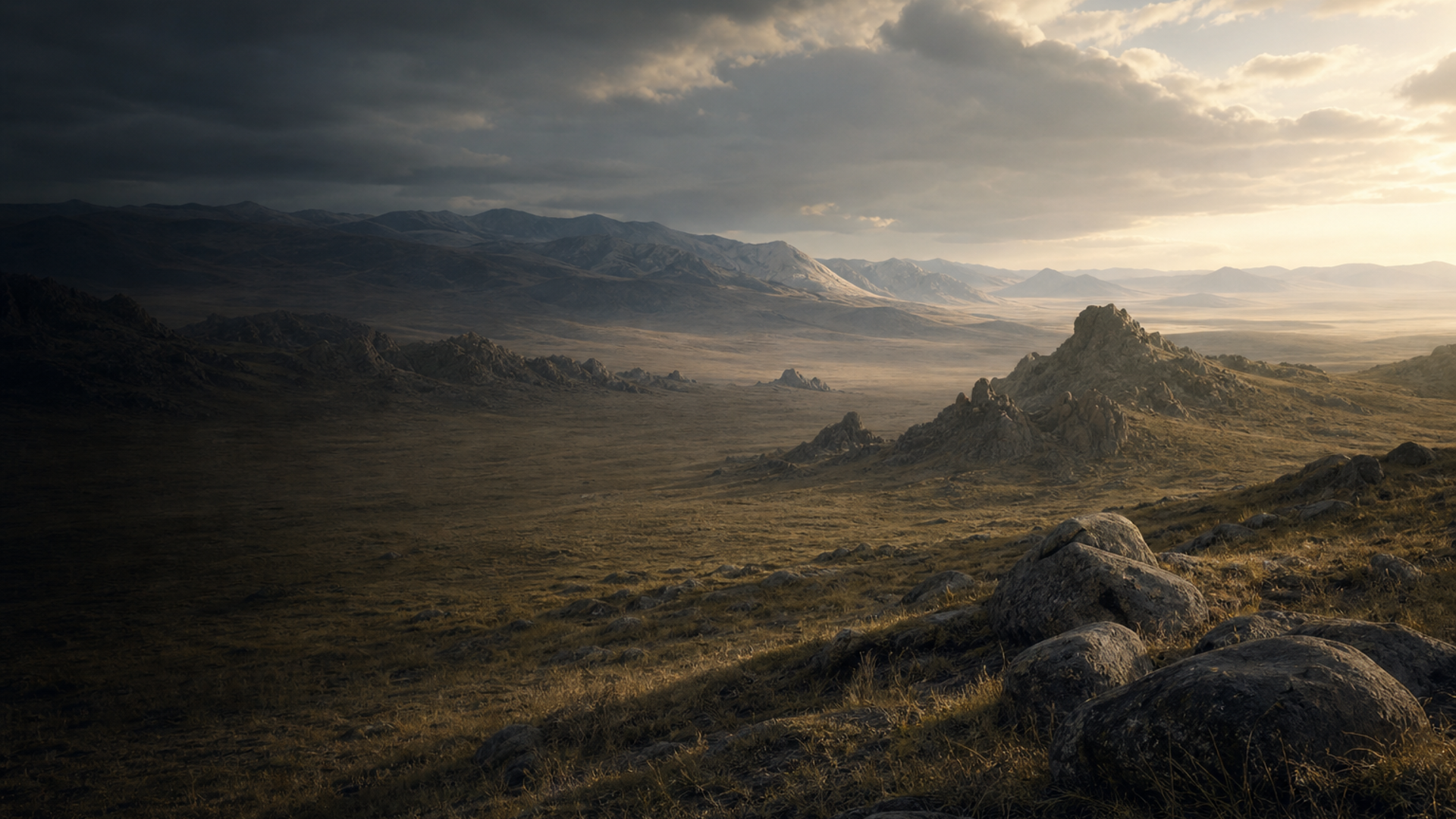
In the waning centuries BCE the broad Xiongnu horizon stretched across the Mongolian steppe, a tapestry woven from mobile pastoralism, alliances and long-distance exchange. Archaeological data indicates the Arkhangai localities — Emeel Tolgoi, Khudgiin Am, Naimaa Tolgoi and Solbi Uul — were part of this dynamic landscape between roughly 200 BCE and 100 CE. The sites sampled here sit in upland valleys and river corridors that archaeologists associate with seasonal herding and trans-regional movement.

Material traces across the Xiongnu world often include nomadic burial practices, horse gear, and imported goods, suggesting vibrant contacts across Eurasia; however, contexts vary greatly by site, and not every Arkhangai find conforms to a single pattern. Limited evidence suggests these Arkhangai communities participated in the confederation’s networks, acting as local protagonists in a wider story of mobility and cultural blending. The genetic snapshot provided by these five samples offers one window into how people at the periphery of the Xiongnu sphere may have emerged from centuries of contact — but it remains an early, tentative portrait rather than a complete biography.

  • Arkhangai sites dated c. 200 BCE–100 CE within Xiongnu-era horizons
  • Regional archaeological indicators point to mobile pastoralism and long-distance exchange
  • Evidence is heterogeneous; local practices reflect a mosaic of influences
Chapitre IV

Daily Life & Society

The daily world of Arkhangai inhabitants was likely dominated by seasonal rhythms: herding, horse management, and the logistics of life on the high steppe. Archaeological indicators from comparable Xiongnu contexts include corrals, ephemeral domestic structures, and burial assemblages that attest to mounted lifeways and the social importance of animals. In Arkhangai, landscape features like river valleys and sheltered hollows would have provided camps and caravan routes.

Social life in Xiongnu-affiliated communities could be sharply hierarchical at times, with elite burials showing rich grave goods elsewhere in Mongolia, while many households practiced mixed pastoral economies and local craft. Trade and raiding brought exotic objects and ideas; children and elders shared a quotidian existence shaped by weather, herd cycles, and seasonal movement. Yet the Arkhangai dataset is small, and while archaeological parallels help sketch daily patterns, specific household behaviors at each sampled site remain only partially known.

  • Economy centered on mobile pastoralism and horse-related activities
  • Material culture reflects both local practice and long-distance contacts
Chapitre V

Genetic Profile

Five ancient genomes from Arkhangai (Emeel Tolgoi, Khudgiin Am, Naimaa Tolgoi, Solbi Uul) dated between 200 BCE and 100 CE provide a tentative genetic window into a small Xiongnu-era population. Y-chromosome results include one individual assigned to haplogroup J and one to R; mitochondrial DNA is more diverse with two K lineages, and one each of B, C and I4a. These counts (Y: J=1, R=1; mtDNA: K=2, B=1, C=1, I4a=1) should be understood as raw tallies from five samples and are therefore preliminary.

The maternal mix — West Eurasian-associated haplogroup K alongside East Eurasian-associated haplogroups B and C — hints at multimodal ancestry, consistent with archaeological expectations for the Xiongnu confederation as a contact zone. Haplogroup J on the Y-chromosome can be associated with connections toward western or southwestern Eurasia in some contexts, while R is widespread across Eurasia and may reflect deeper steppe affiliations; however, haplogroup labels alone cannot specify precise ancestries without broader comparative data. Given the sample size is below ten, statistical conclusions are limited: the data suggest admixture and mobility at Arkhangai but more genomes from the region and time span are needed to robustly model population history.

Future work comparing these genomes to larger Xiongnu and neighboring Iron Age datasets will clarify whether Arkhangai represents a localized pocket of diversity or a pattern reflective of broader Xiongnu-era population processes.

  • Five genomes show mixed maternal lineages (K, B, C, I4a) and two Y-lineages (J, R)
  • Low sample count (<10) makes conclusions preliminary; indicates admixture and mobility
Chapitre VI

Legacy & Modern Connections

The Arkhangai genetic snapshot gestures toward the Xiongnu confederation’s lasting role as a conduit between east and west across the steppe. Modern populations in Mongolia and neighboring regions inherit a complex tapestry of ancestry shaped by millennia of migration, and these ancient genomes provide a small piece of that history. Archaeogenetic continuity is rarely linear; rather, populations recombine, absorb newcomers, and transform.

These five samples cannot be taken as definitive proof of direct ancestry to any contemporary group, but they do illustrate how diverse lineages coexisted in a Xiongnu-era setting. As larger ancient DNA datasets accumulate, researchers will be better able to trace threads of continuity and change from Arkhangai’s valleys to present-day steppe communities. For now, the Arkhangai genomes remind us that the Xiongnu world was not genetically uniform but a living frontier of human encounter.

  • Hints at long-term steppe connectivity between eastern and western Eurasia
  • Small sample size — useful clue, not proof of direct modern descent
Propulsé par l'IA

Assistant IA

Posez des questions sur la culture Arkhangai Xiongnu: Steppe Lives Revealed

Assistant IA par DNAGENICS

Débloquer cette fonction
Posez des questions sur la culture Arkhangai Xiongnu: Steppe Lives Revealed. L'assistant IA peut expliquer les résultats génétiques, le contexte historique, les preuves archéologiques et les liens génétiques avec les populations actuelles, dans les limites de l'interprétation.
Exemple d'analyse IA

La culture Arkhangai Xiongnu: Steppe Lives Revealed représente un chapitre fascinant de l'histoire humaine…

L'analyse génétique met en évidence des similarités avec des populations antérieures et des signes d'adaptations propres. Les échantillons d'ADN ancien éclairent les schémas migratoires et les liens entre populations, avec des limites qui dépendent de l'étude et du contexte archéologique.

Il s'agit d'un aperçu de l'analyse IA. Accédez à l'assistant complet pour explorer :

  • Composition et similarité génétique
  • Schémas migratoires et origines
  • Vie quotidienne et pratiques culturelles
  • Contexte génétique actuel

Explorez d'autres cultures antiques

Découvrez les récits de civilisations issues du monde antique