Préparation du rapport

Chargement des informations et références disponibles

Connexion au corpus archéologique…

Collecte des archives antiques

Aller au contenu principal
Barç Post‑Medieval Voices
Profil culturel

Barç Post‑Medieval Voices

Two maternal lineages from the Korça Basin echo centuries of movement and contact

1452 CE - 1635 CE
Barç, Korça Basin, Southeastern Albania
Faites défiler pour commencer
Chapitre I

Le récit

Comprendre la culture Barç Post‑Medieval Voices

Human remains from Barç (Korça Basin), Albania, dated 1452–1635 CE, yield two mtDNA lineages (U, J). Limited samples hint at regional continuity and external connections during the Post‑Medieval Ottoman period; conclusions remain preliminary.

Time Period

1452–1635 CE

Region

Barç, Korça Basin, Southeastern Albania

Common Y-DNA

Not reported (limited samples)

Common mtDNA

U, J (each 1 of 2 samples)

Chapitre II

Chronologie

Moments clés de l'histoire de cette culture

1452 CE

Earliest sampled burial

One individual from Barç dated to the mid‑15th century, a period of Ottoman consolidation in the region.

1635 CE

Latest sampled burial

The latest Barç sample falls in the early 17th century, a time of continued local continuity amid imperial networks.

Chapitre III

Origins & Emergence

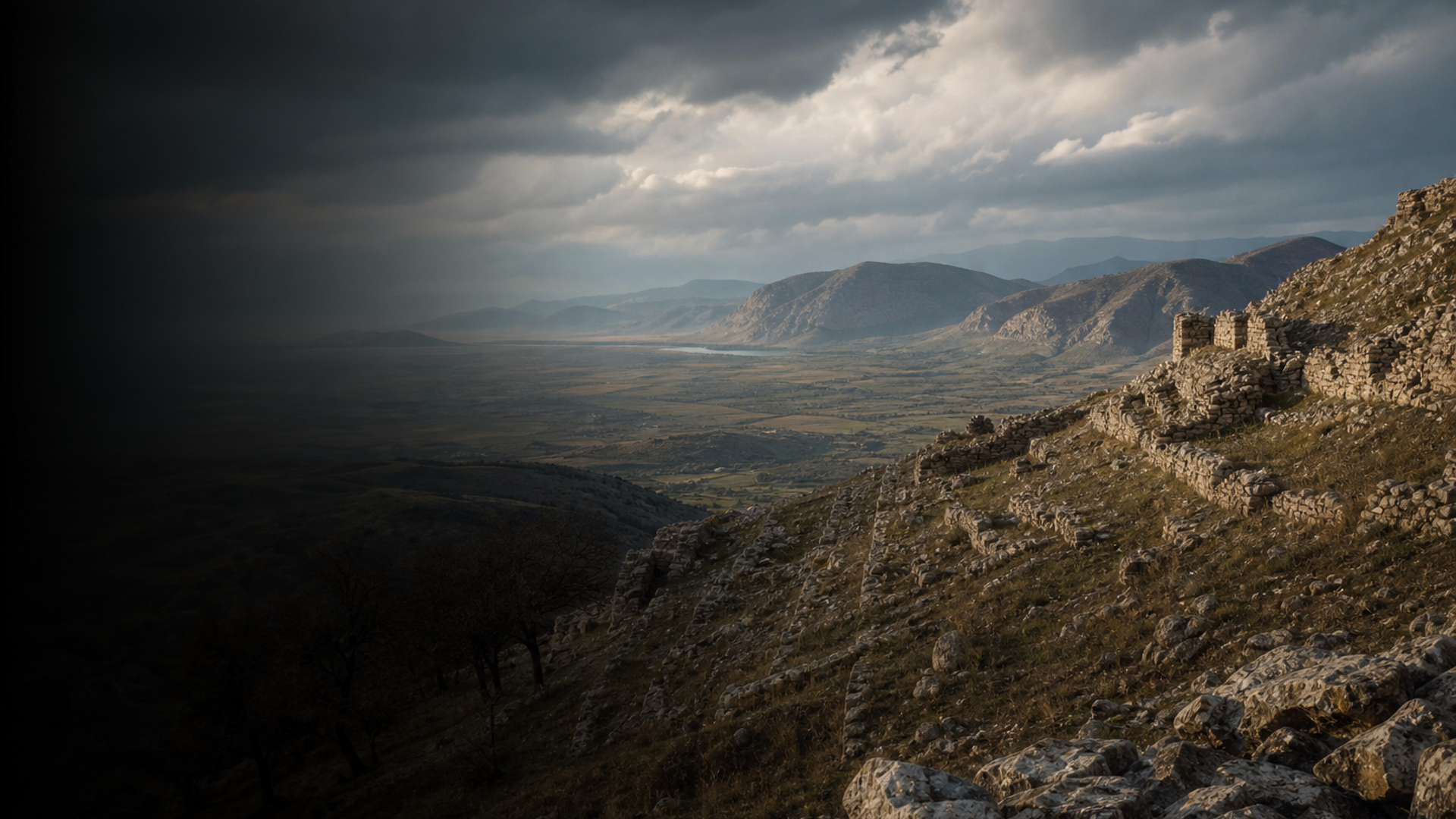
Perched within the fertile Korça Basin of southeastern Albania, the village and cemetery of Barç yield a narrow but evocative window into Post‑Medieval life. Archaeological data indicates two sampled burials with radiocarbon and contextual dates spanning 1452 to 1635 CE—years that trace the consolidation of Ottoman authority and intensifying trade across the southern Balkans. Limited evidence suggests these interments belong to local rural communities that experienced both long‑standing regional traditions and new connections brought by imperial administration, pilgrimage routes, and market networks.

The material record at nearby sites in the Korça region documents continuity in settlement and agriculture from the late medieval into the Ottoman period; however, Barç itself is represented here by a very small number of human samples. Because only two individuals were analyzed, any narrative of population replacement, migration, or demographic change must remain provisional. The genetic signatures recovered are best read as initial indicators of maternal ancestry present in this locale during the 15th–17th centuries, not as definitive portraits of the broader population. Ongoing excavation and targeted sampling across cemeteries and habitation layers will be required to transform these early glimpses into robust regional history.

  • Samples come from Barç, Korça Basin (SE Albania), dated 1452–1635 CE
  • Context overlaps with Ottoman expansion and intensified Balkan trade
  • Very small sample count makes broad demographic claims preliminary
Chapitre IV

Daily Life & Society

The Korça Basin has historically been a patchwork of arable fields, pastures, and villages set against upland zones—landscapes that shaped rhythms of work, diet, and mobility. Archaeological indicators from the wider region record mixed farming, seasonal pasturing, and local craft production during the Post‑Medieval period. In rural settlements like Barç, daily life would have centered on family farms, seasonal cycles, and participation in regional markets, where goods, ideas, and people intermingled.

Burial practices recovered archaeologically in southeastern Albania often reflect a mix of longstanding Christian rites and adaptations under new governance; in some localities, grave goods are minimal, suggesting modest rural households. The two sampled individuals from Barç likely belonged to such village contexts, though osteological details are limited and not reported here. Material culture and settlement patterns across the Korça Basin indicate resilience of local lifeways alongside incremental changes—new coinage, administrative shifts, and movement of artisans and soldiers—that shaped social networks. These networks are the conduits by which genes, languages, and cultural practices flowed, a point the genetic data begins to illuminate even if only faintly.

  • Rural economy: mixed farming and pastoralism in the Korça Basin
  • Burials suggest modest village households with regional cultural ties
Chapitre V

Genetic Profile

Two mitochondrial genomes recovered from Barç reveal maternal haplogroups U and J (one sample each). Haplogroup U is widespread across Europe and has deep roots in the continent’s prehistoric and historic populations; its presence in a Post‑Medieval Albanian context is consistent with long‑term maternal continuity in the Balkans. Haplogroup J has a broader Near Eastern and Mediterranean distribution and is often interpreted as reflecting gene flow related to Neolithic expansions and later trans‑Mediterranean contacts. In a Post‑Medieval horizon marked by Ottoman-era mobility, the appearance of J could reflect historical connections linking the Balkans with Anatolia and beyond.

Crucially, no Y‑chromosome haplogroups are reported for these two samples, and autosomal ancestry profiles are not provided here; therefore paternal dynamics and genome‑wide affinities cannot be assessed. The sample count is very low (<10), so statistical inference is limited: these two mtDNA lineages can suggest potential maternal ancestries present at Barç but cannot define population structure or admixture patterns for the Korça Basin. Archaeogenetic interpretation must remain cautious—expanded sampling, inclusion of male lineages, and comparison to contemporary and earlier Balkan genomes are required to test whether patterns hinted at by U and J reflect continuity, recent migration, or localized family histories.

  • mtDNA: U and J (one individual each), suggesting both local European and wider Mediterranean maternal ties
  • Y‑DNA not reported; sample size (<10) makes conclusions preliminary
Chapitre VI

Legacy & Modern Connections

Although based on only two individuals, the Barç samples contribute to a growing mosaic tying ancient remains to modern genetic landscapes. Haplogroups U and J are both present in contemporary Balkan and Albanian populations, so these maternal lineages could represent threads of continuity spanning centuries. Archaeologically, the Barç burials anchor genetic data to a local place and time, evoking rural lives shaped by fields, kinship ties, and cross‑regional ties during the Ottoman era.

Because the dataset is extremely small, any connection to present‑day populations must be framed as a hypothesis: further sampling and direct comparison with modern genomes and larger ancient series are needed to evaluate continuity, replacement, or complex admixture. When combined with expanded archaeological and genetic work across the Korça Basin, these early results can illuminate how imperial networks, trade routes, and local practice intertwined to shape both bodies and genes.

  • mtDNA lineages found (U, J) are also observed in modern Balkans—possible continuity
  • Expanded sampling needed to test hypotheses about population continuity and mobility
Propulsé par l'IA

Assistant IA

Posez des questions sur la culture Barç Post‑Medieval Voices

Assistant IA par DNAGENICS

Débloquer cette fonction
Posez des questions sur la culture Barç Post‑Medieval Voices. L'assistant IA peut expliquer les résultats génétiques, le contexte historique, les preuves archéologiques et les liens génétiques avec les populations actuelles, dans les limites de l'interprétation.
Exemple d'analyse IA

La culture Barç Post‑Medieval Voices représente un chapitre fascinant de l'histoire humaine…

L'analyse génétique met en évidence des similarités avec des populations antérieures et des signes d'adaptations propres. Les échantillons d'ADN ancien éclairent les schémas migratoires et les liens entre populations, avec des limites qui dépendent de l'étude et du contexte archéologique.

Il s'agit d'un aperçu de l'analyse IA. Accédez à l'assistant complet pour explorer :

  • Composition et similarité génétique
  • Schémas migratoires et origines
  • Vie quotidienne et pratiques culturelles
  • Contexte génétique actuel

Explorez d'autres cultures antiques

Découvrez les récits de civilisations issues du monde antique