Préparation du rapport

Chargement des informations et références disponibles

Connexion au corpus archéologique…

Collecte des archives antiques

Aller au contenu principal
Bell Beaker England: Seeds of Change
Profil culturel

Bell Beaker England: Seeds of Change

A cinematic glimpse into 2800–1600 BCE England where pots, burials and DNA trace a continental influx

2800 CE - 1600 BCE
England, United Kingdom
Faites défiler pour commencer
Chapitre I

Le récit

Comprendre la culture Bell Beaker England: Seeds of Change

Archaeological and genetic evidence from 34 English Bell Beaker individuals (2800–1600 BCE) links burial rites and material culture with a marked influx of R-lineage Y-DNA and diverse maternal lineages, revealing population turnover and continuing regional interactions.

Time Period

2800–1600 BCE

Region

England, United Kingdom

Common Y-DNA

R (19), I (1) — predominantly R lineage

Common mtDNA

K (8), H (3), T2b (3), U (3), T (2)

Chapitre II

Chronologie

Moments clés de l'histoire de cette culture

2500 BCE

Bell Beaker consolidation in England

Bell Beaker pottery and burial forms become widespread in England; emerging genetic evidence shows substantial incoming ancestry accompanying these changes.

Chapitre III

Origins & Emergence

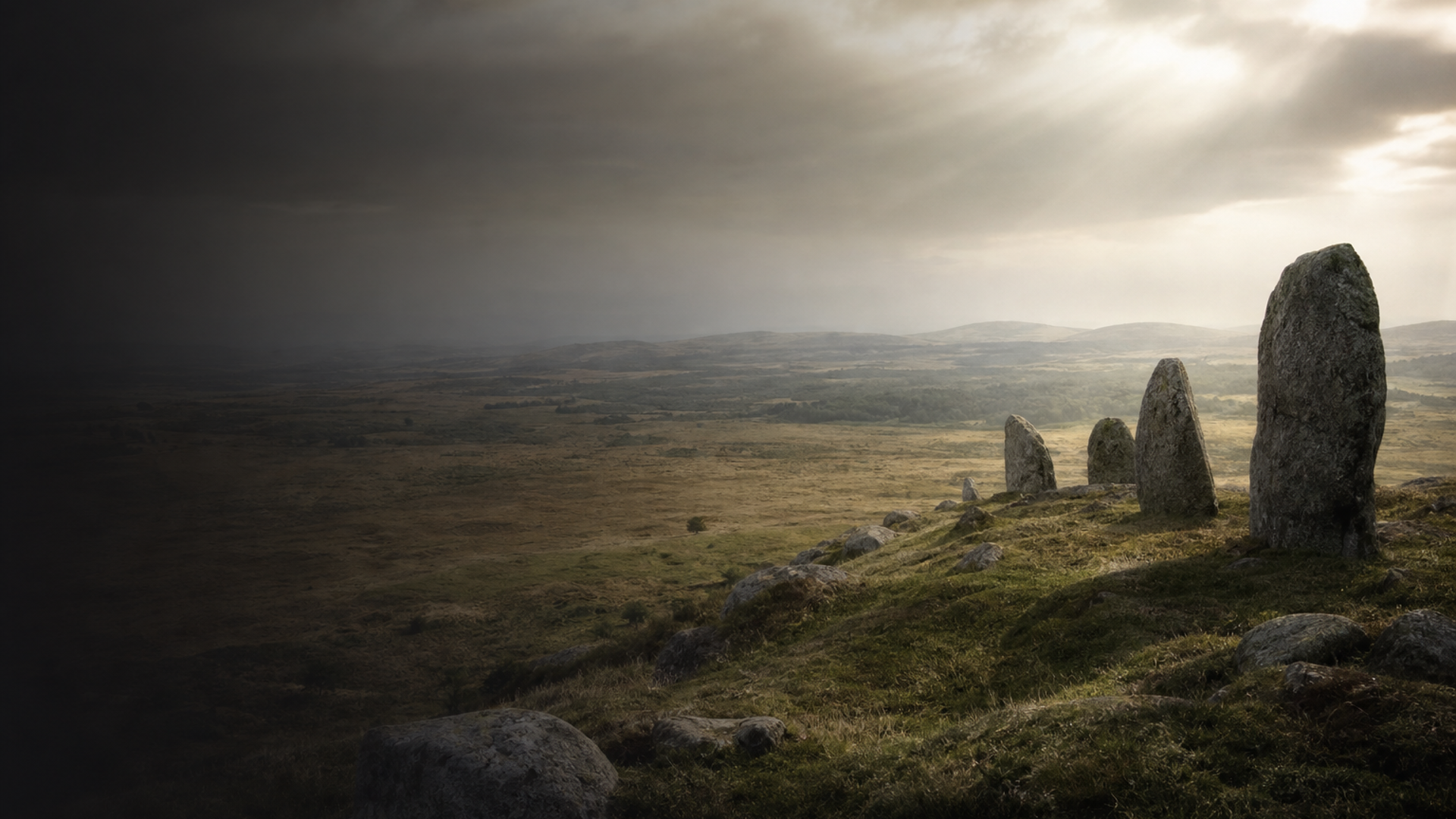
The arrival of Bell Beaker cultural elements in England unfolds like a scene change on a cinematic landscape: the windswept chalk of Wiltshire and river valleys where new pottery and burial forms appear between c. 2800 and 2400 BCE. Archaeological data indicates that Bell Beaker artifacts — characteristic bell-shaped beakers, copper daggers, and new burial practices — first become widespread after 2500 BCE. Key English sites include Amesbury Down and Upavon in Wiltshire, Yarnton in Oxfordshire, and Trumpington Meadows in Cambridgeshire, each providing stratified contexts that anchor the material chronology.

Material culture suggests a rapid adoption of continental fashions rather than a slow local evolution. However, the archaeological picture is complex: some regional traditions persist alongside Bell Beaker forms, implying cultural blending. Limited evidence points to networks of exchange across the English Channel and North Sea that transmitted styles, raw materials and possibly people. While artifacts provide the visible drama, ancient DNA adds a new score: genetic change accompanies the spread of Bell Beaker material culture in England, but the precise mechanisms — migration, elite-led adoption, or mixed processes — require careful, site-by-site interpretation.

  • Bell Beaker material appears in England c. 2800–2400 BCE
  • Key sites: Amesbury Down, Yarnton, Trumpington Meadows, Upavon
  • Evidence supports rapid cultural change with regional persistence
Chapitre IV

Daily Life & Society

Daily life during the Bell Beaker era in England can be sketched from graves, settlement traces and artefact scatters. Burials often feature single inhumations with beakers and sometimes copper items; landscapes bear new funerary monuments and rearranged ritual loci. Sites such as Netheravon and Staxton Beacon produce graves that suggest variability in social display: some individuals were accompanied by prestige goods, others by modest offerings.

Economy and subsistence likely remained grounded in mixed farming: cereal cultivation, animal husbandry, and managed woodlands. Portable objects — pottery, personal ornaments, and metalwork — indicate mobility and wide-ranging contacts. Ceramic styles and grave goods hint at social distinctions and networks of alliance. Yet archaeological data also shows continuity: many aspects of everyday economy and local craft persisted, suggesting that incoming styles and peoples became embedded in existing lifeways rather than replacing them wholesale. The result is a tapestry of local and foreign threads: new rites and objects woven into older economic and social patterns.

  • Funerary variability: single inhumations with beakers and occasional metalwork
  • Mixed farming economy with persistent regional traditions
Chapitre V

Genetic Profile

Ancient DNA from 34 Bell Beaker-associated individuals across England provides a substantive dataset linking archaeology with ancestry. Y-chromosome data are dominated by R lineage (19 of 34), with a single I lineage sample; this pattern is consistent with a strong male-biased input associated with the Bell Beaker horizon. Autosomal ancestry profiles indicate a substantial component of Steppe-derived ancestry in many individuals, aligning with continental movements into northwest Europe, though the exact proportions vary by site.

Mitochondrial diversity is higher: the most common maternal haplogroup in this set is K (8 samples), followed by H (3), T2b (3), U (3), and T (2). This mixture suggests that while male lineages show a marked shift, maternal lineages reflect a blend of incoming and local ancestries — pointing to complex demographic processes, including migration, admixture, and assimilation. Because the sample size is 34 and spatially clustered at several sites (Amesbury Down, Yarnton, West Deeping, Trumpington Meadows, Staxton Beacon, Upavon, Netheravon, Willington, Over Narrows, Windmill Fields), patterns appear robust but regional gaps remain; further sampling could refine the timeline and the social dynamics behind these genetic signals.

  • Predominant Y-lineage R (19/34) indicating substantial incoming male ancestry
  • Diverse mtDNA (K, H, T2b, U) suggests admixture of incoming and local maternal lines
Chapitre VI

Legacy & Modern Connections

The Bell Beaker presence reshaped England's prehistoric population and cultural landscapes. Genetic shifts tied to Bell Beaker horizons contributed to the ancestry of later Bronze Age populations in Britain. Modern genetic variation in parts of the British Isles still carries echoes of these Bronze Age turnovers, but centuries of later migration and admixture have further blended those signals.

Archaeologically, Bell Beaker innovations in metallurgy, pottery forms and burial practices influenced subsequent Bronze Age societies. Culturally, the Bell Beaker period marks a pivotal chapter when long-distance networks intensified — a story told through pots, copper, bones and genomes. While DNA confirms notable demographic change, the human story remains nuanced: local continuity, cultural adaptation, and selective adoption shaped England’s evolving Bronze Age landscapes.

  • Contributed significantly to the ancestry of subsequent Bronze Age populations
  • Material and social practices influenced later Bronze Age developments
Propulsé par l'IA

Assistant IA

Posez des questions sur la culture Bell Beaker England: Seeds of Change

Assistant IA par DNAGENICS

Débloquer cette fonction
Posez des questions sur la culture Bell Beaker England: Seeds of Change. L'assistant IA peut expliquer les résultats génétiques, le contexte historique, les preuves archéologiques et les liens génétiques avec les populations actuelles, dans les limites de l'interprétation.
Exemple d'analyse IA

La culture Bell Beaker England: Seeds of Change représente un chapitre fascinant de l'histoire humaine…

L'analyse génétique met en évidence des similarités avec des populations antérieures et des signes d'adaptations propres. Les échantillons d'ADN ancien éclairent les schémas migratoires et les liens entre populations, avec des limites qui dépendent de l'étude et du contexte archéologique.

Il s'agit d'un aperçu de l'analyse IA. Accédez à l'assistant complet pour explorer :

  • Composition et similarité génétique
  • Schémas migratoires et origines
  • Vie quotidienne et pratiques culturelles
  • Contexte génétique actuel

Explorez d'autres cultures antiques

Découvrez les récits de civilisations issues du monde antique