Préparation du rapport

Chargement des informations et références disponibles

Connexion au corpus archéologique…

Collecte des archives antiques

Aller au contenu principal
Bulgan Steppe: Voices of Medieval Mongolia
Profil culturel

Bulgan Steppe: Voices of Medieval Mongolia

Archaeology and aDNA from Zaan-Khoshuu illuminating 550–1200 CE

550 CE - 1200 CE
Bulgan Province, Mongolia (Zaan-Khoshuu)
Faites défiler pour commencer
Chapitre I

Le récit

Comprendre la culture Bulgan Steppe: Voices of Medieval Mongolia

Archaeological remains and six ancient genomes from Bulgan (Zaan-Khoshuu) reveal a predominantly East Eurasian maternal pool and mixed paternal lines, offering preliminary insights into population dynamics on the Mongolian steppe between 550–1200 CE.

Time Period

550–1200 CE

Region

Bulgan Province, Mongolia (Zaan-Khoshuu)

Common Y-DNA

C (2), J (1)

Common mtDNA

D (3), A24 (1), C (1), F2a (1)

Chapitre II

Chronologie

Moments clés de l'histoire de cette culture

552 CE

Rise of the First Turkic Khaganate

Formation of the Göktürk confederation begins, reshaping power networks across the Mongolian steppe and facilitating new mobility and contacts.

Chapitre III

Origins & Emergence

The Zaan-Khoshuu burials of Bulgan sit at the crossroads of open steppe and riverine corridors, where horse-herding horizons met long-distance networks. Archaeological data indicates occupation and burial activity in this locale between roughly 550 and 1200 CE, a span that bridges the rise and transformation of early medieval steppe polities.

Limited evidence suggests that communities here participated in the shifting political orders of the time — from the early Turkic confederations of the 6th–8th centuries to later, localized polities in the centuries prior to the Mongol Empire. Material culture recovered at Zaan-Khoshuu (grave goods, horse tack fragments, and textile impressions) points to mobile pastoral lifeways combined with selective adoption of exotic goods, likely obtained through trade or alliance networks.

Genetic sampling from six individuals (n=6) provides a narrow but evocative window into this emergence. The predominance of East Eurasian maternal lineages (mtDNA D, A24, C, F2a) aligns with broader regional expectations, while a minority paternal signal (Y-haplogroup J) hints at episodic western connections or movement of individuals into the Bulgan landscape. Because the sample set is small, these observations should be treated as preliminary clues rather than definitive population histories.

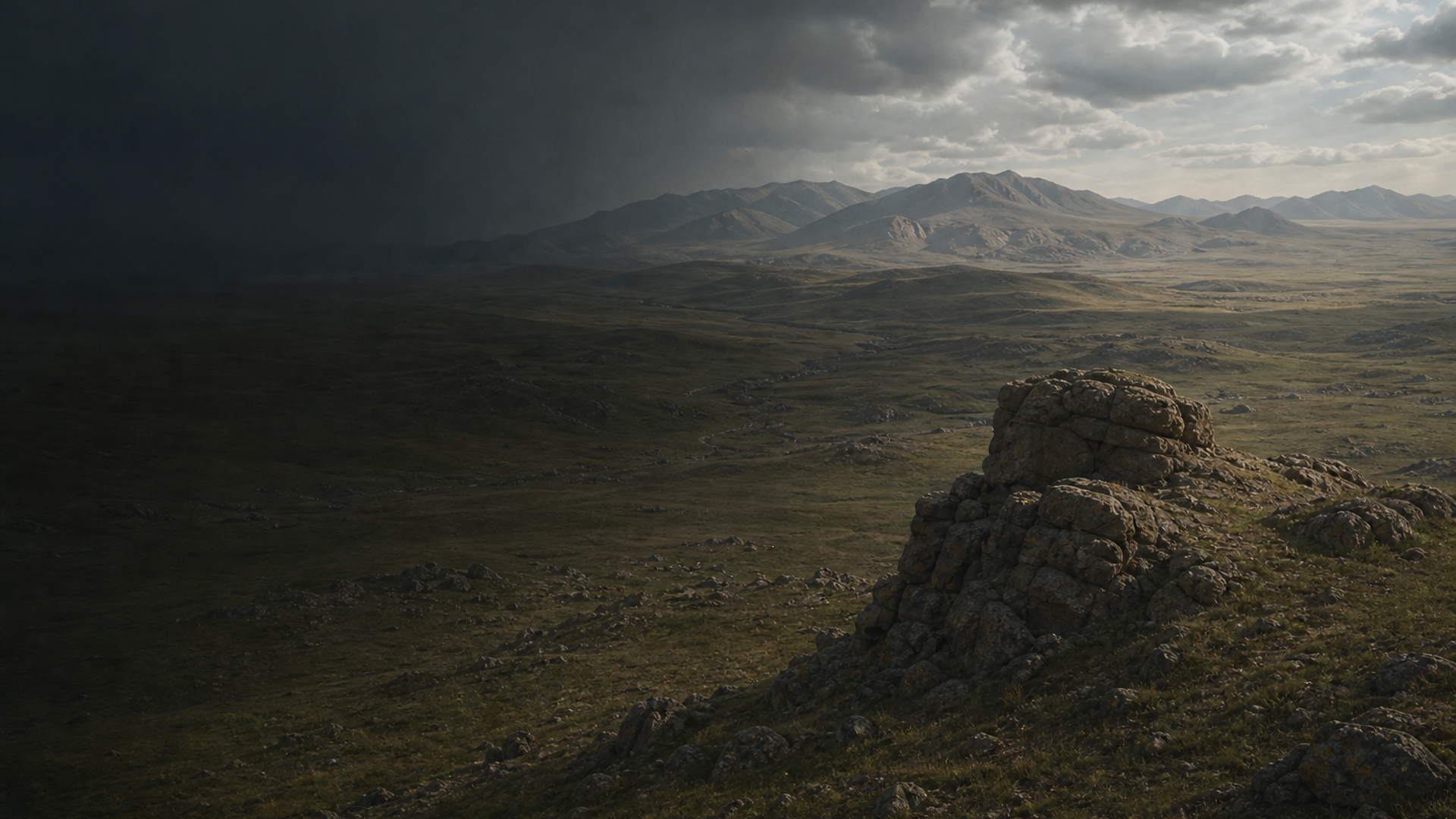
Bulgan’s archaeological horizon therefore reads like a cinematic meeting of hooves, wind-swept graves, and threads of distant contact — a world in motion whose full story will require more excavation and a larger genetic catalogue.

  • Site: Zaan-Khoshuu, Bulgan Province, Mongolia
  • Date range: ~550–1200 CE, Early to Late Medieval Mongolia
  • Material culture suggests pastoral mobility with selective external contacts
Chapitre IV

Daily Life & Society

Archaeological evidence from Bulgan paints a picture of resilient, mobile households adapted to the steppe’s seasonal rhythms. Graves at Zaan-Khoshuu include horse-related gear, bone implements, and textile fragments that evoke riders and herders who organized life around livestock and seasonal pastures. Hearth features and small portable artifacts indicate domestic routines that favored mobility: folding furniture, lightweight harnesses, and tools that could travel with families.

Social structure on the steppe likely combined kin-based herding units with wider alliances. Burial variability — some graves richly furnished, others modest — suggests social differentiation, perhaps reflecting wealth accumulated through herds, craft specialization, or success in long-distance trade. Women and men left different material signatures in graves, which, when paired with genetic sexing, can illuminate patterns of residence and marriage: for example, whether exogamous marriage drove movement of women between groups. In Zaan-Khoshuu, mtDNA diversity concentrated in East Eurasian lineages implies local female ancestry continuity, though with limited sampling this pattern is tentative.

Seasonal movement shaped diet and technology. Zooarchaeological indicators typical of the region show reliance on sheep, goats, horses, and cattle; tooth wear and cut marks on bones reflect slaughter patterns synchronized with herd cycles. Textiles and leather goods bear traces of techniques well-suited to a mobile economy — durable, repairable, and multifunctional.

Taken together, the Bulgan assemblage evokes daily rhythms of herding, exchange, and layered social ties under the vast sky of medieval Mongolia.

  • Mobile pastoral economy centered on horses and flock animals
  • Grave goods indicate social differentiation and long-distance contacts
Chapitre V

Genetic Profile

Ancient DNA recovered from six individuals at Zaan-Khoshuu provides a cautious glimpse into the genetic landscape of medieval Bulgan. Maternal lineages are dominated by East Eurasian mtDNA haplogroups: D (3 individuals), A24 (1), C (1), and F2a (1). These mtDNA classes are widely associated with northern and eastern Asian populations and are consistent with continuity of local maternal ancestry in the Mongolian steppe during the Early to Late Medieval period.

Paternal markers are more heterogeneous in this small sample: two individuals carry Y-haplogroup C, which is common among Mongolic and other northern Eurasian groups, while a single individual carries haplogroup J, typically associated with West Eurasian and Southwest Asian populations. The presence of J does not, in itself, indicate large-scale Western migration; archaeological and genetic scenarios that could explain this placement include long-distance mobility of individuals (merchants, warriors, or allied partners), patrilineal founder events, or admixture introduced through complex social networks. Given the sample size (n=6), any inference about population-wide admixture is preliminary.

Archaeogenomic studies elsewhere in Mongolia often find predominant East Eurasian autosomal ancestry with varying degrees of western Eurasian input across time. If future autosomal data from Bulgan corroborate these patterns, it would suggest episodic but measurable gene flow across Eurasia’s interior corridors during medieval centuries. Until larger sample numbers are available, the Zaan-Khoshuu aDNA should be read as provocative, not conclusive: a fragment of a larger, dynamic genomic mosaic.

  • mtDNA dominated by East Eurasian lineages (D, A24, C, F2a)
  • Y-DNA shows primarily C with a minority J — suggesting local roots with episodic western links
Chapitre VI

Legacy & Modern Connections

The echoes of Zaan-Khoshuu reach into the present through cultural practices, genetic continuities, and the steppe’s enduring mobility. Archaeological signals and the predominance of East Eurasian maternal markers align with broader genetic continuity across Mongolia, where many modern populations retain strong northern Asian ancestry components. The sporadic appearance of western-linked Y-haplogroups in medieval burials underscores the steppe’s role as a conduit for human movement and cultural exchange long before the age of empires.

Because the genetic sample is small, any connection to modern populations must be proposed cautiously. Nevertheless, these early medieval genomes serve as anchor points: they help calibrate models of ancestry change across subsequent centuries, including the transformative period of the Mongol Empire. For museum visitors and descendants alike, the Bulgan finds tell a cinematic story of a living landscape — one shaped by horses, kinship, and intermittent encounters with distant peoples — that continues to inform Mongolia’s biological and cultural heritage.

Future excavations and additional aDNA will refine these connections, making the present legacy of Bulgan both an invitation and a promise for deeper discovery.

  • Genetic continuity suggested with modern northern Asian populations, cautiously inferred
  • Finds illustrate the steppe as a corridor for episodic long-distance movement
Propulsé par l'IA

Assistant IA

Posez des questions sur la culture Bulgan Steppe: Voices of Medieval Mongolia

Assistant IA par DNAGENICS

Débloquer cette fonction
Posez des questions sur la culture Bulgan Steppe: Voices of Medieval Mongolia. L'assistant IA peut expliquer les résultats génétiques, le contexte historique, les preuves archéologiques et les liens génétiques avec les populations actuelles, dans les limites de l'interprétation.
Exemple d'analyse IA

La culture Bulgan Steppe: Voices of Medieval Mongolia représente un chapitre fascinant de l'histoire humaine…

L'analyse génétique met en évidence des similarités avec des populations antérieures et des signes d'adaptations propres. Les échantillons d'ADN ancien éclairent les schémas migratoires et les liens entre populations, avec des limites qui dépendent de l'étude et du contexte archéologique.

Il s'agit d'un aperçu de l'analyse IA. Accédez à l'assistant complet pour explorer :

  • Composition et similarité génétique
  • Schémas migratoires et origines
  • Vie quotidienne et pratiques culturelles
  • Contexte génétique actuel

Explorez d'autres cultures antiques

Découvrez les récits de civilisations issues du monde antique