Préparation du rapport

Chargement des informations et références disponibles

Connexion au corpus archéologique…

Collecte des archives antiques

Aller au contenu principal
Covesea Caves: Scotland, Late Bronze Age
Profil culturel

Covesea Caves: Scotland, Late Bronze Age

A coastal necropolis where bones and genomes whisper of island connections

984 CE - 808 BCE
Scotland, United Kingdom (Covesea Caves)
Faites défiler pour commencer
Chapitre I

Le récit

Comprendre la culture Covesea Caves: Scotland, Late Bronze Age

Archaeological and genetic evidence from four Late Bronze Age individuals from Covesea Caves (984–808 BCE) offers a preliminary glimpse into Scottish coastal communities, mobility, and ancestry during the Late Bronze Age. Limited samples mean conclusions remain tentative.

Time Period

984–808 BCE (Late Bronze Age)

Region

Scotland, United Kingdom (Covesea Caves)

Common Y-DNA

R (2)

Common mtDNA

K, H, I, U (each 1)

Chapitre II

Chronologie

Moments clés de l'histoire de cette culture

1000 BCE

Depositions at Covesea Caves

Archaeological deposits and human remains were placed in Covesea Caves, reflecting Late Bronze Age ritual or funerary practices along the Moray coast.

Chapitre III

Origins & Emergence

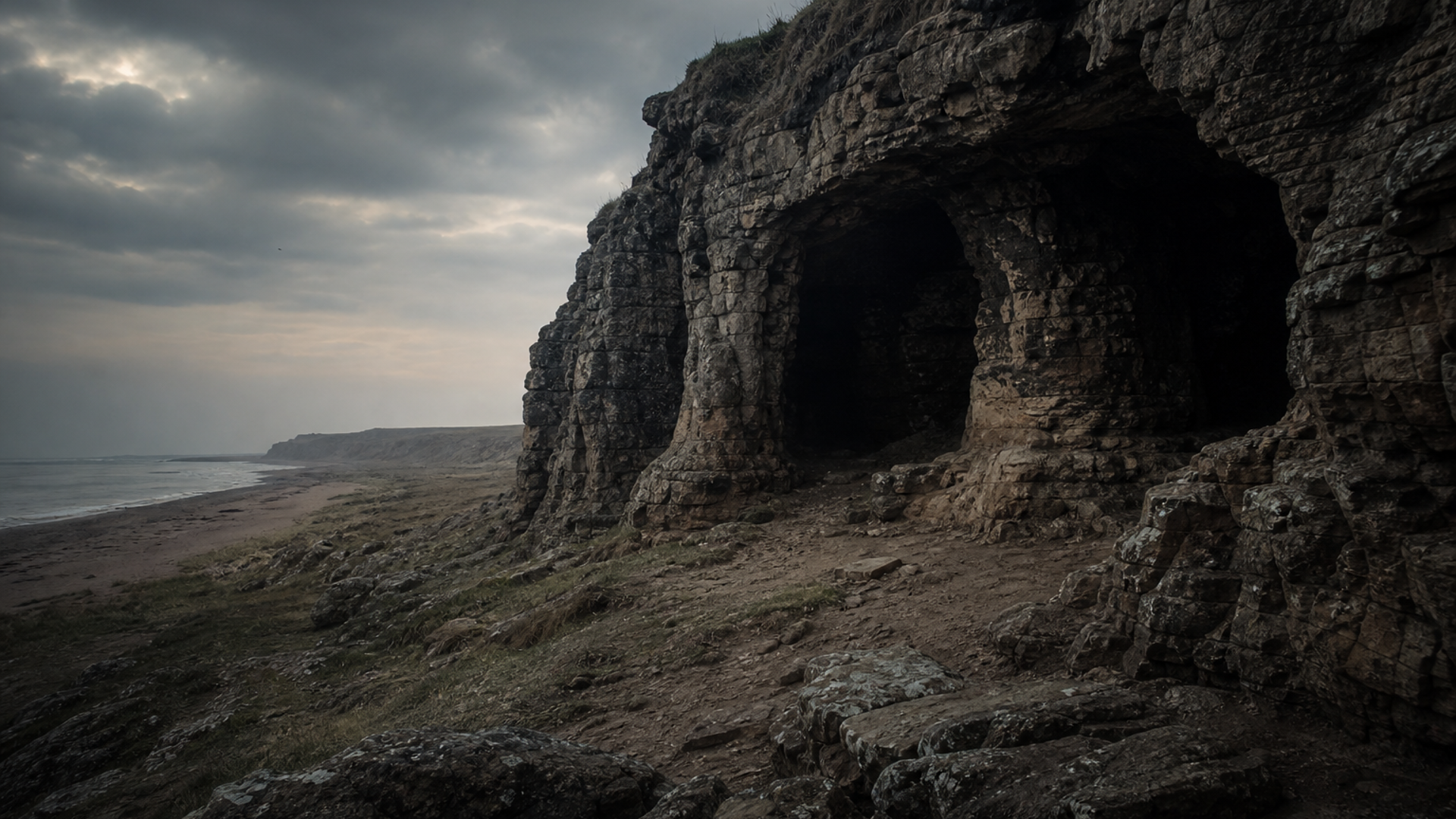
The human remains from Covesea Caves (Covesea Caves and Covesea Cave 2, Moray, Scotland) date to the Late Bronze Age, roughly 984–808 BCE in the sampled material. Archaeological data indicates that coastal caves and rock-shelters along the Moray Firth were used episodically during the Bronze Age for deposition of human bone and material culture, often in contexts that suggest complex ritual and taphonomic histories rather than simple cemetery organization.

Limited evidence suggests these individuals belonged to local island-facing communities that participated in broader Atlantic and North Sea exchange networks: metalwork styles, raw materials, and coastal resource exploitation are consistent with mobility across northern Britain and the Irish Sea. The small radiocarbon cluster represented by these four samples cannot, however, define the full trajectory of population change in Scotland during the Late Bronze Age. Instead, the Covesea material provides a high-resolution snapshot: people living in maritime landscapes, using caves as depositional or ritual spaces, and connected—culturally and genetically—to wider Bronze Age interactions.

The archaeological context of the caves is complex: sediment mixing, post-depositional disturbance, and episodes of intrusive burial are documented in similar coastal sites, so interpretations must remain cautious. Still, the material from Covesea contributes to a mosaic of Late Bronze Age Scotland emerging from excavation, artifact study, and now ancient DNA.

  • Samples dated to 984–808 BCE from Covesea Caves (Moray, Scotland).
  • Cave deposits likely reflect complex ritual and depositional practices.
  • Evidence points to coastal communities engaged in wider Atlantic exchange.
Chapitre IV

Daily Life & Society

Archaeological indicators from Late Bronze Age Scotland suggest lifeways shaped by the sea, upland pastures, and small-scale metalworking. At coastal localities like Covesea, shellfish, coastal fish, and seabird resources supplemented sheep and cattle herding on hinterland slopes. Finds from contemporary Scottish Bronze Age sites include whetstones, metal scrap, and everyday ceramic fragments that imply itinerant craft production and a mixed subsistence economy.

Social lives would have been organized at a community scale: farmsteads, seasonal camps, and small villages dotted the coastline and interior. Exchange of metals, salt, and finished tools tied these communities into regional networks. The cave deposits at Covesea may represent selective depositional practices — perhaps secondary burial, curated remains, or ritual closure of spaces — rather than routine household disposal. Such practices indicate social values attached to place, ancestry, and landscape.

Material culture and landscape use emphasize mobility and local identity at once: people navigated short- and long-distance connections while maintaining strong ties to specific coastal features. That duality—rooted in place but open to exchange—characterizes much of Late Bronze Age Scotland.

  • Mixed economy: pastoralism combined with marine foraging and local craft.
  • Cave deposition suggests ritualized treatment of the dead and curated remains.
Chapitre V

Genetic Profile

Genetic data from four individuals recovered at Covesea Caves (sample count = 4) provide preliminary but valuable insights. Two male-associated Y-chromosome haplogroups are reported as R (2 samples). Mitochondrial haplogroups among the four individuals are K, H, I, and U (one each). These lineages fit broadly within patterns observed across Bronze Age Britain, where R-lineages—often associated with steppe-derived ancestry in the wider prehistoric record—are common among male lineages, and diverse mtDNA types reflect varied maternal ancestries.

Because the dataset is small (n=4), any population-level inference must be made cautiously. The presence of R haplogroups is consistent with the widespread replacement or admixture events during the Bronze Age that increased steppe-derived ancestry across much of northwestern Europe, but we cannot specify subclades or the timing of admixture from this limited set alone. The mitochondrial diversity (K, H, I, U) suggests that maternal lineages in this coastal pocket were heterogeneous, reflecting either long-term continuity with earlier British maternal pools or the incorporation of women from different communities through mobility or marriage networks.

Archaeogenetic interpretation benefits most when tied to archaeology: the cave context, diet inferred from isotopes (where available), and artifact associations help frame questions about mobility, kinship, and social practice. For Covesea, the genetic signal is a tantalizing hint of local people enmeshed in broader Bronze Age demographic landscapes—but preliminary.

  • Y-DNA: R haplogroups in 2 of 4 samples, aligning with broader Bronze Age male lineages.
  • mtDNA: K, H, I, U present (one each), indicating maternal diversity and tentative continuity.
Chapitre VI

Legacy & Modern Connections

The Covesea genetic snapshots connect ancient coastal Scotland to enduring threads in the British genetic landscape. Haplogroups observed—particularly R on the paternal side—are part of wider Bronze Age transformations that helped shape modern northwestern European ancestry. Maternal haplogroup diversity echoes patterns seen across Britain and Ireland, where a mix of older Mesolithic/Neolithic lineages and Bronze Age-associated types persist in modern populations.

However, these connections must be framed by caution: four samples cannot capture centuries of demographic change. Instead, the Covesea finds serve as evocative vignettes—moments frozen in time that, when combined with many other sites, build a robust picture of ancestry and movement. For contemporary people tracing deep roots in Scotland, Covesea illustrates how coastal places acted as both anchors and corridors for human stories, leaving traces in both bone and genome.

  • Covesea contributes to the long-term genetic tapestry of Scotland and Britain.
  • Small sample size means links to modern populations are suggestive, not definitive.
Propulsé par l'IA

Assistant IA

Posez des questions sur la culture Covesea Caves: Scotland, Late Bronze Age

Assistant IA par DNAGENICS

Débloquer cette fonction
Posez des questions sur la culture Covesea Caves: Scotland, Late Bronze Age. L'assistant IA peut expliquer les résultats génétiques, le contexte historique, les preuves archéologiques et les liens génétiques avec les populations actuelles, dans les limites de l'interprétation.
Exemple d'analyse IA

La culture Covesea Caves: Scotland, Late Bronze Age représente un chapitre fascinant de l'histoire humaine…

L'analyse génétique met en évidence des similarités avec des populations antérieures et des signes d'adaptations propres. Les échantillons d'ADN ancien éclairent les schémas migratoires et les liens entre populations, avec des limites qui dépendent de l'étude et du contexte archéologique.

Il s'agit d'un aperçu de l'analyse IA. Accédez à l'assistant complet pour explorer :

  • Composition et similarité génétique
  • Schémas migratoires et origines
  • Vie quotidienne et pratiques culturelles
  • Contexte génétique actuel

Explorez d'autres cultures antiques

Découvrez les récits de civilisations issues du monde antique