Préparation du rapport

Chargement des informations et références disponibles

Connexion au corpus archéologique…

Collecte des archives antiques

Aller au contenu principal
Cueva Calero Archaic Coast
Profil culturel

Cueva Calero Archaic Coast

Ancient coastal foragers of Matanzas whose bones whisper of deep American lineages

1400 BCE - 1300 CE
Cuba (Matanzas Province, Cárdenas)
Faites défiler pour commencer
Chapitre I

Le récit

Comprendre la culture Cueva Calero Archaic Coast

Archaeological and genetic data from Cueva Calero (Cárdenas, Matanzas, Cuba) — 1400 BCE to 1300 CE — reveal a small Archaic assemblage. Limited ancient DNA (4 samples) shows Y haplogroups Q and P and mtDNA A2, hinting at Native American founding lineages; conclusions are preliminary.

Time Period

1400 BCE–1300 CE

Region

Cuba (Matanzas Province, Cárdenas)

Common Y-DNA

Q (2), P (1)

Common mtDNA

A2 (2)

Chapitre II

Chronologie

Moments clés de l'histoire de cette culture

1400 BCE

Earliest documented Archaic activity at Cueva Calero

Initial radiocarbon dates indicate human use of the Cueva Calero coastal site beginning around 1400 BCE; evidence points to Archaic littoral foraging.

Chapitre III

Origins & Emergence

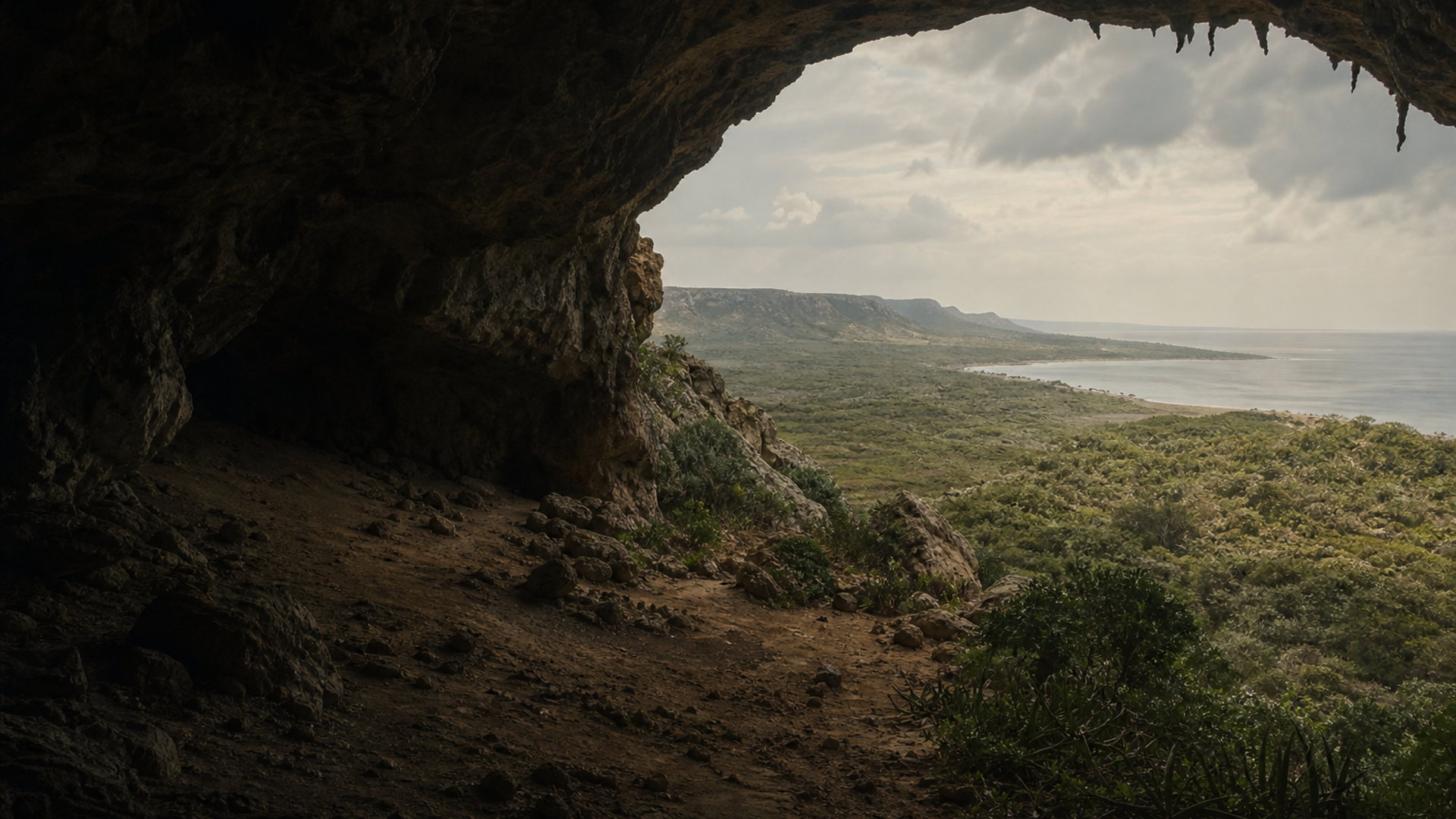
Cueva Calero sits like a silent recorder above the coastal plain at Cárdenas in Matanzas Province. Radiocarbon and stratigraphic data place human activity at the site between roughly 1400 BCE and 1300 CE, spanning late Archaic lifeways into early Ceramic age interactions. Archaeological data indicates repeated seasonal use: shell middens, hearth lenses, and flaked stone tools suggest groups skilled in littoral foraging — fishing, shellfish gathering, and exploiting coastal marshes.

The wider Archaic period in Cuba represents the island adaptation of early American populations who settled the Antilles after initial dispersals from continental source populations. Limited evidence suggests that these inhabitants maintained mobile, kin-based bands with deep knowledge of coastal ecologies rather than large sedentary villages. At Cueva Calero, the material traces are fragmentary and taphonomic processes have compressed centuries into thin deposits; therefore archaeological interpretations remain cautious. Nevertheless, the site contributes a vivid regional chapter: a people shaped by wind, reef, and the slow drift of oceanic seasons.

Key uncertainties remain about the timing and intensity of contact with later Ceramic-using groups and about demographic changes through time; both require broader excavation and increased chronological control.

  • Occupied intermittently between c. 1400 BCE and 1300 CE
  • Located at Cueva Calero, Cárdenas, Matanzas Province, Cuba
  • Archaic coastal foraging economy indicated by middens and lithics
Chapitre IV

Daily Life & Society

Imagine dawn over mangrove and reef: small family groups launching reed or dugout craft, casting nets and collecting conch and fish whose shells accumulate in middens that later archaeologists will read as lines of labor. Material culture at Archaic sites across western Cuba — and indications from Cueva Calero — emphasize lightweight lithic toolkits, percussion flakes, scrapers, and utilitarian bone or shell implements rather than heavy agricultural infrastructures.

Social organization was likely flexible and kin-centered. Mobility patterns would have tracked seasonal resources: inland hunting or foraging during parts of the year and intensified coastal use when fish and shellfish were abundant. Hearths and possible activity floors reflect domestic clusters rather than large formal architecture. Funerary practice evidence at Cueva Calero is limited; thus inferences about ritual and social hierarchy are provisional.

The cinematic rhythm of daily life — wind, salt, fire — created resilient cultural strategies tuned to island ecologies. Yet preservation biases and sparse excavation mean many aspects of residence, craft specialization, and social networks remain shadows on the archaeological record.

  • Coastal subsistence focused on fishing and shellfish, supported by small lithic toolkits
  • Likely seasonally mobile, kin-based groups with limited formal architecture
Chapitre V

Genetic Profile

Ancient DNA from Cueva Calero comprises four low-coverage individuals recovered from stratified Archaic contexts dated between 1400 BCE and 1300 CE. Although sample size is small, patterns mirror broader New World signals. Two male-line Y haplogroups are assigned to Q (2 samples), a lineage widely recognized as a major founding paternal clade in the Americas. One sample is assigned to haplogroup P; this designation may reflect a basal or unresolved placement related to early Pan-American lineages or to analytical uncertainty, and it demands further sequencing and comparative study.

Maternally, two mitochondrial genomes belong to haplogroup A2, one of the principal founding Native American maternal lineages found from North to South America. The presence of A2 and Q aligns Cueva Calero individuals with ancestral populations that dispersed into the Caribbean following continental entry from Beringia, though the precise timing and routes remain debated.

Crucially, with only four samples conclusions are preliminary. Limited evidence suggests continuity with broader Native American founder lineages, but the diversity captured is incomplete. Future higher-coverage genomes and increased sample numbers will be essential to resolve population structure, admixture with later Ceramic-associated groups, and potential genetic continuity with historic and modern Caribbean peoples.

  • Y: Q (2) — consistent with Native American paternal founder lineages
  • mtDNA: A2 (2) — maternal founder lineage; P (1) on Y requires further study
Chapitre VI

Legacy & Modern Connections

The echoes of Cueva Calero reach into present-day narratives of Caribbean peopling. Genetic signals — especially haplogroups Q and A2 — tie these Archaic occupants to the deep continental roots of the Americas. Archaeology frames how lifeways adapted to island niches, while genetics begins to map ancestral links across time and sea.

However, the inferential bridge to modern populations must be crossed with care. Small ancient sample sizes and later demographic processes — migrations, epidemics, colonial-era disruptions, and admixture — have reshaped Caribbean genetic landscapes. Limited evidence from Cueva Calero points toward contribution to the region’s ancestral mosaic rather than direct one-to-one continuity. Preservation of the site and expanded ancient DNA sampling will refine our understanding, allowing communities and scientists to better trace cultural and biological threads from the Archaic shorelines to the present.

  • Genetic affinities suggest links to broader Native American founding populations
  • Small sample size makes continuity with modern Caribbean populations tentative
Propulsé par l'IA

Assistant IA

Posez des questions sur la culture Cueva Calero Archaic Coast

Assistant IA par DNAGENICS

Débloquer cette fonction
Posez des questions sur la culture Cueva Calero Archaic Coast. L'assistant IA peut expliquer les résultats génétiques, le contexte historique, les preuves archéologiques et les liens génétiques avec les populations actuelles, dans les limites de l'interprétation.
Exemple d'analyse IA

La culture Cueva Calero Archaic Coast représente un chapitre fascinant de l'histoire humaine…

L'analyse génétique met en évidence des similarités avec des populations antérieures et des signes d'adaptations propres. Les échantillons d'ADN ancien éclairent les schémas migratoires et les liens entre populations, avec des limites qui dépendent de l'étude et du contexte archéologique.

Il s'agit d'un aperçu de l'analyse IA. Accédez à l'assistant complet pour explorer :

  • Composition et similarité génétique
  • Schémas migratoires et origines
  • Vie quotidienne et pratiques culturelles
  • Contexte génétique actuel

Explorez d'autres cultures antiques

Découvrez les récits de civilisations issues du monde antique