Aller au contenu principal
Profil culturel

Danube Rift: Lepenski Vir People

Riverborne hunters and early farmers on the Iron Gates, seen through archaeology and DNA

6222 CE - 5632 BCE
Iron Gates, Serbia (Lepenski Vir)

Le récit

Small-sample ancient DNA from Lepenski Vir (6222–5632 BCE) illuminates life along the Iron Gates gorge. Archaeological remains and genetic markers suggest a riverine, fish-focused society with complex houses and preliminary signs of admixture between local hunter-gatherers and incoming Neolithic groups.

Time Period

6222–5632 BCE

Region

Iron Gates, Serbia (Lepenski Vir)

Common Y-DNA

R (1 sample)

Common mtDNA

HV, J, H40 (1 each)

Chronologie

6222 BCE

Earliest dated individuals

Radiocarbon dates place some Lepenski Vir individuals around 6222 BCE, anchoring early riverine occupation.

5632 BCE

Latest samples in this set

The latest of the three samples dates to about 5632 BCE, a period of cultural dynamism in the Iron Gates.

Origins & Emergence

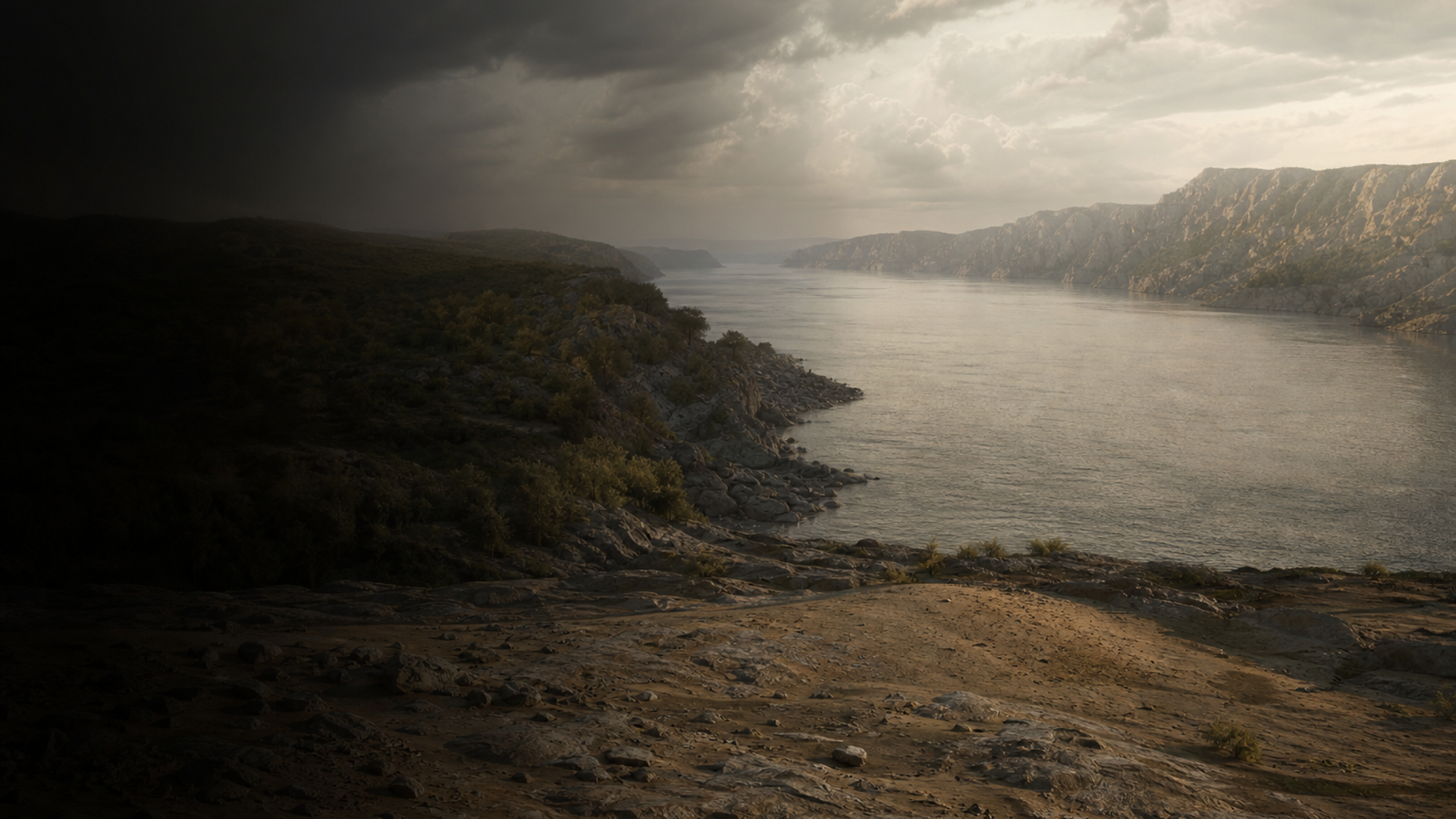
Along the iron-churned gorge of the Danube, communities at Lepenski Vir occupy a liminal world between deep Mesolithic traditions and the first waves of Neolithic change. Radiocarbon dates tied to burials and building phases span roughly 6222–5632 BCE, anchoring these people to the mid-Holocene river landscape. Archaeological data indicates a continuity of riverine lifeways: repeated use of the same terraces, specialized fish-harvesting equipment, and a distinctive architectural vocabulary of trapezoidal stone foundations and bench-like hearths.

Cultural expressions — carved stone faces, sculpted benches and tightly packed dwelling remains — evoke a ritualized inhabitation of place. Limited evidence suggests these rites and building forms developed locally in dialogue with, rather than wholesale replacement by, incoming agrarian ways. Environmental reconstructions of the Iron Gates highlight an abundant Danube ecology that could sustain relatively dense, sedentary communities without immediate reliance on full-scale farming.

Because only three genetic samples are reported for this specific identifier, any narrative connecting demography and cultural emergence must remain tentative. Archaeology provides a rich, cinematic picture of riverside life; genetics offers delicate threads that may, with more data, weave a fuller story of population contact and change.

  • Occupied terraces at Lepenski Vir along the Danube gorge
  • Distinctive trapezoidal architecture and carved stone art
  • Dates range from 6222 to 5632 BCE (mid-Holocene)

Daily Life & Society

Life at Lepenski Vir appears shaped by the river’s cadence. Archaeological assemblages reveal dense concentrations of fish bone, indicating seasonal or year-round intensification of fishing techniques — likely nets, weirs and specialized hooks — supported by hearth complexes and storage features. Houses built on stone foundations, often aligned and close-packed, imply a degree of sedentism unusual for contemporaneous hunter-gatherers and suggest strong community planning and shared craft traditions.

Burial practices at the site, with varied grave goods and body placements, point to social differentiation and ritual behavior. Stone sculptures and bench-like installations within dwellings suggest that domestic and ceremonial spaces were intertwined. Craft production — flint tools, bone points, and ornamentation — shows skillful exploitation of both river and terrestrial resources.

Archaeological data indicates a society attuned to seasonal rhythms of the Danube, able to concentrate efforts on high-yield resources while maintaining cultural investment in built space and symbolic life. Interactions with neighboring early farming communities were likely episodic at first, introducing new materials, crops or practices that would, over generations, transform local lifeways.

  • Fish-dominant diet and river-focused subsistence
  • Stone-founded houses and integrated ritual architecture

Genetic Profile

Genetic data from the Serbia_IronGates_N identifier comprises three individuals dated between 6222 and 5632 BCE, recovered from Lepenski Vir contexts. Among these samples, Y-DNA of haplogroup R appears in one male, while mitochondrial lineages include HV, J and H40 (one individual each). These haplogroups are informative but not definitive: the presence of R is notable because broad R-lineages have diverse geographic histories in Eurasia, and mtDNA HV and J are found across both Mesolithic and early Neolithic contexts in Europe.

Archaeogenetic patterns across the Balkans often show admixture between indigenous hunter-gatherer groups and incoming Anatolian-derived farming populations during the Neolithic transition. The tiny sample size here prevents confident statements about mixture proportions or the timing of gene flow for Lepenski Vir specifically. Limited evidence suggests that these individuals may reflect local hunter-gatherer ancestry with varying degrees of contact with early farmers, but that inference is preliminary.

Key caveats: with only three genomes, population-level conclusions are conjectural. Further sampling is essential to test hypotheses about demographic continuity, admixture, and whether distinctive cultural features at Lepenski Vir correlate with genetic distinctions.

  • Sample count is low (n=3): conclusions are preliminary
  • Y-DNA R and mtDNA HV, J, H40 present; patterns suggest mixed ancestry signals but remain uncertain

Legacy & Modern Connections

The people of Lepenski Vir occupy a compelling place in the deep prehistory of Southeast Europe. Their stone art, tightly arranged dwellings, and river-centered economy form a cultural landmark for the Mesolithic–Neolithic transition. Genetic traces from this small sample hint at the complex demographic choreography that shaped the Balkans: local hunter-gatherer lineages interacting with waves of farming ancestry that swept from the Aegean and Anatolia.

For modern science and public heritage, Lepenski Vir offers a cinematic tableau: carved faces watching the Danube, hearth-smoke clinging to stone benches, and DNA molecules preserving whispers of ancestry. As more ancient genomes from the Iron Gates and surrounding regions accumulate, we expect clearer pictures of how cultural innovation and genetic exchange intertwined here. Until then, the material record and the few DNA threads we have together emphasize continuity, adaptability and the layered history of European populations.

  • Contributes to understanding the hunter-gatherer to farmer transition in the Balkans
  • Current DNA evidence is fragmentary; future samples may clarify modern genetic links

Assistant IA

Assistant IA par DNAGENICS

Débloquer cette fonction
Posez des questions sur la culture Danube Rift: Lepenski Vir People. L'assistant IA peut expliquer les résultats génétiques, le contexte historique, les preuves archéologiques et les liens génétiques avec les populations actuelles, dans les limites de l'interprétation.
Exemple d'analyse IA

La culture Danube Rift: Lepenski Vir People représente un chapitre fascinant de l'histoire humaine…

L'analyse génétique met en évidence des similarités avec des populations antérieures et des signes d'adaptations propres. Les échantillons d'ADN ancien éclairent les schémas migratoires et les liens entre populations, avec des limites qui dépendent de l'étude et du contexte archéologique.

Il s'agit d'un aperçu de l'analyse IA. Accédez à l'assistant complet pour explorer :

  • Composition et similarité génétique
  • Schémas migratoires et origines
  • Vie quotidienne et pratiques culturelles
  • Contexte génétique actuel