Préparation du rapport

Chargement des informations et références disponibles

Connexion au corpus archéologique…

Collecte des archives antiques

Aller au contenu principal
Doggerland Dawn
Profil culturel

Doggerland Dawn

Mesolithic life reclaimed from the North Sea, seen through bones and genomes

9113 CE - 6502 BCE
Doggerland (North Sea, Netherlands)
Faites défiler pour commencer
Chapitre I

Le récit

Comprendre la culture Doggerland Dawn

Archaeological and ancient DNA evidence from eight Mesolithic individuals (9113–6502 BCE) recovered from Doggerland sites off the Netherlands reveals coastal hunter‑gatherer lifeways and a mixed genetic profile. Limited samples make conclusions preliminary but suggest Western Hunter‑Gatherer affinities and male lineage diversity.

Time Period

9113–6502 BCE

Region

Doggerland (North Sea, Netherlands)

Common Y-DNA

M (3), I (2), PF (1) — low sample count

Common mtDNA

U (4), K1e (1)

Chapitre II

Chronologie

Moments clés de l'histoire de cette culture

9113 BCE

Earliest directly dated individual in dataset

An early Mesolithic individual from Doggerland dated to ~9113 BCE marks the oldest genome in this small Netherlands sample set.

Chapitre III

Origins & Emergence

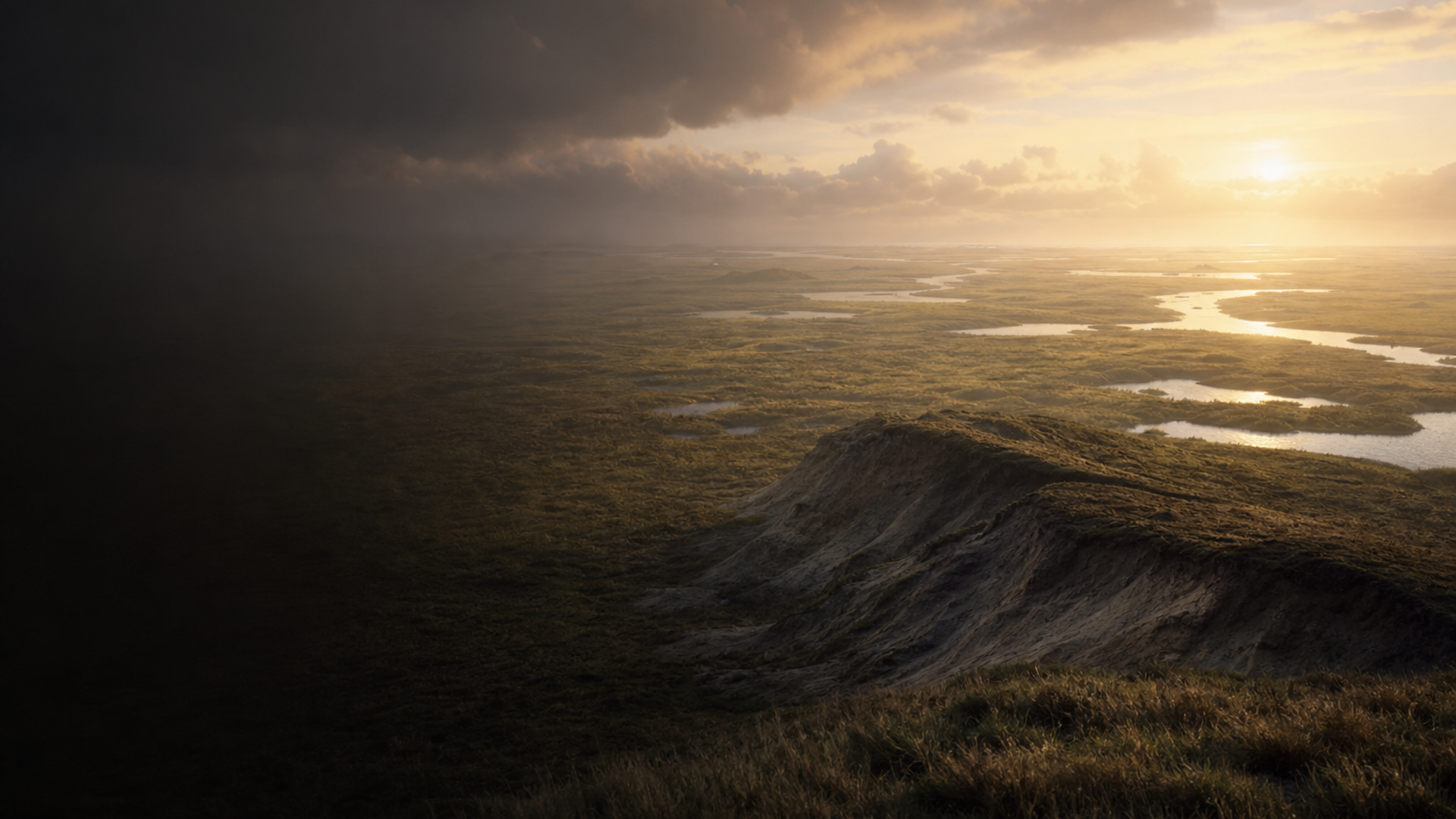
Beneath the churned waves of the southern North Sea lies Doggerland: a drowned mosaic of estuaries, tidal flats and wooded plains that connected Britain and continental Europe after the Ice Age. The human traces recovered in dredged trenches and offshore deposits — from Brown Bank, Eurogeul (Zuid‑Holland), the Noordhinder trenches, Sand Motor and Maasvlakte‑2 — preserve moments of occupation between roughly 9113 and 6502 BCE. Archaeological data indicates small, mobile groups exploiting a rich coastal ecotone of fish, shellfish, marine mammals and seasonally available terrestrial game.

Limited evidence suggests settlement was episodic and tied to shifting shorelines as postglacial sea levels rose. Material culture in the broader Doggerland Mesolithic includes flint toolkits, organic implements where preserved, and food remains dominated by marine resources, but offshore recovery biases our picture toward objects and bones that survived dredging and trawling. Genetic samples from eight individuals allow a first, cautious glimpse into population composition: the temporal spread of dates and spatial distribution across multiple Doggerland localities hint at persistent occupation of these drowned landscapes over millennia.

Uncertainties remain large. Submerged deposits are often disturbed and sampling is sparse; interpretations must therefore emphasize provisional patterns rather than firm narratives.

  • Occupation of Doggerland sites dated 9113–6502 BCE (Mesolithic)
  • Sites: Brown Bank, Sand Motor, Eurogeul, Noordhinder trenches, Maasvlakte‑2
  • Evidence points to coastal, mobile hunter‑gatherer lifeways amid rising seas
Chapitre IV

Daily Life & Society

Imagine low dunes and marshes where tidal channels braided the land, and people moved with tides and seasons. Archaeological deposits recovered from Doggerland contexts portray a subsistence economy tuned to the sea: fish bones, shell concentrations and sea mammal remains dominate assemblages in comparable coastal Mesolithic settings, and lithic scatters suggest repeated short‑term camps. Tools would have included composite fishing gear, bone and antler implements, and versatile flint blades — but preservation varies widely because many sites are now submerged and fragments are recovered by industrial seabed activities.

Social groups were likely small and flexible, organized around kin networks and seasonal rounds. Mobility allowed access to inland woodlands and freshwater resources as well as rich marine shelves. The spatial distribution of the eight genetic samples across several Doggerland localities supports a picture of connected communities rather than an isolated hamlet; however, the archaeological record here is biased by recovery method and taphonomy, so demographic reconstructions remain tentative.

Archaeological context and DNA together can illuminate elements of lifeways — for example, dietary isotopes in human remains (when available) can confirm marine dietary emphasis hinted at by shell and bone assemblages — but the current dataset is small and patchy, so many aspects of social organization and seasonality are still speculative.

  • Coastal foraging economy focused on fish, shellfish, and seasonal game
  • Small, mobile groups exploiting a shifting shoreline; preservation is patchy
Chapitre V

Genetic Profile

Genetic data from eight individuals recovered across Doggerland localities provide a preliminary window into Mesolithic population structure in the southern North Sea. Mitochondrial lineages are dominated by haplogroup U (four individuals), a signature commonly associated with European hunter‑gatherers, while one individual carries K1e, indicating maternal diversity beyond a single matriline. On the paternal side the dataset reports three individuals labeled with Y‑haplogroup M, two with I, and one with PF. The presence of haplogroup I aligns with other Western European Mesolithic males, but the label "M" for Y‑DNA in this context is unusual for northwestern Europe; this could reflect deep, basal branches, issues with haplogroup nomenclature in older datasets, or limited resolution from degraded DNA.

Archaeological and genetic integration suggests these Doggerland people fit broadly within the Western Hunter‑Gatherer (WHG) genetic continuum known elsewhere in Mesolithic Europe, while also showing local lineage variation. Because the dataset includes only eight samples, any broader claims about population continuity, sex‑biased mobility, or fine‑scale structure must be treated as provisional. Future sequencing with larger sample sizes and higher resolution Y‑haplogroup assignment will be essential to resolve whether the observed Y diversity represents true local heterogeneity, rare incoming lineages, or classification artefacts.

In sum, the genetics reinforce an image of Mesolithic Doggerland as part of a wider European hunter‑gatherer network, with hints of local distinctiveness that require more data to confirm.

  • mtDNA dominated by U lineages (4) with K1e present — typical WHG maternal signal
  • Reported Y diversity (M, I, PF) suggests multiple male lineages but sample size and classification uncertainty make conclusions preliminary
Chapitre VI

Legacy & Modern Connections

The drowned landscapes of Doggerland are a poignant reminder that coastal populations can be lost from the archaeological map even as their DNA persists in later populations. Archaeogenetic comparisons show that Mesolithic hunter‑gatherer ancestry contributed to the genetic makeup of subsequent European populations, but in the low countries Neolithic farmer expansions and later migrations substantially reshaped ancestry profiles. Limited evidence here means we cannot claim direct, unbroken continuity between these Doggerland individuals and modern Dutch genomes, though echoes of Mesolithic lineages — particularly maternal U types — survive in the broader European gene pool.

Beyond genetics, the Doggerland finds have driven renewed interest in submerged archaeology and in combining offshore survey, targeted coring and ancient DNA to reconstruct vanished landscapes. Each new sample has outsized value: with only eight individuals studied so far, every additional well‑dated genome will sharpen our view of how rising seas, mobility and contact shaped human history in the North Sea basin.

  • Some Mesolithic ancestry persists in later European populations, but local continuity in the Netherlands is not yet demonstrable
  • Submerged Doggerland sites are crucial targets for integrated archaeology and aDNA; current sample size is very small
Propulsé par l'IA

Assistant IA

Posez des questions sur la culture Doggerland Dawn

Assistant IA par DNAGENICS

Débloquer cette fonction
Posez des questions sur la culture Doggerland Dawn. L'assistant IA peut expliquer les résultats génétiques, le contexte historique, les preuves archéologiques et les liens génétiques avec les populations actuelles, dans les limites de l'interprétation.
Exemple d'analyse IA

La culture Doggerland Dawn représente un chapitre fascinant de l'histoire humaine…

L'analyse génétique met en évidence des similarités avec des populations antérieures et des signes d'adaptations propres. Les échantillons d'ADN ancien éclairent les schémas migratoires et les liens entre populations, avec des limites qui dépendent de l'étude et du contexte archéologique.

Il s'agit d'un aperçu de l'analyse IA. Accédez à l'assistant complet pour explorer :

  • Composition et similarité génétique
  • Schémas migratoires et origines
  • Vie quotidienne et pratiques culturelles
  • Contexte génétique actuel

Explorez d'autres cultures antiques

Découvrez les récits de civilisations issues du monde antique