Préparation du rapport

Chargement des informations et références disponibles

Connexion au corpus archéologique…

Collecte des archives antiques

Aller au contenu principal
Echoes from Ulgii Barrows
Profil culturel

Echoes from Ulgii Barrows

Five Early Bronze Age burials in western Mongolia link earth, bone and ancient DNA

3012 CE - 2474 BCE
Bayan-Ölgii, Ulaankhus (western Mongolia)
Faites défiler pour commencer
Chapitre I

Le récit

Comprendre la culture Echoes from Ulgii Barrows

Archaeogenetic study of five Early Bronze Age burials (3012–2474 BCE) from Ulaankhus, Bayan-Ölgii, Mongolia, reveals predominantly East Eurasian maternal lineages (A, D) and a single C Y-chromosome—offering a tentative glimpse into Altai–Mongolian population dynamics.

Time Period

3012–2474 BCE (Early Bronze Age)

Region

Bayan-Ölgii, Ulaankhus (western Mongolia)

Common Y-DNA

C (observed in 1 of 5 samples)

Common mtDNA

A (4 of 5), D (1 of 5)

Chapitre II

Chronologie

Moments clés de l'histoire de cette culture

2750 BCE

Secondary burials in Ulaankhus

Reburial of human remains at Kurgak Govi, Kulala Ula and Kumdii Govi reflects curated mortuary practices in the Early Bronze Age highlands.

Chapitre III

Origins & Emergence

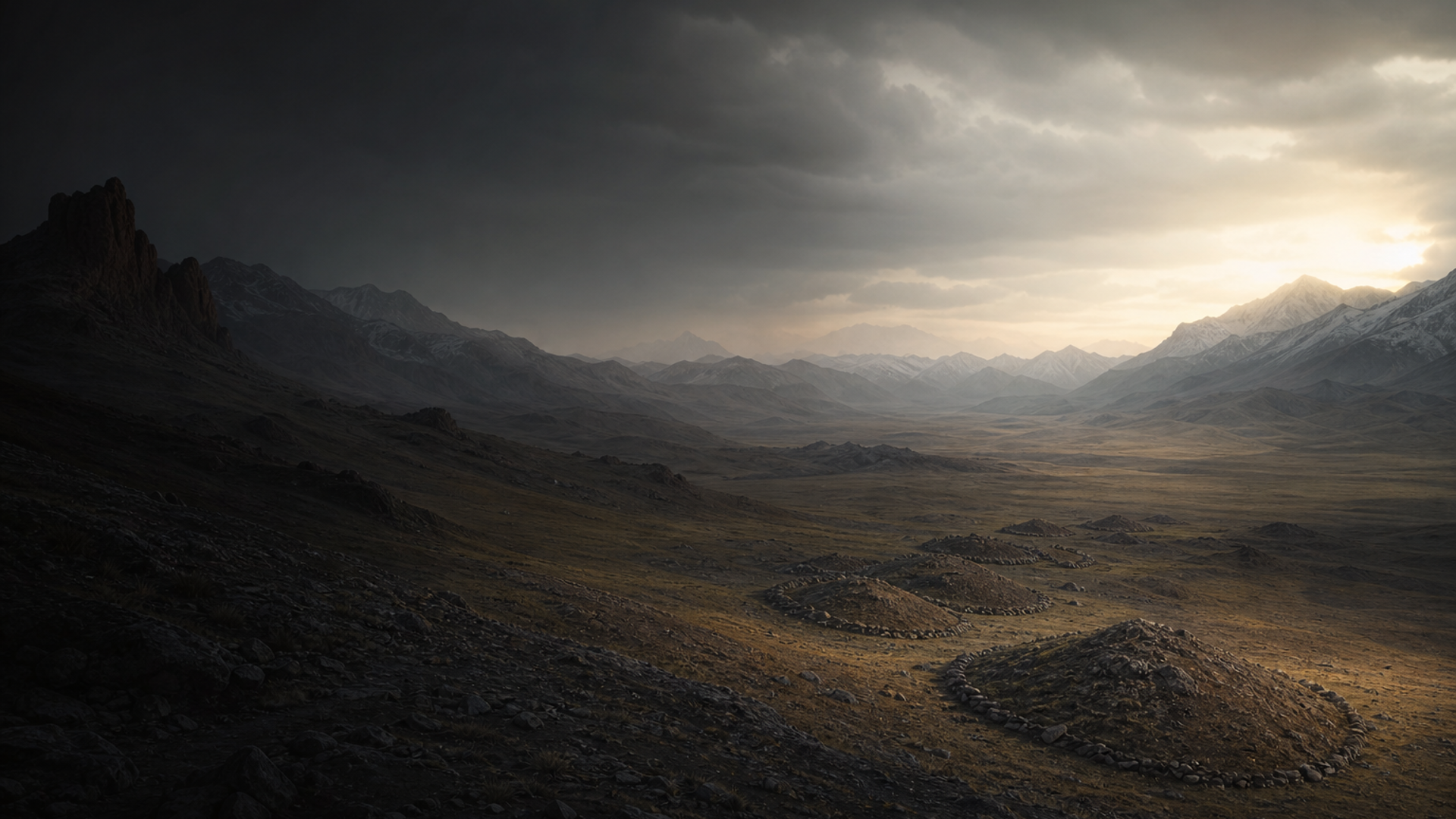
Beneath the wind-scoured grasses of Bayan-Ölgii, barrows preserve quiet chapters of human movement. The five individuals attributed to Mongolia_EBA_Ulgii_1 date from 3012 to 2474 BCE and were recovered in Ulaankhus sum at Kurgak Govi barrow 2 (secondary burial), Kulala Ula barrow 1 (secondary burial), and Kumdii Govi barrow (burial 2). Archaeological data indicates these were secondary interments—bones reburied or curated after initial decomposition—suggesting ritual care of the dead.

Material culture at nearby Early Bronze Age sites in the Altai and Mongolian uplands shows mobile pastoral economies and long-distance connections, but the Ulgii barrows themselves preserve limited grave goods, complicating social reconstruction. Radiocarbon dates anchor the assemblage firmly in the early third to mid-third millennium BCE, a period of growing pastoralism across the steppe fringe. Limited evidence suggests these burials represent local communities adapting to highland ecologies rather than a sudden migration event.

Because only five genomes are available, any narrative of population origin must remain provisional. Archaeological contexts and stratigraphy provide a canvas; ancient DNA adds delicate brushstrokes, hinting at continuity with regional East Eurasian maternal lineages while leaving open questions about incoming paternal ancestry and cultural transmission.

  • Five individuals from Ulaankhus, Bayan-Ölgii (3012–2474 BCE)
  • Secondary burials indicate curated mortuary practices
  • Evidence suggests local highland pastoral adaptations
Chapitre IV

Daily Life & Society

Archaeological traces from Ulgii Early Bronze Age contexts evoke a life balanced between stone, felt and herd. Settlement evidence in the greater Bayan-Ölgii region of this era points to seasonal mobility, corralling of livestock, and the pragmatic use of high-mountain pastures. The barrow contexts at Kurgak Govi, Kulala Ula and Kumdii Govi are funerary rather than domestic, but their burial architecture and few associated artifacts hint at social identities tied to kin groups and pastoral stewardship.

Secondary burial practices imply a ritualized relationship with ancestors: bodies were initially left or processed, then reinterred, sometimes in collective mounds. Such actions can reflect beliefs about life cycles, property transmission, or social memory. Lithic tools, pottery fragments and occasional metal items in nearby sites suggest craft specialization and networks of exchange—commodities and ideas moving along foothill corridors toward the Altai and beyond.

Archaeobotanical and faunal remains are sparse in these specific barrows, so reconstruction of diet and seasonal rhythms relies on regional analogies. Consequently, while the cinematic image of nomadic herders tending sheep and horses is plausible, archaeological data indicates cautious interpretation: local lifeways likely combined mobility with anchored ritual landscapes centered on burial mounds.

  • Seasonal pastoralism inferred from regional archaeological patterns
  • Secondary burials point to ritualized ancestor practices
Chapitre V

Genetic Profile

Genetic data from Mongolia_EBA_Ulgii_1 offers a concentrated, if preliminary, portrait. Of the five individuals sequenced, four carry mitochondrial haplogroup A and one carries haplogroup D—both maternal lineages commonly associated with Northeast Asian and Siberian populations. On the paternal side, a single observed Y-chromosome belongs to haplogroup C, a lineage with deep roots across East and Central Eurasia.

These results suggest predominant East Eurasian maternal ancestry in this small Ulaankhus sample, consistent with broader patterns seen across northern Mongolia and adjacent Siberia in the Early Bronze Age. The presence of Y-haplogroup C in one male aligns with regional paternal diversity but, with only one Y observation, offers limited insight into male-mediated gene flow.

Comparative analyses (when available) can test whether these individuals cluster with contemporaneous Altai and northern Mongolian groups or show admixture with western steppe populations. At present, with only five genomes, conclusions about population structure, sex-biased migration, or continuity into later periods must be tentative. Future sampling from neighbouring cemeteries and settlement contexts will be essential to move from evocative glimpses to robust population histories.

  • mtDNA dominated by A (4/5) with one D (1/5)—typical of Northeast Asian maternal ancestry
  • Y-DNA C observed in 1/5 samples; low Y-sample count limits paternal inferences
Chapitre VI

Legacy & Modern Connections

The maternal lineages found in these Ulaankhus burials—haplogroups A and D—persist in varying frequencies among contemporary populations across Mongolia, Siberia and northeastern Asia. Archaeogenetic continuity of mtDNA types suggests elements of maternal ancestry may have deep regional roots. However, cultural and genetic landscapes have been reshaped repeatedly across millennia by mobility, trade and migration.

These burials form a fragile bridge between past and present: they allow modern communities and researchers to glimpse ancestral threads but do not provide a complete lineage map. Given the small sample size, any claims of direct descent or cultural continuity should remain cautious. The true legacy of Mongolia_EBA_Ulgii_1 lies in its potential to, when combined with broader datasets, reveal how highland pastoral lifeways and human networks in the Early Bronze Age contributed to the genetic tapestry of Eurasia.

  • Maternal haplogroups echo patterns still seen in modern Mongolia and Siberia
  • Small sample size means connections to modern populations are tentative
Propulsé par l'IA

Assistant IA

Posez des questions sur la culture Echoes from Ulgii Barrows

Assistant IA par DNAGENICS

Débloquer cette fonction
Posez des questions sur la culture Echoes from Ulgii Barrows. L'assistant IA peut expliquer les résultats génétiques, le contexte historique, les preuves archéologiques et les liens génétiques avec les populations actuelles, dans les limites de l'interprétation.
Exemple d'analyse IA

La culture Echoes from Ulgii Barrows représente un chapitre fascinant de l'histoire humaine…

L'analyse génétique met en évidence des similarités avec des populations antérieures et des signes d'adaptations propres. Les échantillons d'ADN ancien éclairent les schémas migratoires et les liens entre populations, avec des limites qui dépendent de l'étude et du contexte archéologique.

Il s'agit d'un aperçu de l'analyse IA. Accédez à l'assistant complet pour explorer :

  • Composition et similarité génétique
  • Schémas migratoires et origines
  • Vie quotidienne et pratiques culturelles
  • Contexte génétique actuel

Explorez d'autres cultures antiques

Découvrez les récits de civilisations issues du monde antique