Aller au contenu principal
Profil culturel

Echoes of 2200 BP South Africa

Five ancient genomes from South Africa reveal maternal continuity and complex local histories

403 BCE - 17932200 CE
South Africa (KwaZulu-Natal, Drakensberg; St. Helena Bay)

Le récit

Archaeogenetic and archaeological evidence from five sites in South Africa (403 BCE–1793 CE) suggests deep maternal continuity (mtDNA L) and a small number of Y-chromosome A lineages. Limited sample size makes conclusions preliminary; archaeological context points to long-term forager and local interactions.

Time Period

403 BCE – 1793 CE (samples span ~2200 BP)

Region

South Africa (KwaZulu-Natal, Drakensberg; St. Helena Bay)

Common Y-DNA

A (observed in 1 of 5 samples)

Common mtDNA

L (observed in 5 of 5 samples)

Chronologie

2500 BCE

Deep forager ancestries established in southern Africa

Limited archaeological and genetic evidence points to longstanding hunter-gatherer populations in southern Africa by the mid-Holocene, forming a deep substrate for later demographic events.

Origins & Emergence

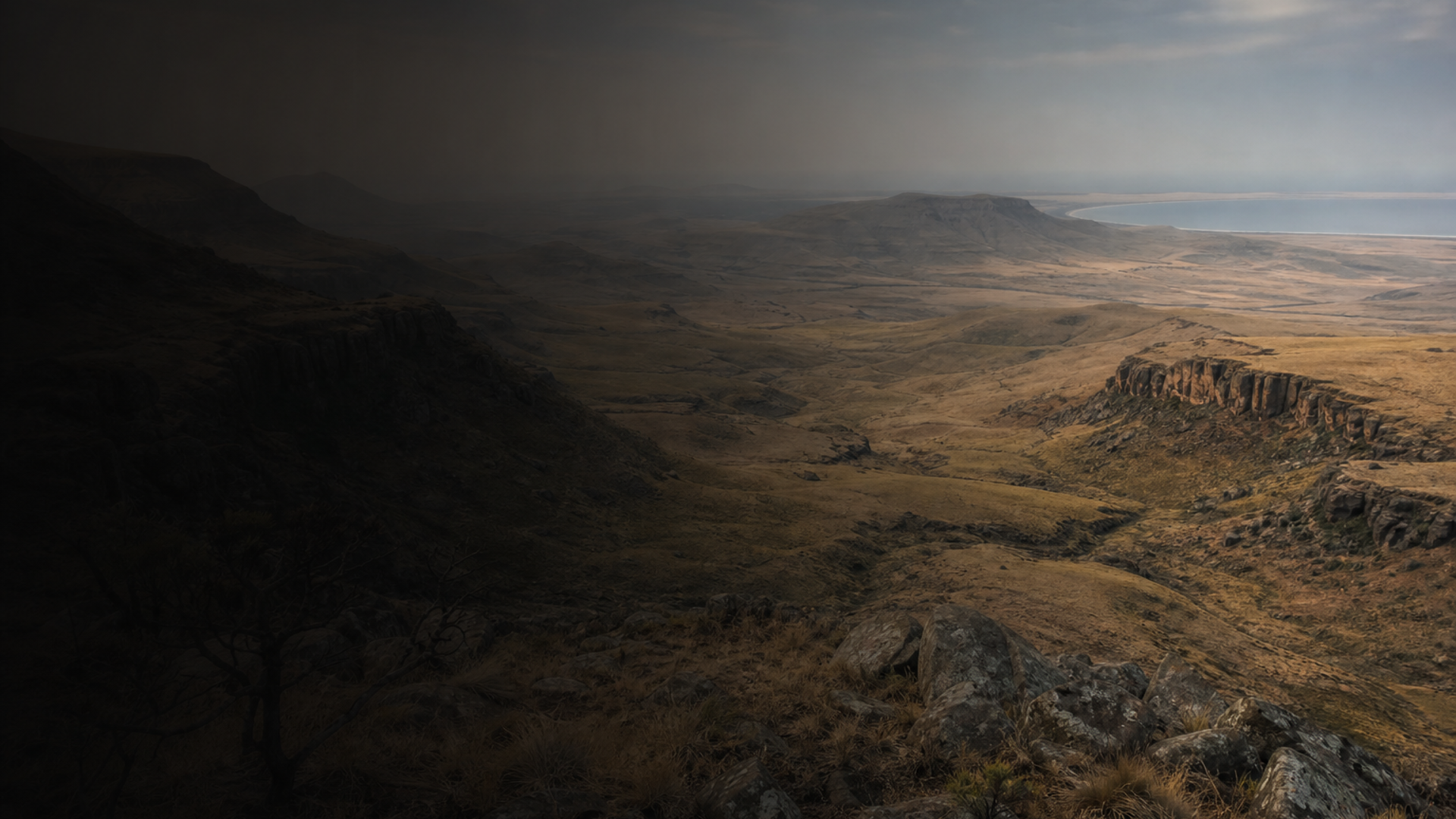
Set against the rugged spine of the Drakensberg and the wind-shaped bays of the South African coast, the individuals labelled South_Africa_2200BP come from a long-lived human landscape. Archaeological contexts include rock shelters and coastal deposits at Champagne Castle, Eland Cave, Mfongosi, Newcastle and St. Helena. Radiocarbon and stratigraphic associations place the dated individuals between roughly 403 BCE and 1793 CE, a span that captures pre-Iron Age forager lifeways and later periods of regional interaction.

Archaeological data indicate continuity in certain material practices—stone tool reduction strategies, shell bead ornaments, and use of rock shelters—while also suggesting episodic contacts with incoming groups and technologies during the first millennium CE and later. Limited evidence suggests that local populations retained deep-rooted subsistence strategies alongside novel elements. Genetically, the samples preserve maternal lineages (mtDNA L) common across sub-Saharan Africa and a Y-chromosome A lineage that is often found at higher frequency among southern African forager groups. Because the dataset comprises only five genomes, these origin narratives are provisional: they illuminate possibilities rather than establish definitive population histories.

This horizon should be seen as a patchwork of lifeways in a dynamic landscape—an archaeological record that is best read alongside expanding ancient DNA datasets and careful excavation reports.

  • Samples from Champagne Castle, Eland Cave, Mfongosi, Newcastle, St. Helena
  • Dates span 403 BCE to 1793 CE, capturing long-term local sequences
  • Material continuity in shelters and ornaments; episodic external contacts

Daily Life & Society

The places these people inhabited were cinematic: cliff overhangs that collect centuries of refuse, estuaries that concentrate fish and shellfish, and upland grasslands hunted with traps and projectiles. Archaeological assemblages at Eland Cave and Champagne Castle preserve stone flakes, hearth features, and ochre-stained artifacts that point to tool manufacture, cooking, and symbolic behavior. Shell beads and small personal items indicate long-distance exchange or coastal connections for inland groups.

Zooarchaeological remains from similar regional sites indicate a reliance on diverse resources—antelopes, small game, fish and marine shell—suggesting flexible seasonal rounds rather than a single subsistence strategy. By later centuries within the dated range, iron implements and pastoral residues appear regionally; archaeological data indicates that interactions with pastoralists and farming communities affected local economies unevenly across space and time.

Socially, mortuary variability (burial position, grave goods where present) implies varied social roles and identities. Yet the sparse sample set limits broad inferences about social structure across centuries. Carefully contextualized excavation and future aDNA sampling will help reveal whether observed patterns reflect local continuity, episodic migration, or layered occupations at the same sites.

  • Stone tools, hearths, ochre, and shell beads found in rock shelters
  • Mixed subsistence: hunting, fishing, coastal foraging; later regional influences

Genetic Profile

The genetic portrait from South_Africa_2200BP is intriguing but preliminary. All five sampled individuals carry mitochondrial haplogroup L lineages, a broad maternal clade widely distributed across sub-Saharan Africa today and historically. This repeated recovery of mtDNA L suggests maternal continuity in the region across the sampled centuries, consistent with archaeological signs of long-term local occupancy.

On the paternal side, a single observed Y-chromosome haplogroup A was detected in one individual. Haplogroup A is often associated with deep-rooted southern African forager populations (e.g., Khoe-San groups) in modern and some ancient datasets. However, with only one Y result and five genomes total, it is premature to equate these samples with any single modern ethnolinguistic group.

Important caveats frame interpretation: the chronological span of the samples (403 BCE–1793 CE) likely covers multiple cultural phases and possible admixture events. Low sample count (<10) makes demographic modeling unstable and increases sensitivity to chance sampling of particular maternal or paternal lines. Archaeogenetic evidence therefore should be read as suggestive—pointing toward regional maternal continuity and occasional paternal lineages linked to deep southern African ancestries—while inviting larger, stratified datasets to resolve migration, admixture, and sex-biased processes.


  • mtDNA L in all 5 samples suggests maternal continuity across centuries
  • Y-DNA A observed in 1 sample; interpretation limited by small sample size

Legacy & Modern Connections

The genetic signals preserved in these five individuals form a fragile bridge to modern southern African populations. Archaeological continuity in certain artifact types and the recurrence of mtDNA L hint at long-term local lineages that contributed to the gene pool of later communities. The presence of Y-DNA A in one individual resonates with paternal lineages tied to ancient forager groups, but this single data point cannot map onto modern identities.

For museum narratives and public engagement, the most responsible message is one of continuity and contingency: these genomes illustrate lineages that persisted locally through centuries of environmental and cultural change, yet the story is incomplete. Expanding the ancient DNA sample set, integrating isotopic mobility studies and detailed site stratigraphy, will clarify how these individuals relate to later pastoralists, Bantu-speaking farmers, and present-day populations. Until then, the South_Africa_2200BP samples remain evocative snapshots—important pieces in a larger, still-unfolding regional history.

  • Suggests maternal continuity that likely contributed to later regional gene pools
  • Single Y-A result and small sample size require caution in linking to modern groups

Assistant IA

Assistant IA par DNAGENICS

Débloquer cette fonction
Posez des questions sur la culture Echoes of 2200 BP South Africa. L'assistant IA peut expliquer les résultats génétiques, le contexte historique, les preuves archéologiques et les liens génétiques avec les populations actuelles, dans les limites de l'interprétation.
Exemple d'analyse IA

La culture Echoes of 2200 BP South Africa représente un chapitre fascinant de l'histoire humaine…

L'analyse génétique met en évidence des similarités avec des populations antérieures et des signes d'adaptations propres. Les échantillons d'ADN ancien éclairent les schémas migratoires et les liens entre populations, avec des limites qui dépendent de l'étude et du contexte archéologique.

Il s'agit d'un aperçu de l'analyse IA. Accédez à l'assistant complet pour explorer :

  • Composition et similarité génétique
  • Schémas migratoires et origines
  • Vie quotidienne et pratiques culturelles
  • Contexte génétique actuel