Préparation du rapport

Chargement des informations et références disponibles

Connexion au corpus archéologique…

Collecte des archives antiques

Aller au contenu principal
Echoes of Early Bronze Sardinia
Profil culturel

Echoes of Early Bronze Sardinia

Cave light and bronze shadows: genetic glimpses into Sardinia, 2468–1600 BCE

2468 CE - 1600 BCE
Sardinia, Italy
Faites défiler pour commencer
Chapitre I

Le récit

Comprendre la culture Echoes of Early Bronze Sardinia

Archaeogenetic portrait of Sardinia's Early Bronze Age (2468–1600 BCE) from 28 samples across cave and shelter sites. Y haplogroups R and I and diverse mtDNA hint at both incoming male lineages and local maternal continuity within island funerary landscapes.

Time Period

2468–1600 BCE (Early Bronze Age)

Region

Sardinia, Italy

Common Y-DNA

R (11), I (8), R1 (1)

Common mtDNA

K (5), J (5), H (4), T (3), U (3)

Chapitre II

Chronologie

Moments clés de l'histoire de cette culture

2500 BCE

Early Bronze Age activity across Sardinian caves

Cave and shelter sites like Su Crucifissu Mannu and Su Stampu Erdi are used for habitation, craftwork and burial—material and genetic traces begin to reflect both local continuity and wider connections.

Chapitre III

Origins & Emergence

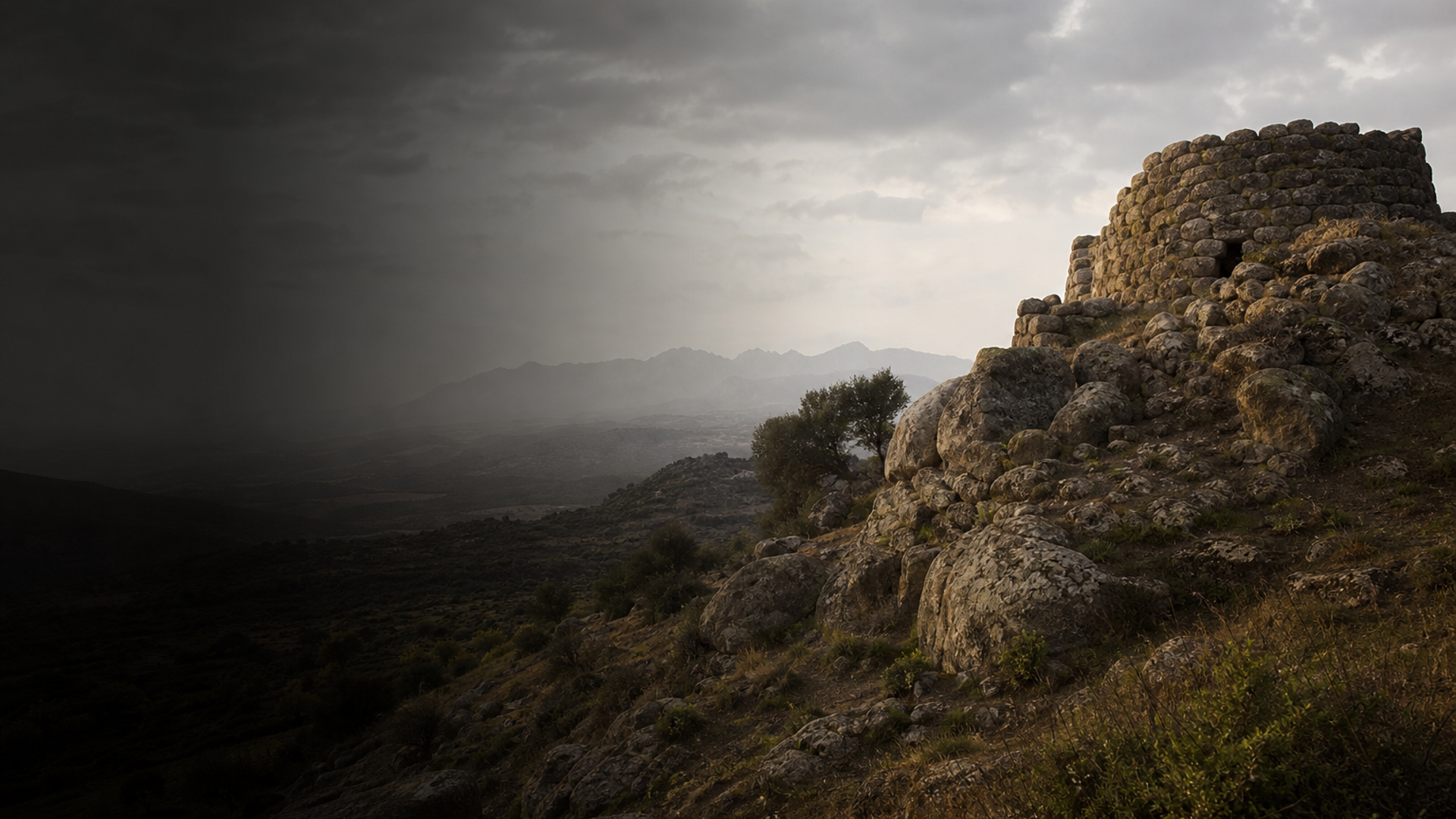
Sardinia's Early Bronze Age unfolds in a theater of limestone cliffs, cave mouths, and sheltered coastal promontories. Archaeological data indicates habitation and mortuary use of rock shelters such as Su Crucifissu Mannu (Porto Torres), Su Stampu Erdi, Su Grutta ’e is Bittuleris and Grutta I de Longu Fresu (Seulo), Padru Jossu (Seneghe) and Riparo sotto roccia Su Asedazzu. Radiocarbon-dated contexts fall between 2468 BCE and 1600 BCE, marking a centuries-long phase of local adaptation and broader Mediterranean contact.

Material remains from these contexts—ceramics, metal objects, and personal ornaments—point to increasing metallurgical knowledge and exchange networks during the Early Bronze Age. Limited evidence suggests both persistent local traditions inherited from Neolithic and Chalcolithic communities, and new cultural influences arriving by sea or via continental corridors. Genetically, the island's assemblage preserves signatures of continuity alongside markers commonly associated with wider Bronze Age population movements.

Archaeological interpretations must remain cautious: depositional complexity in caves complicates chronology, and the current genetical sample set, while informative, is one piece of a larger puzzle. Ongoing excavation and additional ancient DNA sampling will refine narratives of how Sardinia’s communities emerged and interacted in this liminal island landscape.

  • Sites include Su Crucifissu Mannu, Su Stampu Erdi, Su Grutta ’e is Bittuleris
  • Dates span 2468–1600 BCE, Early Bronze Age contexts
  • Evidence of local continuity plus external contacts via artifacts and genetics
Chapitre IV

Daily Life & Society

Life in Early Bronze Age Sardinia was shaped by rocky coasts, shepherding plains, and cave-roofed shelters that doubled as homes, workshops and tombs. Archaeological assemblages show vibrant craft traditions: pottery forms used for storage and cooking, copper-alloy objects signaling access to metalworking, and personal ornaments that index status, identity and long-distance exchange. Rock shelters such as Riparo Su Asedazzu preserve stratified debris suggesting repeated seasonal or generational use.

Cemeteries and burial deposits reveal varied funerary practices—single inhumations, multiple interments and curated skeletal deposits—indicating complex social registers and perhaps kin-based groupings. Animal remains attest to herding of sheep and goats, supplemented by wild resources. Subsistence strategies likely combined pastoralism with horticulture and marine foraging, integrating island-specific resources into daily rhythms.

Craft specialization and long-distance trade appear to have coexisted with strong local traditions, producing a society that was both rooted and outward-looking. Yet archaeological visibility is uneven: many deposits are disturbed or isolated within caves, and social organization must be inferred indirectly from material traces. The 28 genetic samples tied to these sites add a new dimension, allowing us to see not just objects but the biological ties that underpinned these communities.

  • Pastoral economy with sheep/goat herding and local cultivation
  • Burial diversity (single, multiple, curated deposits) suggests complex social structures
Chapitre V

Genetic Profile

Twenty-eight ancient individuals from Sardinian cave and shelter contexts yield a genetic snapshot of Early Bronze Age islanders. The Y-chromosome distribution shows a prominence of haplogroup R (11 individuals) and haplogroup I (8 individuals), with one sample assigned more specifically to R1. Mitochondrial lineages are diverse—K (5), J (5), H (4), T (3) and U (3)—reflecting a range of maternal ancestries.

This pattern suggests a mixed genetic landscape. The presence of R-lineages, which elsewhere in Europe are often associated with Bronze Age continental expansions, hints at incoming male-mediated ancestry or contacts during the Early Bronze Age. Simultaneously, the variety of mtDNA types—some common in Neolithic and later European populations—points to substantial continuity of maternal lines on the island.

Interpreting these signals requires caution. While the sample size of 28 is meaningful, spatial clustering in caves and potential kinship within burial groups can bias frequencies; therefore, conclusions about island-wide population shifts remain provisional. Population genetic modeling that integrates these samples with contemporaneous mainland data can clarify the magnitude of external gene flow versus local persistence. For now, the genetic evidence paints a cinematic image: Sardinia as a place of enduring local roots threaded with strands of wider Bronze Age mobility.

  • Y-DNA dominated by haplogroups R and I, suggesting mixed male lineages
  • mtDNA diversity (K, J, H, T, U) indicates maternal continuity and admixture
Chapitre VI

Legacy & Modern Connections

The Early Bronze Age is a formative chapter in Sardinia’s deep past, leaving demographic echoes detectable in later millennia. Modern Sardinian populations show a degree of genetic continuity with ancient islanders, but also layers of subsequent contact and change. Archaeological continuity in settlement patterns, craft traditions and funerary forms further links Bronze Age people to later cultural horizons on the island.

Genetically, the admixture of local maternal lineages with some incoming paternal signatures contributes to the island’s distinctive genetic profile seen in both ancient and modern datasets. However, the story is not simple continuity: migrations, trade and cultural transformations in the Bronze and Iron Ages reshaped ancestry over time. Continued sampling from more sites and integration with mainland sequences will sharpen our understanding of how these Early Bronze Age communities contributed to the living heritage of Sardinia.

  • Ancient DNA shows threads of continuity with modern Sardinians, amid later admixture
  • Further sampling needed to resolve the island-wide impact of Early Bronze Age gene flow
Propulsé par l'IA

Assistant IA

Posez des questions sur la culture Echoes of Early Bronze Sardinia

Assistant IA par DNAGENICS

Débloquer cette fonction
Posez des questions sur la culture Echoes of Early Bronze Sardinia. L'assistant IA peut expliquer les résultats génétiques, le contexte historique, les preuves archéologiques et les liens génétiques avec les populations actuelles, dans les limites de l'interprétation.
Exemple d'analyse IA

La culture Echoes of Early Bronze Sardinia représente un chapitre fascinant de l'histoire humaine…

L'analyse génétique met en évidence des similarités avec des populations antérieures et des signes d'adaptations propres. Les échantillons d'ADN ancien éclairent les schémas migratoires et les liens entre populations, avec des limites qui dépendent de l'étude et du contexte archéologique.

Il s'agit d'un aperçu de l'analyse IA. Accédez à l'assistant complet pour explorer :

  • Composition et similarité génétique
  • Schémas migratoires et origines
  • Vie quotidienne et pratiques culturelles
  • Contexte génétique actuel

Explorez d'autres cultures antiques

Découvrez les récits de civilisations issues du monde antique