Préparation du rapport

Chargement des informations et références disponibles

Connexion au corpus archéologique…

Collecte des archives antiques

Aller au contenu principal
Echoes of Jirentaigoukou
Profil culturel

Echoes of Jirentaigoukou

Iron Age burials from the Yili Basin where archaeology meets maternal lineages

401 CE - 106 BCE
Jirentaigoukou, Nileke County, Yili Region, Xinjiang, China
Faites défiler pour commencer
Chapitre I

Le récit

Comprendre la culture Echoes of Jirentaigoukou

Three Iron Age burials from Jirentaigoukou (401–106 BCE) in Xinjiang's Yili Region link local material culture to maternal haplogroups R, H, and U. Limited samples mean conclusions are tentative, but the finds hint at Eurasian-scale connections on the northern Silk Road corridors.

Time Period

401–106 BCE

Region

Jirentaigoukou, Nileke County, Yili Region, Xinjiang, China

Common Y-DNA

Not reported (limited data)

Common mtDNA

R, H, U (each observed once; N=3)

Chapitre II

Chronologie

Moments clés de l'histoire de cette culture

250 BCE

Approximate burial activity

Burials at Jirentaigoukou date to the late Iron Age (within 401–106 BCE), representing local funerary use of the Yili corridor.

Chapitre III

Origins & Emergence

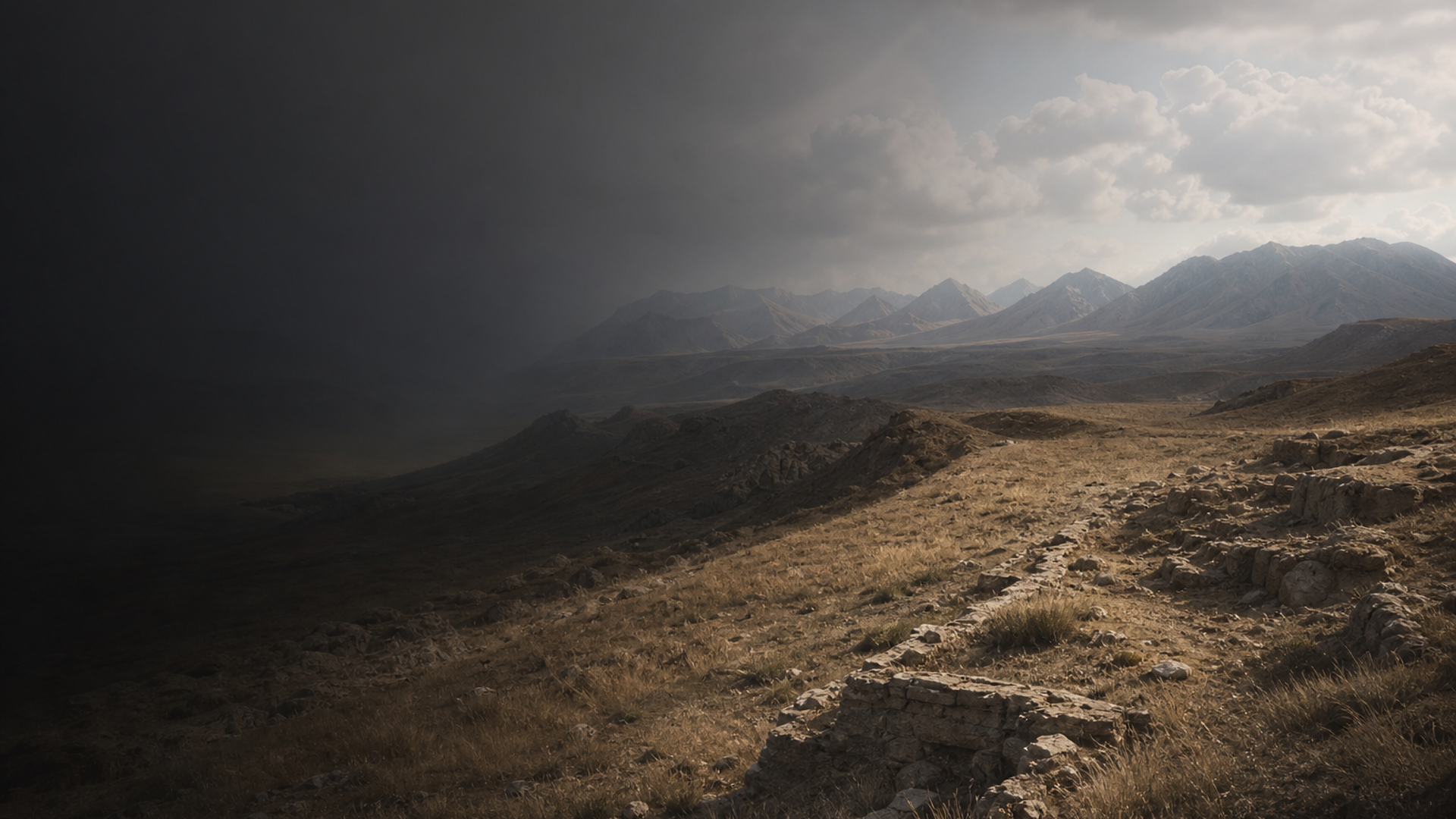
The Jirentaigoukou burials sit on the wide stage of the Yili Basin, a fertile corridor at the northern edge of the Tarim and Dzungarian landscapes. Archaeological data indicates funerary activity at Jirentaigoukou during the late Iron Age (401–106 BCE), a period when mobile pastoralists, oasis farmers and long-distance traders intersected along emergent trans-Eurasian routes.

Limited excavations and surface surveys at Nileke County have revealed grave contexts consistent with small Iron Age cemeteries in northern Xinjiang: articulated human remains, modest grave goods, and burial architecture that speaks of local traditions adapted to a cross-cultural frontier. Material evidence is fragmentary; therefore, reconstructions of cultural origin rely on regional comparisons rather than abundant on-site assemblages.

From a cinematic vantage, these graves are like waystations — quiet testimonies to lives shaped by the Yili’s rivers, seasonal pastures, and connections to distant horizons. Archaeological inference suggests Jirentaigoukou was a point of contact rather than an isolated enclave, but with only three sampled individuals the picture of emergence remains tentative and open to revision as more data appear.

  • Located in Nileke County, Yili Region — a northern Xinjiang corridor
  • Late Iron Age burials dated 401–106 BCE
  • Archaeological evidence suggests a small cemetery in a contact zone
Chapitre IV

Daily Life & Society

Archaeological traces from Iron Age sites across the Yili Basin portray landscapes of mixed lifeways: seasonal pastoralism on surrounding steppes, irrigated plots in river valleys, and craft and exchange concentrated near oasis nodes. At Jirentaigoukou, skeletal preservation and burial treatment hint at communities intimately tied to livestock, mobility, and local agricultural patches, though direct evidence for specific economic practices at this site is limited.

Objects recovered in regional contemporaneous sites — tools, textile fragments, and metal ornaments — suggest artisanship that blended local forms with motifs circulating along early east–west routes. Graves often held belongings that signaled identity, status, or itinerant connections, implying a society where family networks and long-distance ties mattered.

Daily life here would have been tactile and seasonal: mornings filled with herding and mending, afternoons with weaving or metalworking, evenings with storytelling that stitched memories of journeys into household history. Yet we must emphasize the tentative nature of these reconstructions; Jirentaigoukou’s small published assemblage limits confident statements about social organization.

  • Economy likely centered on mixed pastoralism and localized agriculture
  • Material culture shows regional and transregional influences
Chapitre V

Genetic Profile

Three individuals from Jirentaigoukou yielded mitochondrial DNA haplogroups R, H, and U (one individual each). These maternal lineages are widespread across Eurasia: H and U are common in western and northern Eurasia and have been reported in steppe and European contexts, while R is a broader macro-haplogroup with diverse sublineages distributed across Eurasia. The presence of these maternal haplogroups in northern Xinjiang during the Iron Age suggests maternal ancestry components that connect to west Eurasian or steppe-associated lineages, but the evidence is limited.

No consistent Y-chromosome signal is reported for this small set, and genome-wide autosomal data are either unpublished or absent for these individuals. Without autosomal profiles and with only three mtDNA samples, any inference about population admixture, sex-biased migration, or the proportion of western versus eastern ancestry remains preliminary. Archaeological context, however, supports the idea that the region functioned as a crossroads — a mechanism that could generate mixed genetic signatures over generations.

In short, the mtDNA signal hints at Eurasian connectivity but is insufficient alone to map detailed population histories. Additional sampling, genome-wide analysis, and integration with regional datasets are required to move from evocative possibility to robust inference.

  • mtDNA: R, H, U observed (each in one individual; N=3)
  • Y-DNA not reported; conclusions are preliminary due to small sample size
Chapitre VI

Legacy & Modern Connections

Jirentaigoukou’s whisper echoes into modern Xinjiang and the wider Eurasian tapestry. The maternal lineages found among these burials mirror haplogroups still present across Central and West Eurasia, underscoring long-term genetic continuity and movement along northern Silk Road corridors. Archaeological continuity in settlement patterns and trade appears to have facilitated enduring networks of exchange — biological as well as cultural.

However, any direct tie between these three Iron Age individuals and modern populations must be made cautiously. With such limited sampling, we can say only that the site reflects connections consistent with broader Iron Age mobility in Xinjiang. Future, larger-scale ancient DNA studies — especially genome-wide analyses — are essential to trace how these maternal lineages contributed to the genetic landscape of later communities in the region.

  • Ancient maternal lineages mirror broader Eurasian distributions
  • Direct links to modern populations are tentative pending larger datasets
Propulsé par l'IA

Assistant IA

Posez des questions sur la culture Echoes of Jirentaigoukou

Assistant IA par DNAGENICS

Débloquer cette fonction
Posez des questions sur la culture Echoes of Jirentaigoukou. L'assistant IA peut expliquer les résultats génétiques, le contexte historique, les preuves archéologiques et les liens génétiques avec les populations actuelles, dans les limites de l'interprétation.

Exemple d'analyse IA

La culture Echoes of Jirentaigoukou représente un chapitre fascinant de l'histoire humaine…

L'analyse génétique met en évidence des similarités avec des populations antérieures et des signes d'adaptations propres. Les échantillons d'ADN ancien éclairent les schémas migratoires et les liens entre populations, avec des limites qui dépendent de l'étude et du contexte archéologique.

Il s'agit d'un aperçu de l'analyse IA. Accédez à l'assistant complet pour explorer :

  • Composition et similarité génétique
  • Schémas migratoires et origines
  • Vie quotidienne et pratiques culturelles
  • Contexte génétique actuel

Explorez d'autres cultures antiques

Découvrez les récits de civilisations issues du monde antique