Préparation du rapport

Chargement des informations et références disponibles

Connexion au corpus archéologique…

Collecte des archives antiques

Aller au contenu principal
Eleuthera Ceramic Age Echoes
Profil culturel

Eleuthera Ceramic Age Echoes

Island seafarers of Eleuthera (500–1500 CE) revealed through pottery, caves, and DNA

500 CE - 1500 CE
Eleuthera Island, Bahamas
Faites défiler pour commencer
Chapitre I

Le récit

Comprendre la culture Eleuthera Ceramic Age Echoes

A cinematic look at the Ceramic-period communities of Eleuthera Island (500–1500 CE). Archaeology from Preacher's Cave, Garden Cave and Blue Hole paired with 14 DNA samples shows Indigenous American maternal lineages (C, B2) and Y haplogroup Q, offering cautious glimpses of Bahamian ancestry.

Time Period

500–1500 CE

Region

Eleuthera Island, Bahamas

Common Y-DNA

Q (observed)

Common mtDNA

C, B2, C1b, C1d

Chapitre II

Chronologie

Moments clés de l'histoire de cette culture

500 CE

Ceramic tradition appears on Eleuthera

Pottery-bearing communities establish on Eleuthera, reflected in sherds from cave and coastal sites (dating begins c. 500 CE).

1000 CE

Sustained occupation and site use

Archaeological deposits at Preacher's Cave and Garden Cave indicate long-term resource use and episodic habitation.

1492 CE

First European contact impacts the Bahamas

Columbian-era contact initiates demographic and cultural disruptions across the Bahamian islands, altering Indigenous lifeways.

Chapitre III

Origins & Emergence

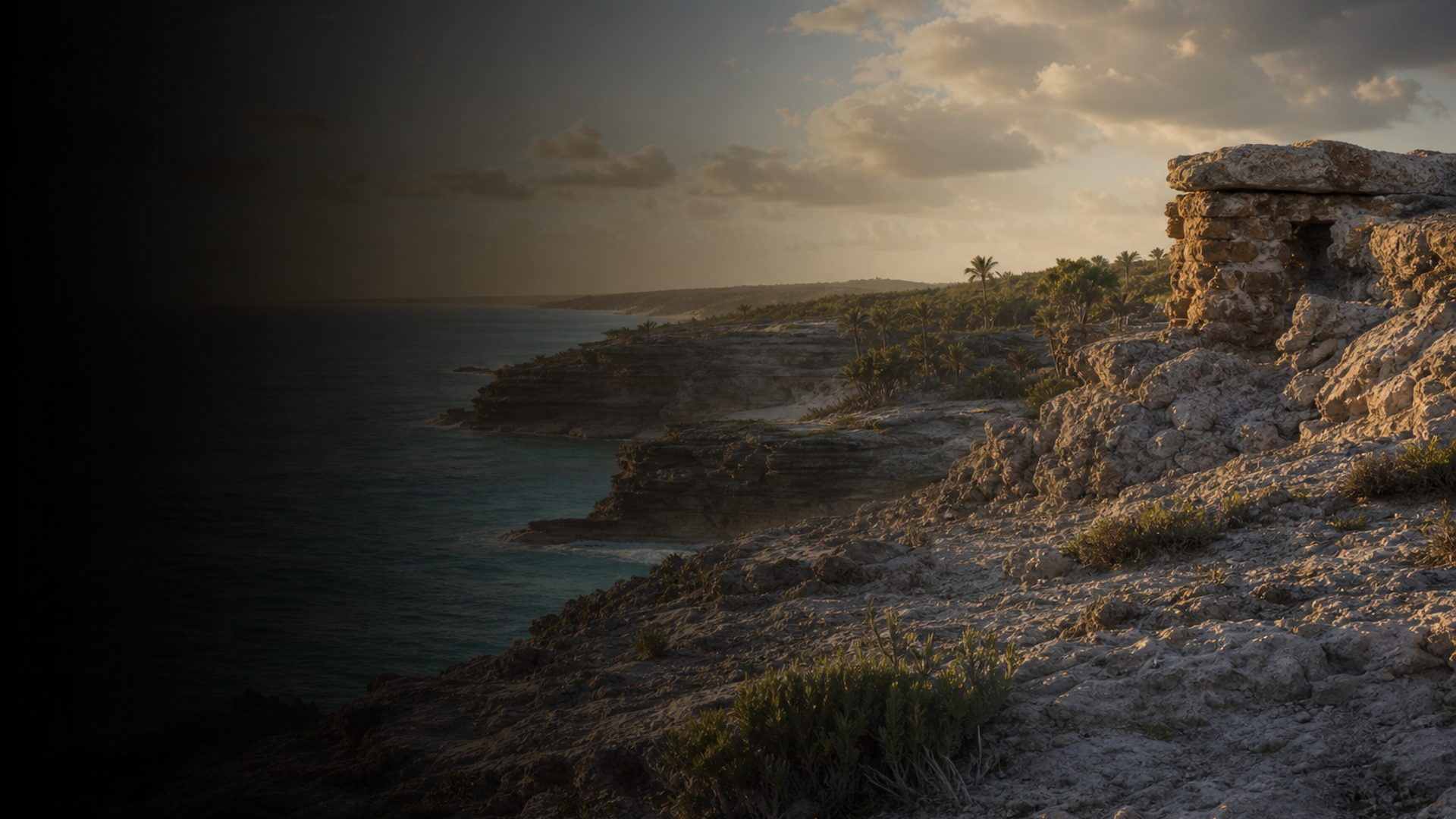
Under a vault of turquoise sky and restless surf, communities of the Ceramic period took root on Eleuthera between roughly 500 and 1500 CE. Archaeological data indicates that pottery-bearing populations—archaeologically connected to broader Ceramic traditions in the Greater Antilles—established seasonal and permanent loci of activity along Eleuthera’s northern shores. Key sites include Preacher's Cave and Garden Cave, and inland features such as Blue Hole sinkholes where midden deposits and charcoal dates anchor a chronology spanning the late first millennium CE into the late pre-contact era.

Material culture—thin-walled grooved pottery, shell tools, bone implements and fishhooks—signals a maritime lifeway adapted to island edges. Limited evidence suggests migration and cultural transmission from larger Greater Antilles islands (for example, Hispaniola and Cuba), though the archaeological signal is complex: local innovations in ceramic styles and site usage appear alongside traits shared across the Caribbean. Radiocarbon dates from cave contexts yield calibrated ranges consistent with occupation and use across several centuries, but preservation biases and limited excavated areas mean our reconstruction remains provisional. Where DNA is available, it provides an independent line of evidence that can corroborate patterns of movement and continuity suggested by artifacts and radiocarbon chronology.

  • Occupation roughly 500–1500 CE, concentrated in northern Eleuthera
  • Primary sites: Preacher's Cave, Garden Cave, Blue Hole
  • Material culture links to broader Greater Antilles Ceramic traditions
Chapitre IV

Daily Life & Society

Life on Eleuthera was shaped by the sea and the island’s porous limestone spine. Archaeological excavations in caves and coastal middens reveal a diet rich in fish, shellfish, and marine reptiles, supplemented by cultivated and gathered starchy plants—archaeobotanical remains are sparse but suggest a mixed subsistence strategy. Pottery vessels and roasting pits imply food processing and communal cooking; shallow shell middens layered against cave walls record long-lived use and episodic occupation.

Caves such as Preacher's Cave show evidence for diverse activities: shelter, storage, and possibly ritual deposition. Tools fashioned from conch, shark teeth and bone speak to fishing-specialized technologies. Social landscapes were likely organized in small, mobile hamlets rather than dense urban centers—archaeological data indicates flexible settlement patterns adapted to changing resource availability and sea-level dynamics. Mortuary behaviors are unevenly preserved; where human remains are found they provide the crucial material for genetic study, but caveats about taphonomy, selective preservation, and small sample sizes must temper broad reconstructions.

  • Maritime diet dominated by fish and shellfish; plant cultivation likely supplemental
  • Caves used for shelter, storage, and repeated episodic activities
Chapitre V

Genetic Profile

Fourteen DNA samples from Eleuthera (sites including Preacher's Cave, Garden Cave, and Blue Hole) offer a modest but informative window into population ancestry. Maternal lineages are dominated by Native American-associated mtDNA: haplogroups C (total 4), B2 (4), C1b (3), and C1d (1). These clades are consistent with post-Pleistocene Indigenous American diversity and align broadly with haplogroups documented across the northern Caribbean and mainland source regions.

On the paternal side, Y-chromosome haplogroup Q is the most observed (3 instances), a lineage commonly associated with Indigenous peoples of the Americas. The presence of Q alongside Indigenous mtDNA haplotypes supports biological continuity with pre-contact Native American populations rather than a later Eurasian paternal input.

Caveats and context: a sample count of 14 is moderate for uniparental inferences but still limited for fine-grained demographic modeling. Genome-wide (autosomal) data would be required to resolve admixture timing, proportions, and relationships to Greater Antilles groups such as the Lucayan and neighboring island communities. Archaeogenetic patterns here corroborate archaeological interpretations of Indigenous origins and maritime lifeways, but many questions—directionality of migration, relative contributions from different source islands, and micro-regional structure—remain open pending larger datasets.

  • 14 samples show mtDNA dominated by C and B2 lineages
  • Y-DNA presence of haplogroup Q consistent with Indigenous American paternal ancestry
Chapitre VI

Legacy & Modern Connections

The genetic and archaeological traces from Eleuthera cast a long, resilient shadow. Though colonial upheavals after 1492 drastically disrupted Indigenous lifeways and demographic continuity across the Bahamas, the mtDNA and Y-DNA signatures recovered on Eleuthera provide empirical anchors for ancestral links between pre-contact islanders and broader Native American populations. These data help restore unique island stories suppressed in historical records.

Modern Bahamian populations are shaped by complex histories of migration, enslavement, and admixture; however, uniparental lineages like those observed on Eleuthera can persist as vestiges of pre-contact ancestry. Archaeology and genetics together enable museums and communities to reconstruct cultural biographies—sites such as Preacher's Cave are not just deposits of pottery and bones but chapters in a living heritage. Continued respectful collaboration with descendant communities and expanded genetic sampling will refine these connections and honor the islanders whose lives are etched into Eleuthera’s caves and shorelines.

  • Provides evidence for Indigenous ancestry continuity in the Bahamas
  • Highlights need for expanded sampling and community collaboration
Propulsé par l'IA

Assistant IA

Posez des questions sur la culture Eleuthera Ceramic Age Echoes

Assistant IA par DNAGENICS

Débloquer cette fonction
Posez des questions sur la culture Eleuthera Ceramic Age Echoes. L'assistant IA peut expliquer les résultats génétiques, le contexte historique, les preuves archéologiques et les liens génétiques avec les populations actuelles, dans les limites de l'interprétation.
Exemple d'analyse IA

La culture Eleuthera Ceramic Age Echoes représente un chapitre fascinant de l'histoire humaine…

L'analyse génétique met en évidence des similarités avec des populations antérieures et des signes d'adaptations propres. Les échantillons d'ADN ancien éclairent les schémas migratoires et les liens entre populations, avec des limites qui dépendent de l'étude et du contexte archéologique.

Il s'agit d'un aperçu de l'analyse IA. Accédez à l'assistant complet pour explorer :

  • Composition et similarité génétique
  • Schémas migratoires et origines
  • Vie quotidienne et pratiques culturelles
  • Contexte génétique actuel

Explorez d'autres cultures antiques

Découvrez les récits de civilisations issues du monde antique