Préparation du rapport

Chargement des informations et références disponibles

Connexion au corpus archéologique…

Collecte des archives antiques

Aller au contenu principal
England Neolithic Echoes
Profil culturel

England Neolithic Echoes

Peoples of early farming England, seen through caves, causeways and ancient genomes

4000 CE - 2400 BCE
United Kingdom (England)
Faites défiler pour commencer
Chapitre I

Le récit

Comprendre la culture England Neolithic Echoes

Archaeological remains from 4000–2400 BCE across England — caves, causewayed enclosures and flint mines — paired with 30 ancient genomes reveal a Neolithic population dominated by haplogroup I Y-lineages and maternal diversity (K, U, J, H). Evidence suggests farmer ancestry with local hunter-gatherer admixture.

Time Period

4000–2400 BCE

Region

United Kingdom (England)

Common Y-DNA

I (predominant), R, CT, I2

Common mtDNA

K, U, J, H (diverse maternal lines)

Chapitre II

Chronologie

Moments clés de l'histoire de cette culture

2500 BCE

Late Neolithic change and incoming influences

Around 2500 BCE communities in England show shifting practices and the earliest archaeological signs of cultural change that precede Bronze Age transformations.

Chapitre III

Origins & Emergence

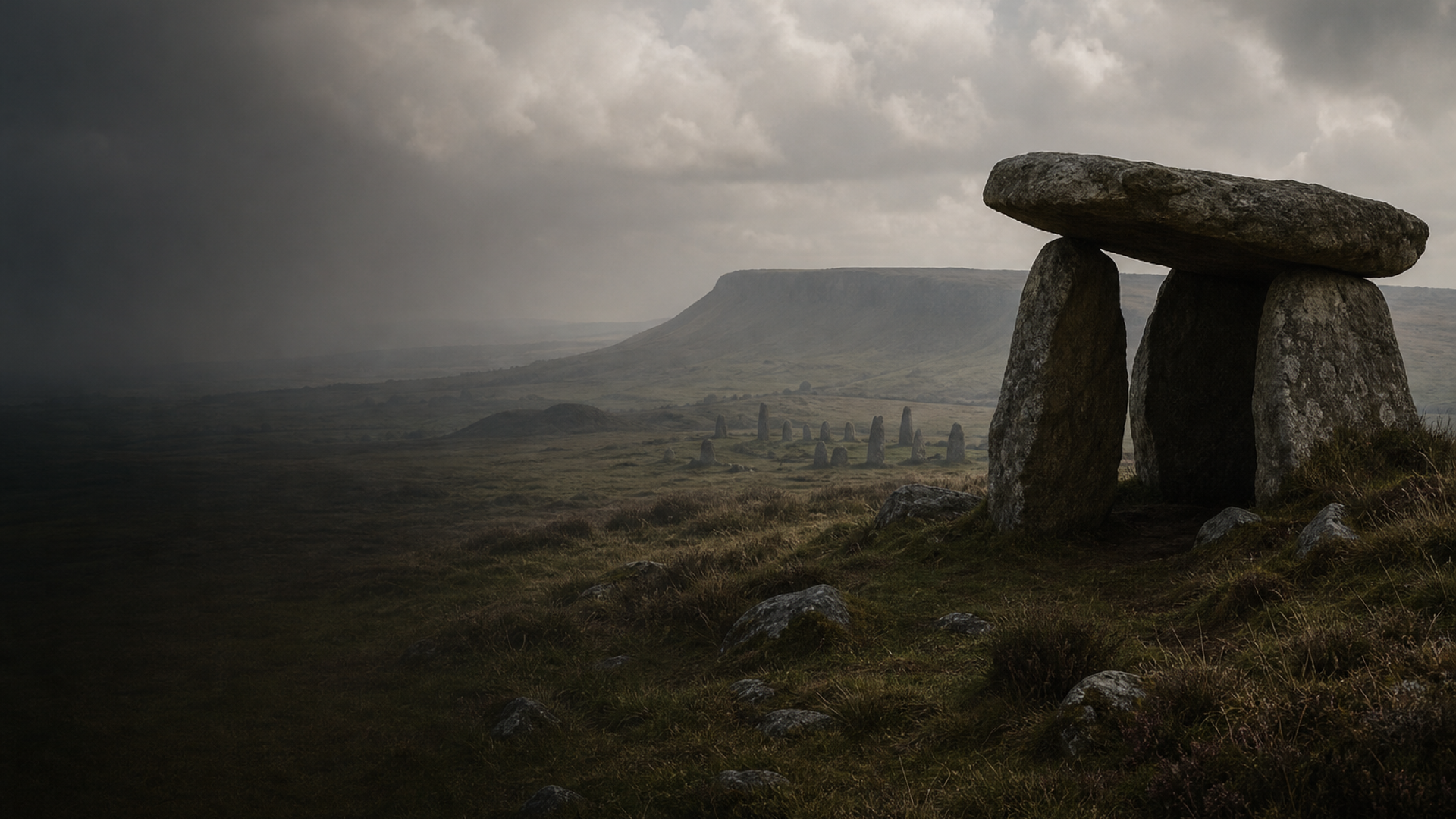
From about 4000 BCE the English landscape changed: fields and enclosures replaced the roaming of Mesolithic hunter-gatherers, and communities left marks in caves, chalk scarp mines and causewayed earthworks. Archaeological data from sites such as Carsington Pasture Cave (Derbyshire), Aveline's Hole in Burrington Combe (Somerset), Whitehawk (Brighton) and Cissbury (Sussex) show ritual deposits, burials and large-scale flint extraction that speak to a new, rooted way of life.

Material culture — polished axes, grooved ware pottery and causewayed enclosures — links these people to continental Neolithic networks that spread farming from Anatolia into Western Europe. Genetic evidence (see Genetics section) supports that these communities carried substantial Anatolian-farmer-related ancestry while also acquiring local western hunter-gatherer (WHG) ancestry through admixture.

Limited evidence suggests regional variation: coastal and southern sites such as Cissbury and Whitehawk show intensive monument building, whereas cave burials in Somerset and North Yorkshire preserve more fragmentary records of ritual and deposition. Archaeological interpretations remain provisional where stratigraphy is complex or radiocarbon coverage is sparse.

  • Farming and monument-building arrive c.4000 BCE
  • Key sites: Carsington Pasture Cave, Aveline's Hole, Whitehawk, Cissbury
  • Continental Neolithic cultural links combined with local adaptation
Chapitre IV

Daily Life & Society

Daily life for England_N communities blended cultivation, animal husbandry and continued use of wild resources. Archaeobotanical and faunal remains from cave and open-air sites indicate cereals, sheep and cattle formed staples, while seasonally gathered wild plants, fish and shellfish supplemented diets. Flint from mines at Cissbury attests to specialized production and long-distance exchange in tool-making materials.

Burial practice varied: Aveline's Hole (Somerset) preserves multiple interments and secondary deposition in a cave context; Whitehawk’s causewayed enclosure includes ritual deposits and potential communal burials; Carsington Pasture Cave contains human remains and domestic debris in a subterranean setting that blurs life and ritual. Social structure likely ranged from small kin groups to broader ritual communities organized around enclosures and mining sites.

Archaeological data indicates craftsmanship in pottery and polished stone, and seasonal mobility patterns tied to pasture and resource exploitation. Interpretations are cautious where preservation is poor or contexts disturbed.

  • Mixed economy: farming complemented by hunting, fishing and gathering
  • Variation in burial and ritual practice between cave and enclosure sites
Chapitre V

Genetic Profile

The dataset of 30 genomes from England (4000–2400 BCE) provides a window into the biological makeup of early farmers in Britain. Y-chromosome calls in this collection are dominated by haplogroup I (17 occurrences), with smaller counts of R (3), CT (2) and I2 (1). These counts derive from the male subset of the sampled individuals; they indicate a strong presence of haplogroup I lineages among Neolithic males in these sites.

Mitochondrial diversity among the sampled individuals is notable for high counts of K (8), U (5), J (3), H (3) and H1c (2). Maternal haplogroup K is common in early European farmers and here suggests continuity of farmer-associated maternal lines in Neolithic England. Archaeogenomic autosomal profiles are consistent with predominant Anatolian-farmer-related ancestry admixed with local western hunter-gatherer ancestry — a pattern seen across Neolithic Britain and matching archaeological expectations of migrated farming communities mixing with resident foragers.

Caveats: some haplogroup counts are small, and the Y- and mtDNA tallies represent subsets of the 30 total genomes. Where counts are fewer than 10 for a lineage (for example many individual R and CT calls), conclusions about their frequency and regional patterning are preliminary. Broader patterns, however, point toward farmer ancestry with regional admixture and later replacement events (post-2400 BCE) that altered the genetic landscape.

  • Dataset (n=30) shows predominant Anatolian-farmer autosomal ancestry with WHG admixture
  • Y-DNA dominated by I; mtDNA enriched for farmer-linked K and diverse maternal lines
Chapitre VI

Legacy & Modern Connections

The archaeological monuments and genomic echoes of England_N endure in the British Isles’ deep history. Material legacies — causewayed enclosures, flint mines and cave burials — shaped later ritual landscapes and provide anchors for reconstructing social life. Genetically, some maternal lineages associated with these Neolithic farmers (notably mtDNA K and U) persist in modern populations, indicating partial maternal continuity.

However, later events — particularly the arrival of Beaker-associated groups and Bronze Age transformations after c.2500–2000 BCE — substantially reshaped paternal lineages in Britain, increasing Steppe-related ancestry and altering Y-haplogroup frequencies. Thus, while England_N contributes a clear chapter to Britain’s ancestry, it is one part of a longer, multi-layered story. Ongoing sampling across more sites and higher-resolution genomes will refine how much of this Neolithic legacy survives locally versus being overwritten by later migrations.

  • Material culture influenced later ceremonial landscapes and monument traditions
  • Genetic continuity exists maternally, but later Bronze Age migrations reshaped paternal ancestry
Propulsé par l'IA

Assistant IA

Posez des questions sur la culture England Neolithic Echoes

Assistant IA par DNAGENICS

Débloquer cette fonction
Posez des questions sur la culture England Neolithic Echoes. L'assistant IA peut expliquer les résultats génétiques, le contexte historique, les preuves archéologiques et les liens génétiques avec les populations actuelles, dans les limites de l'interprétation.
Exemple d'analyse IA

La culture England Neolithic Echoes représente un chapitre fascinant de l'histoire humaine…

L'analyse génétique met en évidence des similarités avec des populations antérieures et des signes d'adaptations propres. Les échantillons d'ADN ancien éclairent les schémas migratoires et les liens entre populations, avec des limites qui dépendent de l'étude et du contexte archéologique.

Il s'agit d'un aperçu de l'analyse IA. Accédez à l'assistant complet pour explorer :

  • Composition et similarité génétique
  • Schémas migratoires et origines
  • Vie quotidienne et pratiques culturelles
  • Contexte génétique actuel

Explorez d'autres cultures antiques

Découvrez les récits de civilisations issues du monde antique