Préparation du rapport

Chargement des informations et références disponibles

Connexion au corpus archéologique…

Collecte des archives antiques

Aller au contenu principal
Goyet Aurignacian Dawn
Profil culturel

Goyet Aurignacian Dawn

Early Upper Paleolithic occupants of Goyet Cave, 35.2–34.5k BCE — a fragile genetic window

35170 CE - 34519 BCE
Wallonia, Belgium (Goyet Cave)
Faites défiler pour commencer
Chapitre I

Le récit

Comprendre la culture Goyet Aurignacian Dawn

Archaeological remains from Goyet Cave (Belgium) capture an Aurignacian presence ~35.2–34.5k BCE. One sequenced individual links material culture to early European modern humans; conclusions remain preliminary due to a single sample.

Time Period

35170–34519 BCE

Region

Wallonia, Belgium (Goyet Cave)

Common Y-DNA

Not reported — insufficient data (1 sample)

Common mtDNA

Not reported — insufficient data (1 sample)

Chapitre II

Chronologie

Moments clés de l'histoire de cette culture

35000 BCE

Aurignacian occupation of Goyet Cave

Goyet's Troisième caverne records Aurignacian activity — toolmaking, hunting debris, and symbolic objects — dated to ~35.2–34.5k BCE.

Chapitre III

Origins & Emergence

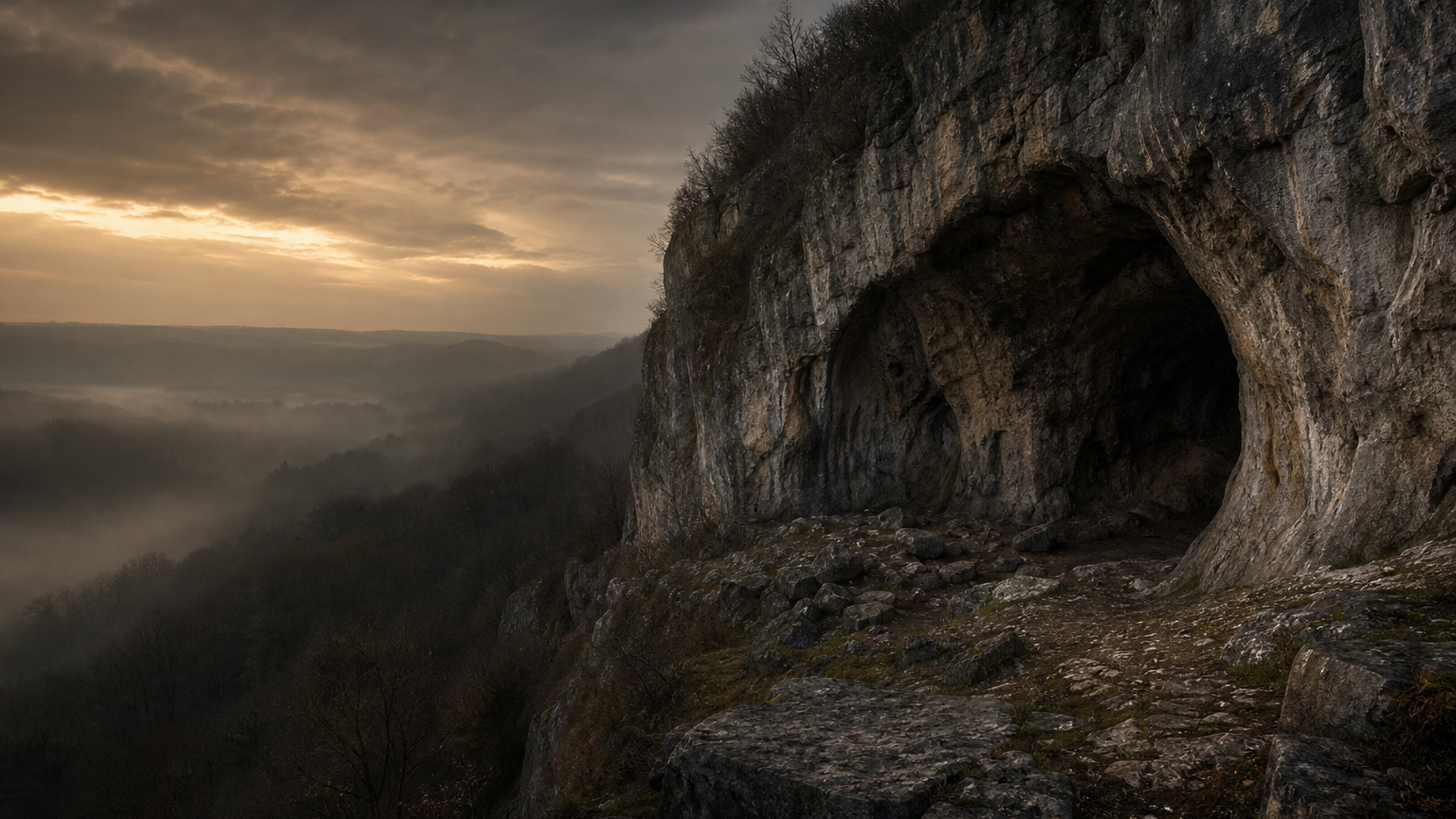
Beneath the limestone roof of Goyet Cave (Troisième caverne, Gesves municipality, Namur province) lie horizons of the Aurignacian: a cultural horizon associated with some of the earliest indisputable modern human occupations of northwestern Europe. Dated by direct and contextual methods to roughly 35,170–34,519 BCE, the deposits record a cold, fluctuating landscape of open tundra and patchy woodland on the margins of glacial advances. Archaeological data indicates toolkits dominated by blade-based lithics, bone and antler work, and occasional personal ornaments — signatures of a mobile population with complex symbolic practices.

The term "Aurignacian" groups a range of related technocomplexes rather than a single people. At Goyet, stratigraphy and artifact associations suggest repeated seasonal occupations: camps where hunting, tool manufacture, and symbolic production intersected. Limited evidence suggests that these groups were part of broader networks that stretched across western and central Europe during the early Upper Paleolithic, carrying innovations in technology and symbolic life that help mark the expansion of anatomically modern humans into higher latitudes.

Cave contexts preserve a palimpsest of human activity, faunal remains, and hearths. Archaeological interpretation emphasizes mobility, adaptability to cold climates, and the emergence of social behaviours visible in curated tools and ornaments. However, gaps in preservation and later disturbance mean many details remain provisional.

  • Aurignacian horizons in Goyet dated ~35.2–34.5k BCE
  • Blade-centric lithics, bone work, and symbolic objects indicate complex behavior
  • Evidence points to seasonal mobility and regional connections
Chapitre IV

Daily Life & Society

Imagine a winter light slanting into the cave mouth while a small group repairs blades, fashions a bone point, and tends a hearth. The archaeological record at Goyet preserves fragments of that daily choreography: concentrations of lithic waste from on-site knapping, fragmented faunal bones bearing butchery marks, and isolated worked bone fragments that may have served tools or ornaments. These traces speak less of static villages than of highly mobile bands whose lifeways were organized around hunting herds, seasonal resource patches, and intimate social networks.

Faunal assemblages from Aurignacian layers show exploitation of cold-adapted species, and seasonality studies (where available) suggest repeated returns to favored shelter spots. The presence of curated tools and personal items hints at long-term planning, repair economies, and social signaling through material culture. Spatial patterns within the cave point to differentiated activity areas — knapping floors, food processing loci, and hearth-centered social spaces — though post-depositional mixing complicates fine-grained reconstructions.

Archaeological data indicates that symbolic behavior—beads, pigments, and worked bone—was part of daily life, suggesting rich interpersonal and perhaps ritual practices. Yet, because preservation is uneven and sample counts low, many reconstructions remain interpretive and subject to refinement as new analyses appear.

  • Knapping debris and tool repair indicate on-site manufacture and curation
  • Faunal remains and butchery traces point to cold-adapted hunting strategies
Chapitre V

Genetic Profile

The genetic window provided by the Belgium_Aurignacian identifier hinges on a single sequenced individual from Goyet Cave dated to 35.17–34.52k BCE. Ancient DNA retrieved from such Pleistocene contexts is often fragmentary; while it can reveal broad affinities, the statistical power of population-level inferences is limited when sample counts are low. Archaeogenetic analyses therefore treat this individual as a preliminary data point rather than a definitive population portrait.

Genetic data from comparable early Upper Paleolithic individuals across Europe typically show affiliation with the expanding populations of anatomically modern humans who replaced or absorbed earlier groups. At Goyet, the available genome-scale data (single sample) can be used to assess broad-scale ancestry components, shared drift with other Upper Paleolithic Europeans, and mitochondrial or Y-chromosome markers when preservation permits. However, because no common haplogroups are reported for this dataset and the sample count is one, any statements about prevalent Y-DNA or mtDNA lineages in the regional Aurignacian must be framed as provisional.

In short: the lone Goyet individual provides a cinematic glimpse into the genetics of an early modern human in northwestern Europe, but robust conclusions about population structure, migration corridors, or lineage frequencies await larger sample sizes and higher-coverage genomes.

  • One sequenced individual — useful for broad affinities but not population-level claims
  • No common Y- or mtDNA haplogroups reported; conclusions are preliminary
Chapitre VI

Legacy & Modern Connections

Goyet's Aurignacian occupants are ancestors in the broadest sense: part of the tapestry of early modern humans who peopled Ice Age Europe and carried cultural innovations that shaped later behaviors. Archaeological legacies include blade technologies, bone tool traditions, and symbolic practices that echo through subsequent Upper Paleolithic cultures.

From a genetic perspective, the Goyet individual contributes to the long-term project of mapping how early Europeans were related to one another and to later populations. Limited evidence suggests continuity of some ancestry components across the Upper Paleolithic, but regional turnover and demographic shifts are also documented in other studies. For the public and descendent communities, Goyet offers a tangible connection to deep human time — a reminder that modern genetic diversity rests on many small, ancient stories, each preserved unevenly in stone and bone. Continued excavation and increased ancient DNA sampling are necessary to transform this single genetic window into a panoramic view of Aurignacian Belgium.

  • Material culture contributed to broader Upper Paleolithic traditions
  • Single genetic sample hints at links to early European modern humans but larger datasets are needed
Propulsé par l'IA

Assistant IA

Posez des questions sur la culture Goyet Aurignacian Dawn

Assistant IA par DNAGENICS

Débloquer cette fonction
Posez des questions sur la culture Goyet Aurignacian Dawn. L'assistant IA peut expliquer les résultats génétiques, le contexte historique, les preuves archéologiques et les liens génétiques avec les populations actuelles, dans les limites de l'interprétation.
Exemple d'analyse IA

La culture Goyet Aurignacian Dawn représente un chapitre fascinant de l'histoire humaine…

L'analyse génétique met en évidence des similarités avec des populations antérieures et des signes d'adaptations propres. Les échantillons d'ADN ancien éclairent les schémas migratoires et les liens entre populations, avec des limites qui dépendent de l'étude et du contexte archéologique.

Il s'agit d'un aperçu de l'analyse IA. Accédez à l'assistant complet pour explorer :

  • Composition et similarité génétique
  • Schémas migratoires et origines
  • Vie quotidienne et pratiques culturelles
  • Contexte génétique actuel

Explorez d'autres cultures antiques

Découvrez les récits de civilisations issues du monde antique