Préparation du rapport

Chargement des informations et références disponibles

Connexion au corpus archéologique…

Collecte des archives antiques

Aller au contenu principal
Huatuyan Cave: Ming-era Lives in Guangxi
Profil culturel

Huatuyan Cave: Ming-era Lives in Guangxi

Small cave community in Hechi County (1400–1700 CE) connecting archaeology with maternal lineages

1400 CE - 1700 CE
Guangxi, Southern China (Hechi, Nandan County)
Faites défiler pour commencer
Chapitre I

Le récit

Comprendre la culture Huatuyan Cave: Ming-era Lives in Guangxi

Archaeological and ancient DNA data from Huatuyan Cave (Nandan, Guangxi) illuminate a small Ming-period community. Limited samples (n=8) show diverse maternal haplogroups typical of southern China. Evidence is preliminary but suggests local continuity with southern coastal and inland populations.

Time Period

1400–1700 CE (Ming era)

Region

Guangxi, Southern China (Hechi, Nandan County)

Common Y-DNA

Not reported / insufficient Y-chromosome data

Common mtDNA

D (2), F (1), N (1), M (1), R (1)

Chapitre II

Chronologie

Moments clés de l'histoire de cette culture

1400 CE

Ming-period occupation begins (approx.)

Archaeological and radiocarbon indicators place human activity at Huatuyan Cave beginning around the early 1400s CE, within the Ming dynasty context.

Chapitre III

Origins & Emergence

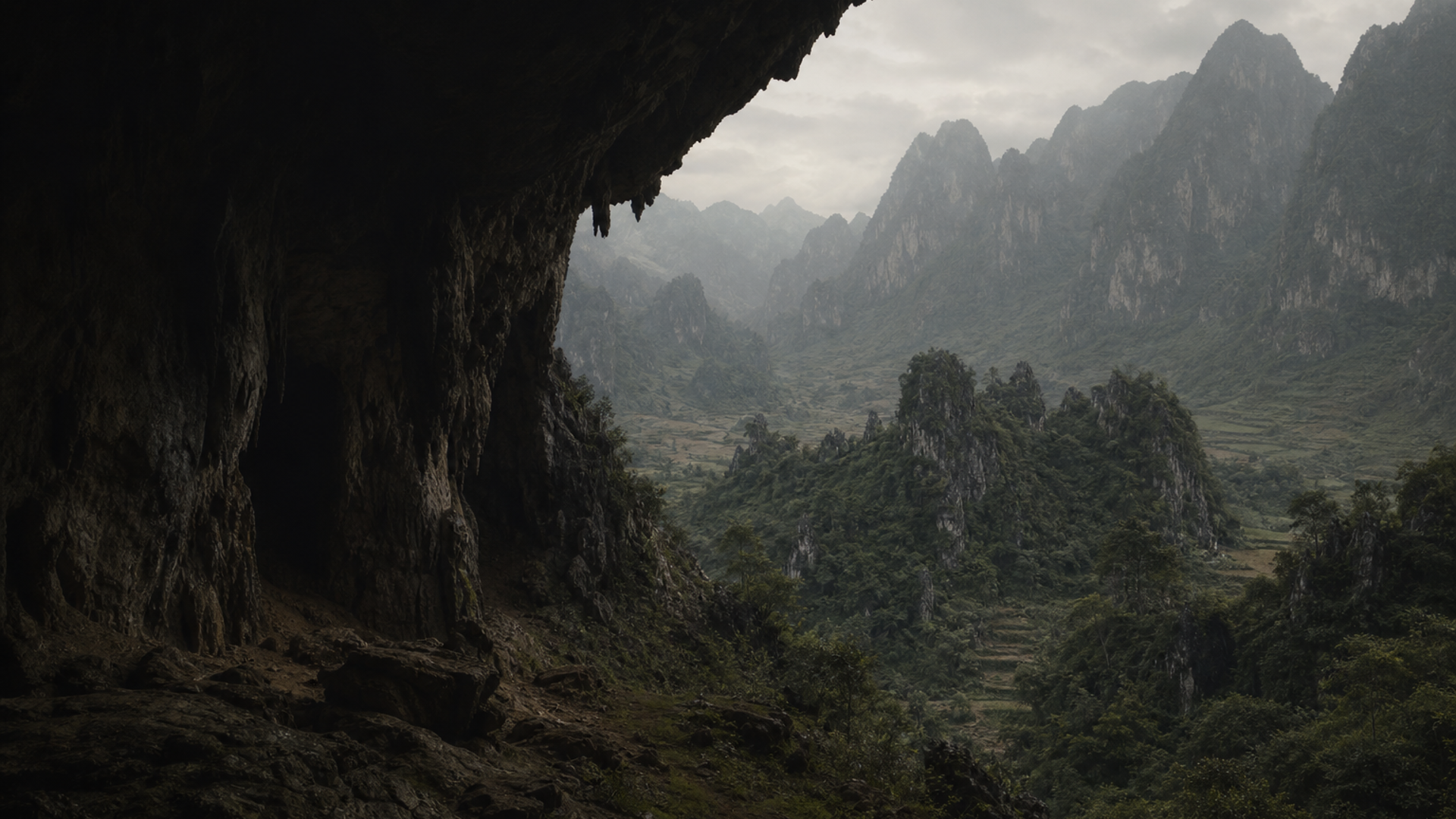
Huatuyan Cave sits on a limestone outcrop overlooking the valleys of Lihu Yaozu Town, Huatu Village in Nandan County (Hechi City, Guangxi). Archaeological data indicates episodic use of the cave across the late medieval period, concentrated within the Ming dynasty centuries (roughly 1400–1700 CE). Excavations yielded discrete hearth features, small assemblages of ceramic fragments and faunal remains, and human skeletal material in disturbed depositional contexts consistent with a small, possibly seasonally occupied settlement or communal burial area.

The cinematic layers of soot-stained walls and broken sherds speak to everyday continuity rather than elite construction—people living at the forest's edge, adapting to a karst landscape. Limited evidence suggests links with broader Ming-era material culture in southern China, but local practices likely persisted, creating a hybrid of regional traditions and household-level adaptations. Spatially, the site is one among many small cave and rock-shelter occupations documented in Guangxi, reflecting a pattern of localized habitation rather than a major population center.

Archaeological interpretation remains cautious: stratigraphic disturbance, small assemblage size, and sparse contextual information limit firm conclusions about chronology and social organization. The story that emerges is provisional—a fragmentary portrait of a small Ming-era community embedded in Guangxi's rugged landscape.

  • Site: Huatuyan Cave, Huatu Village, Lihu Yaozu Town, Nandan County, Hechi City
  • Date range: 1400–1700 CE, within the Ming dynasty period
  • Occupation scale: small cave occupation or community use; evidence is limited and locally focused
Chapitre IV

Daily Life & Society

Archaeological traces at Huatuyan evoke intimate, everyday scenes: small hearths offering warmth and the routine of cooking; ceramic fragments hinting at pots used for stews and grain processing; and faunal bone fragments that suggest hunting, trapping, or small-scale animal husbandry. The cave's sheltered position would have offered protection from seasonal rains and a vantage over terraced fields and forest resources below.

Social organization likely revolved around kin networks and household groups rather than centralized authority. Material culture recovered is modest, suggesting a community making pragmatic use of locally available resources. The archaeological record does not preserve clear indicators of elaborate ritual paraphernalia, though funerary deposits and skeletal remains point to established mortuary practices in the locale. Ethnographic parallels in southern China underline how households in marginal landscapes blended agriculture, foraging, and craft production—patterns that could plausibly reflect life at Huatuyan, but direct parallels should be drawn cautiously given limited data.

  • Economy: mixed subsistence — local agriculture, forest resources, small hunting
  • Social scale: household/kin-based community; no evidence for elite settlement at site
Chapitre V

Genetic Profile

Ancient DNA analysis from Huatuyan Cave includes eight sampled individuals dated to the 1400–1700 CE range. This is a small dataset: because the sample count is under 10, conclusions must be regarded as preliminary. Maternal lineages (mtDNA) were resolved for several individuals and show haplogroups commonly associated with East and Southeast Asia: D (2 individuals), F (1), N (1), M (1), and R (1). These maternal haplogroups are widely distributed in southern China and parts of mainland Southeast Asia and are consistent with continuity of regional maternal ancestry during the late medieval period.

Y-chromosome (paternal) haplogroup information is not reported or was insufficiently preserved for confident assignment in the available samples, limiting insights into paternal lineages and patrilineal structure. Some samples exhibited low coverage or degraded DNA, which explains why not all eight individuals yielded full mitochondrial or nuclear profiles.

Genetic affinities inferred from available genomic markers tentatively suggest alignment with contemporary and ancient southern Chinese populations rather than large-scale influx from distant regions during the sampled interval. However, low sample counts, potential kinship among sampled individuals, and limited geographic scope mean that these genetic patterns should be treated as a preliminary window into local population history rather than definitive evidence of population continuity or migration.

  • Sample count: 8 individuals — small dataset; interpretations are preliminary
  • mtDNA diversity: D (2), F (1), N (1), M (1), R (1); Y-DNA data insufficient or not reported
Chapitre VI

Legacy & Modern Connections

Huatuyan Cave's genetic and archaeological traces offer a fragile but evocative thread connecting the Ming-era people of Guangxi to the present-day genetic landscape of southern China. The maternal lineages observed are consistent with haplogroups still common in Guangxi and neighboring provinces, hinting at long-term regional continuity in maternal ancestry. At the same time, the diversity of mtDNA types within a small assemblage underscores the complex social networks—marriage patterns, mobility, and local assimilation—that shaped population structure in late medieval times.

Archaeology and aDNA together emphasize nuance: continuity in some genetic lineages does not preclude cultural change, and small-scale communities like those at Huatuyan played a role in the broader mosaic of Ming-era society. Future work with larger sample sizes, better-preserved Y-chromosome data, and comparative regional sampling will refine these connections and test hypotheses about demographic change, migration, and kinship in southern China.

  • mtDNA affinities suggest potential continuity with modern southern Chinese populations
  • Further sampling and better Y-chromosome data are needed to clarify paternal lineages and migration
Propulsé par l'IA

Assistant IA

Posez des questions sur la culture Huatuyan Cave: Ming-era Lives in Guangxi

Assistant IA par DNAGENICS

Débloquer cette fonction
Posez des questions sur la culture Huatuyan Cave: Ming-era Lives in Guangxi. L'assistant IA peut expliquer les résultats génétiques, le contexte historique, les preuves archéologiques et les liens génétiques avec les populations actuelles, dans les limites de l'interprétation.
Exemple d'analyse IA

La culture Huatuyan Cave: Ming-era Lives in Guangxi représente un chapitre fascinant de l'histoire humaine…

L'analyse génétique met en évidence des similarités avec des populations antérieures et des signes d'adaptations propres. Les échantillons d'ADN ancien éclairent les schémas migratoires et les liens entre populations, avec des limites qui dépendent de l'étude et du contexte archéologique.

Il s'agit d'un aperçu de l'analyse IA. Accédez à l'assistant complet pour explorer :

  • Composition et similarité génétique
  • Schémas migratoires et origines
  • Vie quotidienne et pratiques culturelles
  • Contexte génétique actuel

Explorez d'autres cultures antiques

Découvrez les récits de civilisations issues du monde antique