Préparation du rapport

Chargement des informations et références disponibles

Connexion au corpus archéologique…

Collecte des archives antiques

Aller au contenu principal
Jierzankale Iron Age Voices
Profil culturel

Jierzankale Iron Age Voices

Burials on the Pamir fringe that reveal a tapestry of eastern and western ancestries

800 BCE - 1 BCE
Xinjiang (Kashgar / Taxkorgan, Jierzankale)
Faites défiler pour commencer
Chapitre I

Le récit

Comprendre la culture Jierzankale Iron Age Voices

Ancient DNA from 13 individuals (800–1 BCE) at Jierzankale, Taxkorgan, Xinjiang reveals a mixed genetic signature — Y-lineage Q and diverse maternal haplogroups — reflecting Iron Age contacts on the high Silk Road margins.

Time Period

800 BCE – 1 BCE

Region

Xinjiang (Kashgar / Taxkorgan, Jierzankale)

Common Y-DNA

Q (noted; 6/13)

Common mtDNA

C (3), H (2), U (2), A+ (2), D (2)

Chapitre II

Chronologie

Moments clés de l'histoire de cette culture

800 BCE

Formation of Jierzankale burial landscape

Construction of funerary clusters on the Pamir approaches, marking local Iron Age mortuary practices and increased mobility.

400 BCE

Peak period of interregional exchange

Archaeological and genetic signals suggest intensified contacts linking steppe, Central Asian, and highland communities.

2000 CE

Modern excavation and DNA sampling

Archaeological fieldwork and ancient DNA analyses provide the first focused genetic snapshot from Jierzankale.

Chapitre III

Origins & Emergence

A frontier of movement and mixture

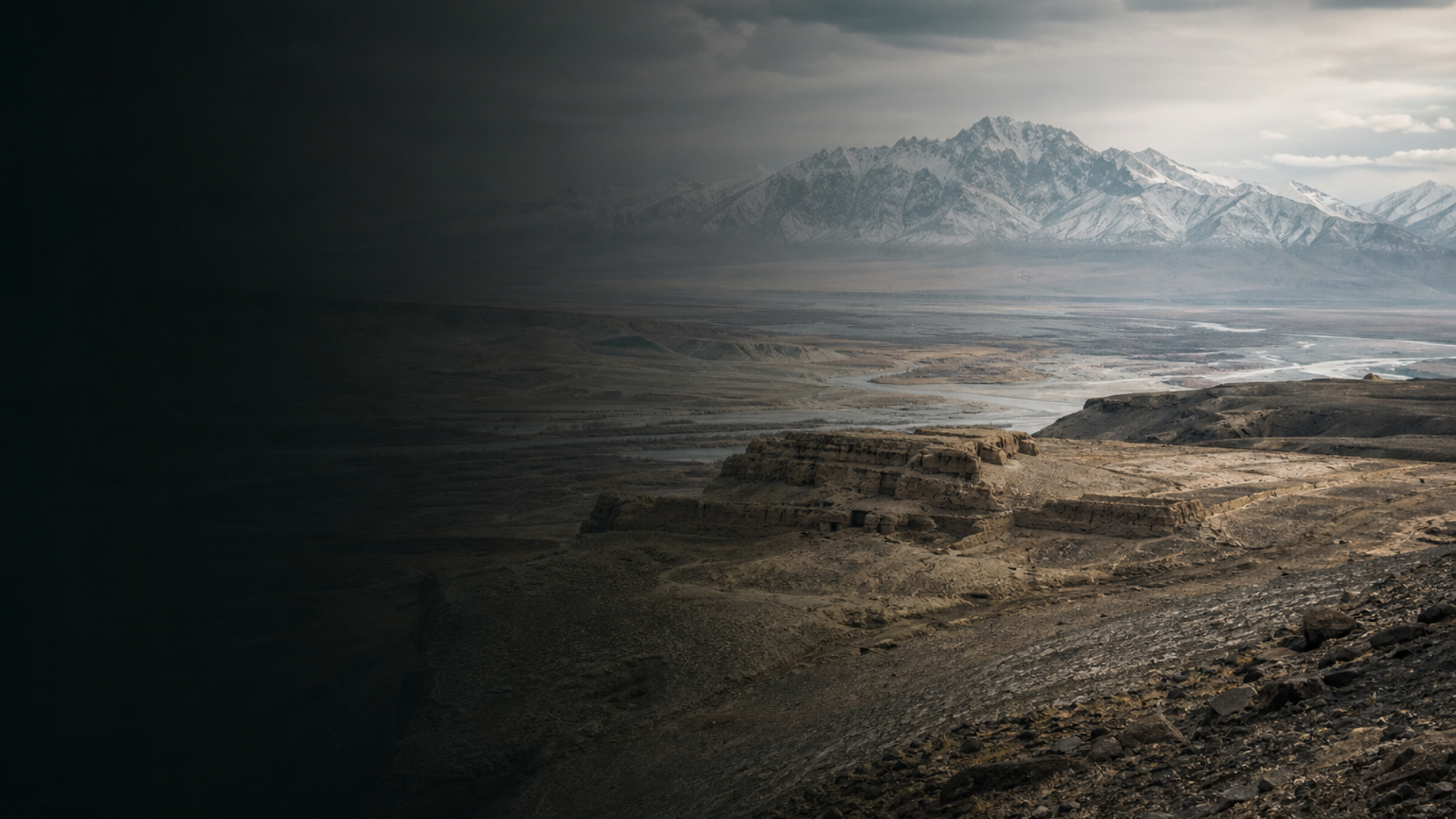
Perched on the high approaches to the Pamir and Karakoram ranges, the Jierzankale funerary complex (Jirzankal, Taxkorgan County, Kashgar Region) dates from roughly 800–1 BCE. Archaeological data indicate a funerary landscape of stone tombs and surface burials concentrated on the plateau rim, an environment that funneled people, goods and ideas between the Inner Asian steppe and the southern passes.

Limited evidence suggests these communities developed in an era of intensified mobility across Eurasia: pastoral networks, hybrid craft traditions, and nascent Silk Road corridors. The material record at nearby Iron Age sites in Xinjiang shows affinities with both eastern steppe nomadic practices and western Central Asian motifs, suggesting Jierzankale formed where cultural currents converged.

Because excavation and sampling remain geographically focused, interpretations are regional snapshots rather than broad generalizations. The archaeological picture is coherent with a community shaped by long-distance exchange, seasonal pastoralism and dynastic pressures radiating from adjacent lowland polities.

  • High-altitude funerary clusters on the Pamir fringe
  • Cultural influences from steppe and western Central Asia
  • Site formation tied to mobility and long-distance exchange
  • High-altitude funerary clusters on Pamir approaches
  • Mixture of steppe and western Central Asian cultural traits
  • Site reflects mobility and long-distance exchange
Chapitre IV

Daily Life & Society

Life at the margins: pastoral rhythms and caravan echoes

Archaeological indicators point to a society organized around pastoralism with strong seasonal rhythms. The landscape around Jierzankale supports transhumant herding—sheep, goats and perhaps horses—on summer pastures, with winter movements to lower valleys. Grave goods in the region commonly include items associated with riding, textile fragments and portable metalwork, which together suggest a mobile material culture adapted to life on the move.

Socially, funerary variability hints at differences in status or role: some burials are richer in artifacts or more prominent on the landscape. The presence of goods with both eastern (steppe-style) and western (Central Asian) affinities implies that household and community identities were negotiated through exchange, alliance, and perhaps intermarriage across cultural boundaries.

The archaeological record also shows practical ingenuity: compact domestic assemblages, repair of gear for mobility, and the reuse of architectural stone imply communities tuned to resource constraints in a highland environment.

  • Economy based on pastoralism with seasonal transhumance
  • Material culture displaying both mobile steppe traits and western motifs
  • Pastoral, transhumant economy
  • Burial variability suggests social differentiation
Chapitre V

Genetic Profile

DNA speaks of east–west connections

Ancient DNA from 13 individuals dated to 800–1 BCE at Jierzankale provides a focused genetic window onto Iron Age population dynamics on the Pamir margins. Y-chromosome lineages are dominated by haplogroup Q (6 of 13 males), a lineage that has deep roots in northern Eurasia and is observed across Siberia and parts of Central Asia. Maternal lineages are diverse: haplogroups C (3), A+ (2), and D (2) are commonly associated with East Eurasian ancestries, while H (2) and U (2) are typically linked to West Eurasian lineages. This mixture indicates local admixture between eastern and western Eurasian gene pools.

Archaeogenetic modeling suggests these individuals do not represent a homogeneous population: instead, they appear as a mosaic, consistent with archaeological evidence for mobility and interregional exchange. The presence of both East Eurasian and West Eurasian maternal lineages alongside Y-Q implies sex-biased or complex patterns of contact — for example, male-mediated movements from northern steppe groups combined with local or incoming female lineages from multiple directions.

Caveats: while 13 samples offer valuable insight, they represent a regional snapshot. Broader sampling across time and sites is required to test whether these patterns reflect long-term demographics or shorter-term episodes of movement and admixture.

  • Dominant Y lineage: Q (6/13)
  • Maternal diversity: C, A+, D (East Eurasian) and H, U (West Eurasian)
  • Mixed east–west ancestry consistent with archaeological mobility
  • Dominant Y haplogroup Q (6/13)
  • Maternal lineages show East and West Eurasian admixture
Chapitre VI

Legacy & Modern Connections

Threads into the present

The genetic and archaeological signals from Jierzankale illuminate how the high corridors of Xinjiang were a locus for mingling ancestries long before the classical Silk Road floresced. Modern populations of the Pamir and greater Xinjiang region carry variable proportions of East and West Eurasian ancestry; the Jierzankale profile provides a plausible ancestral component to this mosaic, especially in highland communities.

However, direct lines of descent are difficult to prove: centuries of migration, empire-building and cultural change have reshaped gene pools. The Jierzankale samples are best understood as snapshots of Iron Age mixture processes that contributed to, but did not alone determine, later population histories.

  • Offers an Iron Age genetic source for regional admixture patterns
  • Demonstrates long-standing east–west connectivity on the Pamir fringe

  • Contributes to the ancestral mosaic of Xinjiang/Pamir populations
  • Illustrates long-standing east–west connectivity
Propulsé par l'IA

Assistant IA

Posez des questions sur la culture Jierzankale Iron Age Voices

Assistant IA par DNAGENICS

Débloquer cette fonction
Posez des questions sur la culture Jierzankale Iron Age Voices. L'assistant IA peut expliquer les résultats génétiques, le contexte historique, les preuves archéologiques et les liens génétiques avec les populations actuelles, dans les limites de l'interprétation.
Exemple d'analyse IA

La culture Jierzankale Iron Age Voices représente un chapitre fascinant de l'histoire humaine…

L'analyse génétique met en évidence des similarités avec des populations antérieures et des signes d'adaptations propres. Les échantillons d'ADN ancien éclairent les schémas migratoires et les liens entre populations, avec des limites qui dépendent de l'étude et du contexte archéologique.

Il s'agit d'un aperçu de l'analyse IA. Accédez à l'assistant complet pour explorer :

  • Composition et similarité génétique
  • Schémas migratoires et origines
  • Vie quotidienne et pratiques culturelles
  • Contexte génétique actuel

Explorez d'autres cultures antiques

Découvrez les récits de civilisations issues du monde antique