Préparation du rapport

Chargement des informations et références disponibles

Connexion au corpus archéologique…

Collecte des archives antiques

Aller au contenu principal
Kalehöyük: Assyrian Colony Echoes
Profil culturel

Kalehöyük: Assyrian Colony Echoes

Three Bronze Age genomes hint at maternal connections across Anatolia and the Assyrian trade network

2000 CE - 1750 BCE
Kalehöyük, Central Anatolia (Turkey)
Faites défiler pour commencer
Chapitre I

Le récit

Comprendre la culture Kalehöyük: Assyrian Colony Echoes

Archaeological data from Kalehöyük (Turkey) dated 2000–1750 BCE, combined with three ancient mitochondrial genomes, suggest mixed West Eurasian maternal lineages within the Assyrian Colony Period horizon. Limited samples make conclusions preliminary, but links to Anatolian–Mesopotamian exchange are evident.

Time Period

2000–1750 BCE

Region

Kalehöyük, Central Anatolia (Turkey)

Common Y-DNA

Undetermined (no consistent Y-haplogroup from 3 samples)

Common mtDNA

J (1), U1a (1), H (1)

Chapitre II

Chronologie

Moments clés de l'histoire de cette culture

2000 BCE

Assyrian trade networks active in central Anatolia

Archaeological horizons at Kalehöyük align with Assyrian Colony Period commerce linking Anatolia and Mesopotamia, marked by imported goods and new economic ties.

Chapitre III

Origins & Emergence

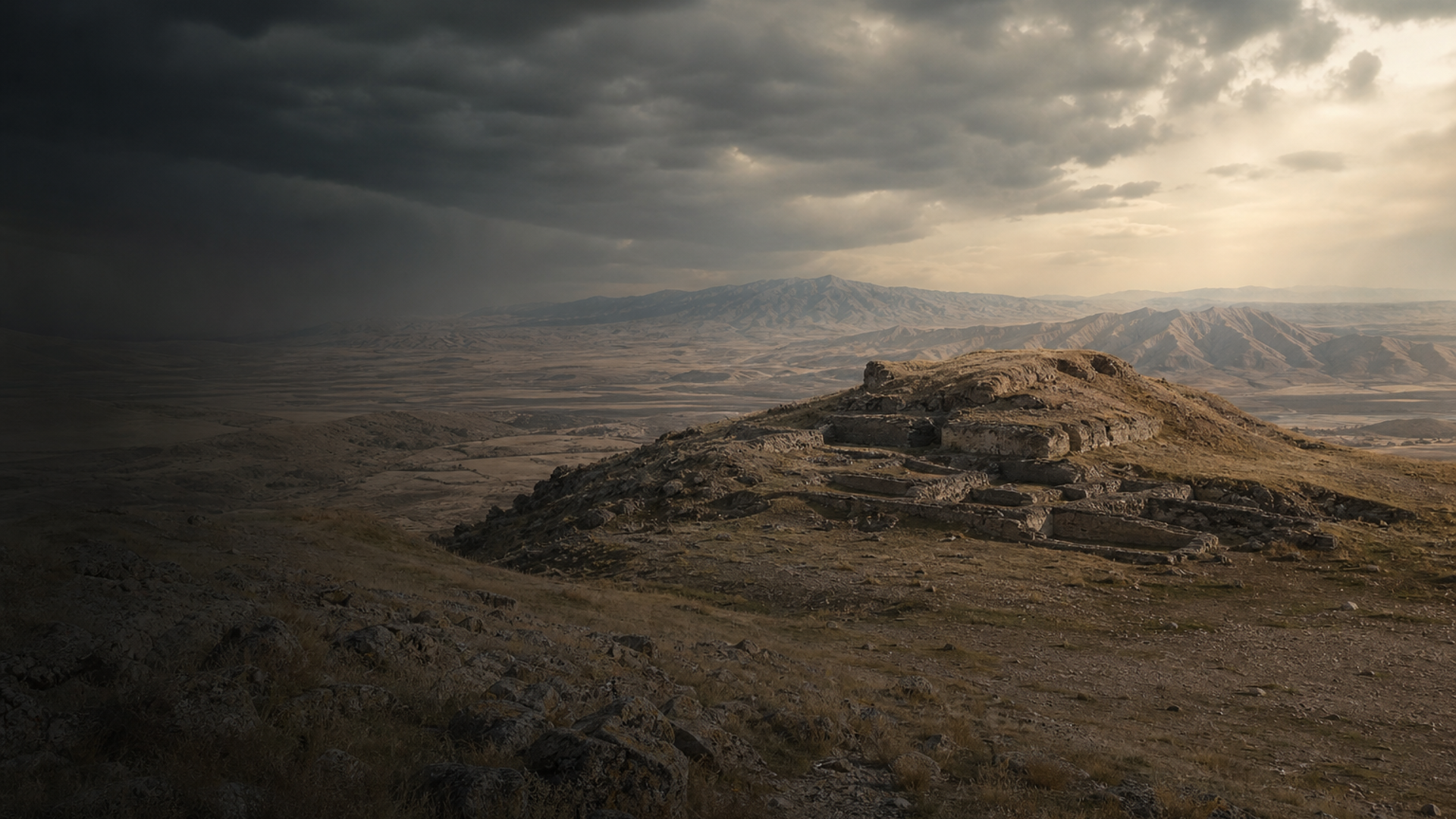
Kalehöyük sits as a cinematic ridge in central Anatolia where local traditions meet long-distance exchange. Archaeological layers dated to the Assyrian Colony Period (roughly 2000–1750 BCE) capture a moment when Anatolian towns were pulled into a growing web of Mesopotamian commerce. Excavations at Kalehöyük reveal stratified deposits of pottery styles, imported prestige goods, and building phases that align chronologically with better-known karum (Assyrian trading posts) such as Kültepe (ancient Kanesh).

Material culture indicates intensive contact rather than full population replacement: local ceramic traditions continue alongside imports and new administrative or mercantile practices. Limited evidence suggests merchant-led enclaves or households with ties to Assyrian traders operating within Anatolian polities. The archaeological signal is one of porous frontiers — places where merchants, metals, and ideas moved seasonally or for decades, leaving layered signatures in architecture and refuse.

Because the dataset from Kalehöyük for this period is small, interpretations must remain cautious: current stratigraphy and finds allow reconstruction of trade relationships and cultural interaction, but demographic conclusions await larger samples and broader regional comparisons.

  • Kalehöyük occupation during Assyrian Colony Period (c. 2000–1750 BCE)
  • Material evidence shows Anatolian traditions alongside imported goods
  • Archaeology suggests trade-driven interaction, not wholesale colonization
Chapitre IV

Daily Life & Society

The lived landscape of Kalehöyük during 2000–1750 BCE would have been a tapestry of local households, craft workshops, and transient merchant activity. Archaeological indicators — pottery kilns, metalworking debris, animal bone assemblages, and domestic features — point to mixed economies combining farming, specialized crafts, and participation in long-distance exchange. Goods moved in and out: Anatolian metals and textiles likely flowed toward Mesopotamian markets, while weights, seals, and prestige items arrived from the east.

Social life appears layered. Local elites may have brokered access to Assyrian merchants, and household spaces could double as storage and small-scale commercial premises. Literacy in cuneiform is attested at nearby karum sites (notably Kültepe), but Kalehöyük has produced comparatively fewer written records; this suggests different roles within the network — perhaps more craft and production than administrative control. Funerary remains and household assemblages indicate varied diets and craft specialization, reflecting social differentiation but also everyday continuity with earlier Bronze Age practices.

Archaeological data indicates interaction was sustained but selective: foreign elements coexist with long-standing Anatolian lifeways, producing hybrid material and social patterns.

  • Craft production (metalworking, pottery) evident alongside farming
  • Merchants and local elites likely mediated trade and social exchanges
Chapitre V

Genetic Profile

Genetic data from Kalehöyük for the Assyrian Colony Period are preliminary but evocative. The dataset comprises three ancient individuals dated to 2000–1750 BCE. Mitochondrial haplogroups observed are J (1), U1a (1), and H (1) — maternal lineages common across West Eurasia and present in both Anatolian and Near Eastern ancient and modern populations. These mtDNA results suggest a mix of maternal ancestries consistent with long-standing regional diversity and the connectivity expected from trade networks that linked central Anatolia and Mesopotamia.

Y-chromosome information is not consistent or not determinable from these three samples; therefore, no firm statements about paternal lineage structure can be made. Because the sample count is very small (n = 3), any inference about population structure, migration, or admixture must be treated as tentative. The maternal diversity observed can be interpreted as (a) local Anatolian continuity with existing West Eurasian lineages, (b) incorporation of women from different parts of the trade network, or (c) sampling of a socially mixed neighborhood. Archaeological context — trade, craft, and occasional long-distance ties — is compatible with all these scenarios.

Future sampling and genome-wide analyses will be necessary to test whether Kalehöyük reflects continuity with Bronze Age Anatolia, gene flow from Mesopotamia, or a mosaic of both.

  • MtDNA: J, U1a, H observed across three individuals
  • Sample size small (n=3); conclusions are preliminary
Chapitre VI

Legacy & Modern Connections

The imprint of the Assyrian Colony Period endures in the archaeological landscape and, tentatively, in genetic patterns. The maternal haplogroups found at Kalehöyük (J, U1a, H) still occur in modern Anatolian populations, but this continuity does not imply direct lineal descent without admixture — rather, it reflects the deep, layered genetic substratum of West Eurasia. Archaeology shows that long-distance trade forged durable cultural links: administrative practices, prestige goods, and craft techniques crossed borders and influenced local life.

Ancient DNA offers a new lens to see these interactions as biological as well as cultural exchanges. However, with only three genomes, we can only sketch possibilities: trade networks likely facilitated movements of people as well as goods, contributing to Anatolia’s genetic mosaic. Continued sampling across sites and time will clarify how transient merchant enclaves versus permanent migrations shaped the genetic landscape of the region.

  • Maternal lineages overlap with modern Anatolian genetic diversity
  • Ancient DNA hints at exchange-driven admixture but needs more samples
Propulsé par l'IA

Assistant IA

Posez des questions sur la culture Kalehöyük: Assyrian Colony Echoes

Assistant IA par DNAGENICS

Débloquer cette fonction
Posez des questions sur la culture Kalehöyük: Assyrian Colony Echoes. L'assistant IA peut expliquer les résultats génétiques, le contexte historique, les preuves archéologiques et les liens génétiques avec les populations actuelles, dans les limites de l'interprétation.
Exemple d'analyse IA

La culture Kalehöyük: Assyrian Colony Echoes représente un chapitre fascinant de l'histoire humaine…

L'analyse génétique met en évidence des similarités avec des populations antérieures et des signes d'adaptations propres. Les échantillons d'ADN ancien éclairent les schémas migratoires et les liens entre populations, avec des limites qui dépendent de l'étude et du contexte archéologique.

Il s'agit d'un aperçu de l'analyse IA. Accédez à l'assistant complet pour explorer :

  • Composition et similarité génétique
  • Schémas migratoires et origines
  • Vie quotidienne et pratiques culturelles
  • Contexte génétique actuel

Explorez d'autres cultures antiques

Découvrez les récits de civilisations issues du monde antique