Préparation du rapport

Chargement des informations et références disponibles

Connexion au corpus archéologique…

Collecte des archives antiques

Aller au contenu principal
Layi Cave: Guangxi Echoes
Profil culturel

Layi Cave: Guangxi Echoes

A single burial from 419–548 CE that hints at life and movement in southern China

419 CE - 548 CE
Guangxi, China (Hechi, Dahua Yao County)
Faites défiler pour commencer
Chapitre I

Le récit

Comprendre la culture Layi Cave: Guangxi Echoes

Archaeological remains from Layi Cave (Baida Village, Guangxi) date to the Northern and Southern Dynasties (419–548 CE). One ancient DNA sample carries mtDNA haplogroup R. Limited material offers a glimpse into regional connections and population dynamics—preliminary but evocative.

Time Period

419–548 CE

Region

Guangxi, China (Hechi, Dahua Yao County)

Common Y-DNA

Undetermined / not reported

Common mtDNA

R (1 sample)

Chapitre II

Chronologie

Moments clés de l'histoire de cette culture

419 CE

Burial dated within Layi Cave range

A human interment at Layi Cave is dated to the Northern and Southern Dynasties period (within 419–548 CE), providing the single ancient DNA sample from the site.

Chapitre III

Origins & Emergence

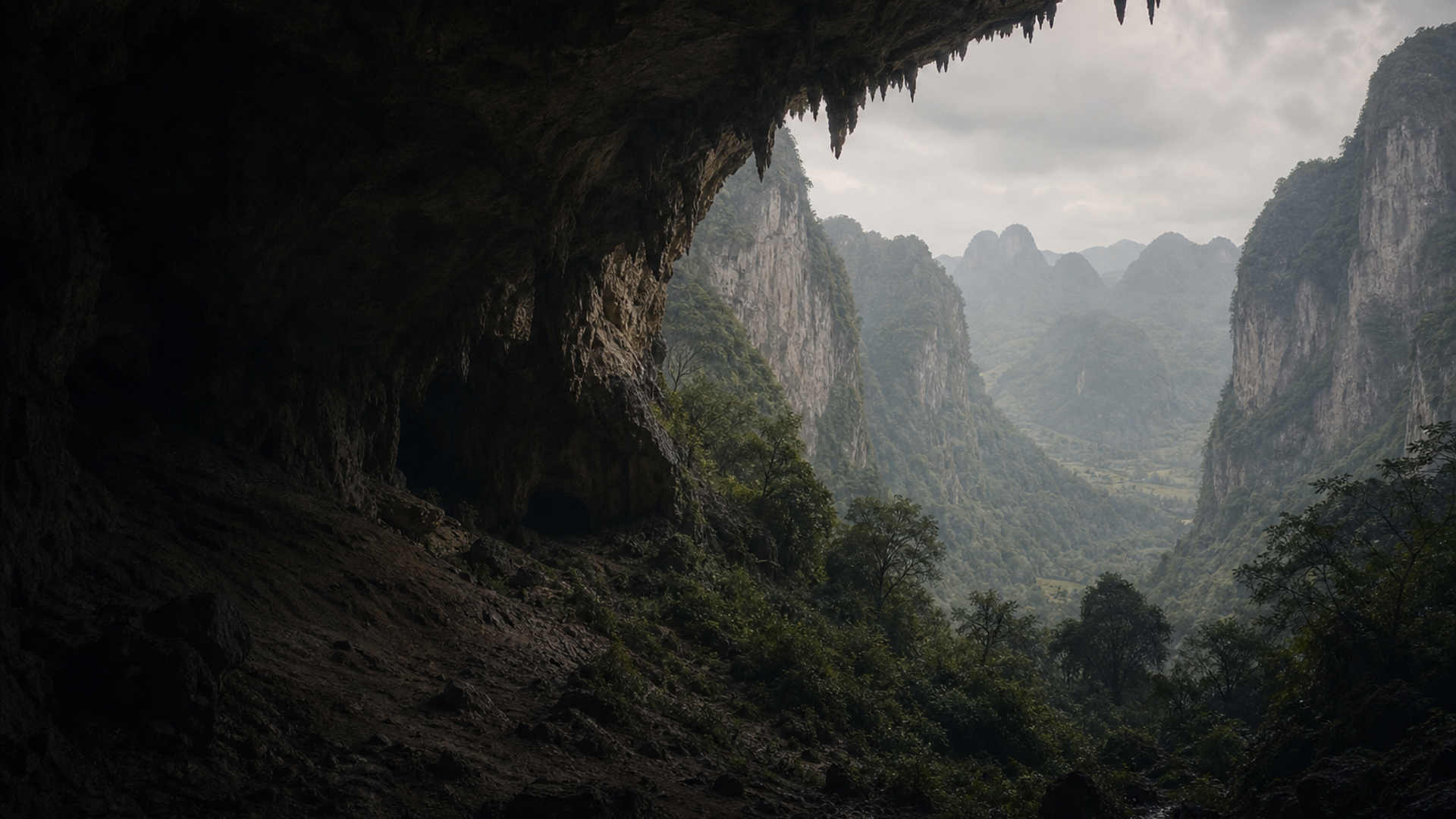
The individual from Layi Cave (Baida Village, Beijing Town, Dahua Yao Autonomous County, Hechi City) was deposited during the turbulent Northern and Southern Dynasties era (419–548 CE), a time of political fragmentation and intensified regional interaction across China. Archaeological data indicates the cave was used as a burial locus within a landscape of terraced fields and karst hills characteristic of Guangxi.

Limited evidence from Layi itself means we must read it alongside broader regional sequences: contemporaneous sites in southern China show continuing agricultural economies, ceramic exchange, and localized burial practices. Material culture from the Layi period suggests a community negotiating both continuity with earlier southern traditions and new connections brought by migration and trade along inland and coastal networks.

Important caution: this narrative rests on a single excavated individual and associated context. While evocative, interpretations about wide-scale population movements or cultural shifts require more samples and comparative stratigraphy. This site offers a focal point for asking how local communities experienced the wider political and social changes of the 5th–6th centuries CE.

  • Layi Cave burial dated to 419–548 CE, Northern & Southern Dynasties era
  • Site located in Baida Village, Beijing Town, Dahua Yao Autonomous County, Hechi City, Guangxi
  • Conclusions are preliminary due to a single sample and limited excavation data
Chapitre IV

Daily Life & Society

Archaeological patterns in Guangxi during the Layi period suggest lives shaped by rice agriculture, riverine routes, and karst landscapes. Pottery types and tool assemblages from nearby sites indicate domestic economies focused on wet-rice cultivation, local craft production, and foraged resources from hills and streams. Seasonal rhythms—planting and harvest—likely structured labor and ritual.

Burials in caves and rock shelters are a recurrent feature in southern China’s archaeological record; they often reflect intimate community practices rather than imperial funerary grandeur. The Layi burial may have included simple grave goods and body treatments consistent with local belief systems that emphasized ancestor ties and landscape-based cosmologies. Trade and mobility are evident in the distribution of ceramics and metal objects across Guangxi, pointing to connections with lowland and coastal networks.

Archaeological data indicates a mosaic of small-scale villages rather than large urban centers in this part of Guangxi at the time. Social life would have balanced communal cooperation in agriculture with kinship-based obligations and regional exchanges that carried ideas, goods, and people across valleys and rivers.

  • Economy likely centered on wet-rice cultivation and local crafts
  • Cave burials indicate localized ritual practice and strong landscape ties
Chapitre V

Genetic Profile

Ancient DNA from Layi Cave is currently limited to a single sampled individual whose mitochondrial DNA (mtDNA) is assigned to haplogroup R. Haplogroup R is a broad maternal lineage found across Eurasia with many downstream clades; without deeper resolution or nuclear genome data, precision about origin or affinity is low.

Genetic data from one individual can spark hypotheses but cannot demonstrate population-level patterns. The presence of mtDNA R in a Guangxi burial of the Northern and Southern Dynasties period could reflect long-standing maternal lineages in East and Southeast Asia, occasional gene flow from northern or western groups, or local diversity within southern China. Nuclear DNA (if recovered) would help clarify ancestry components, such as affinity to other ancient southern Chinese, inland East Asian farmers, or northern migrants associated with the era’s political upheavals.

Archaeogenetic context: regional studies show varying degrees of continuity and admixture across Chinese prehistory; the Layi sample is a valuable datapoint but must be integrated with additional samples (>10) before robust conclusions about migration or demographic change can be drawn. Until then, statements about population movement remain provisional.

  • mtDNA haplogroup R detected in 1 individual — broad, Eurasian maternal lineage
  • Single-sample evidence is preliminary; nuclear DNA and more samples needed for population-level claims
Chapitre VI

Legacy & Modern Connections

Layi Cave offers a cinematic fragment of human experience in southern China during the 5th–6th centuries CE. Archaeologically, it anchors questions about how communities in Guangxi negotiated changing political landscapes, maintained agricultural lifeways, and participated in regional exchange.

Genetically, the mtDNA R lineage points to maternal connections that are widespread across Eurasia, but the limited sample prevents direct statements about continuity with modern populations such as the Yao or other Guangxi groups. Instead, Layi's true legacy is methodological: it highlights how integrating careful excavation, regional archaeology, and expanded ancient DNA sampling can transform isolated finds into narratives of movement, contact, and resilience across millennia.

  • Site emphasizes need for broader sampling to link ancient and modern populations
  • Layi contributes to regional narratives of adaptation and exchange during the Northern and Southern Dynasties
Propulsé par l'IA

Assistant IA

Posez des questions sur la culture Layi Cave: Guangxi Echoes

Assistant IA par DNAGENICS

Débloquer cette fonction
Posez des questions sur la culture Layi Cave: Guangxi Echoes. L'assistant IA peut expliquer les résultats génétiques, le contexte historique, les preuves archéologiques et les liens génétiques avec les populations actuelles, dans les limites de l'interprétation.
Exemple d'analyse IA

La culture Layi Cave: Guangxi Echoes représente un chapitre fascinant de l'histoire humaine…

L'analyse génétique met en évidence des similarités avec des populations antérieures et des signes d'adaptations propres. Les échantillons d'ADN ancien éclairent les schémas migratoires et les liens entre populations, avec des limites qui dépendent de l'étude et du contexte archéologique.

Il s'agit d'un aperçu de l'analyse IA. Accédez à l'assistant complet pour explorer :

  • Composition et similarité génétique
  • Schémas migratoires et origines
  • Vie quotidienne et pratiques culturelles
  • Contexte génétique actuel

Explorez d'autres cultures antiques

Découvrez les récits de civilisations issues du monde antique