Préparation du rapport

Chargement des informations et références disponibles

Connexion au corpus archéologique…

Collecte des archives antiques

Aller au contenu principal
Lchashen: Armeniahashen Late Bronze Age
Profil culturel

Lchashen: Armeniahashen Late Bronze Age

Burials at Lchashen (1420–1150 BCE) illuminate life, trade, and maternal lineages in ancient Armenia

1420 CE - 1150 BCE
Lchashen, Armenia (Lake Sevan region)
Faites défiler pour commencer
Chapitre I

Le récit

Comprendre la culture Lchashen: Armeniahashen Late Bronze Age

Archaeological and ancient DNA data from 13 Lchashen burials (1420–1150 BCE) reveal a Late Bronze Age Armeniahashen community with predominantly West Eurasian maternal haplogroups (H, N, T2h). Archaeological context suggests local craft, trade links, and complex ancestry patterns.

Time Period

1420–1150 BCE

Region

Lchashen, Armenia (Lake Sevan region)

Common Y-DNA

Not reported / insufficient data

Common mtDNA

H (4), N (2), T2h (2), H20 (1), W (1)

Chapitre II

Chronologie

Moments clés de l'histoire de cette culture

1420 BCE

Earliest dated Lchashen burials

Radiocarbon and stratigraphic data place initial cemetery use at Lchashen around 1420 BCE, marking the start of the sampled Armeniahashen phase.

Chapitre III

Origins & Emergence

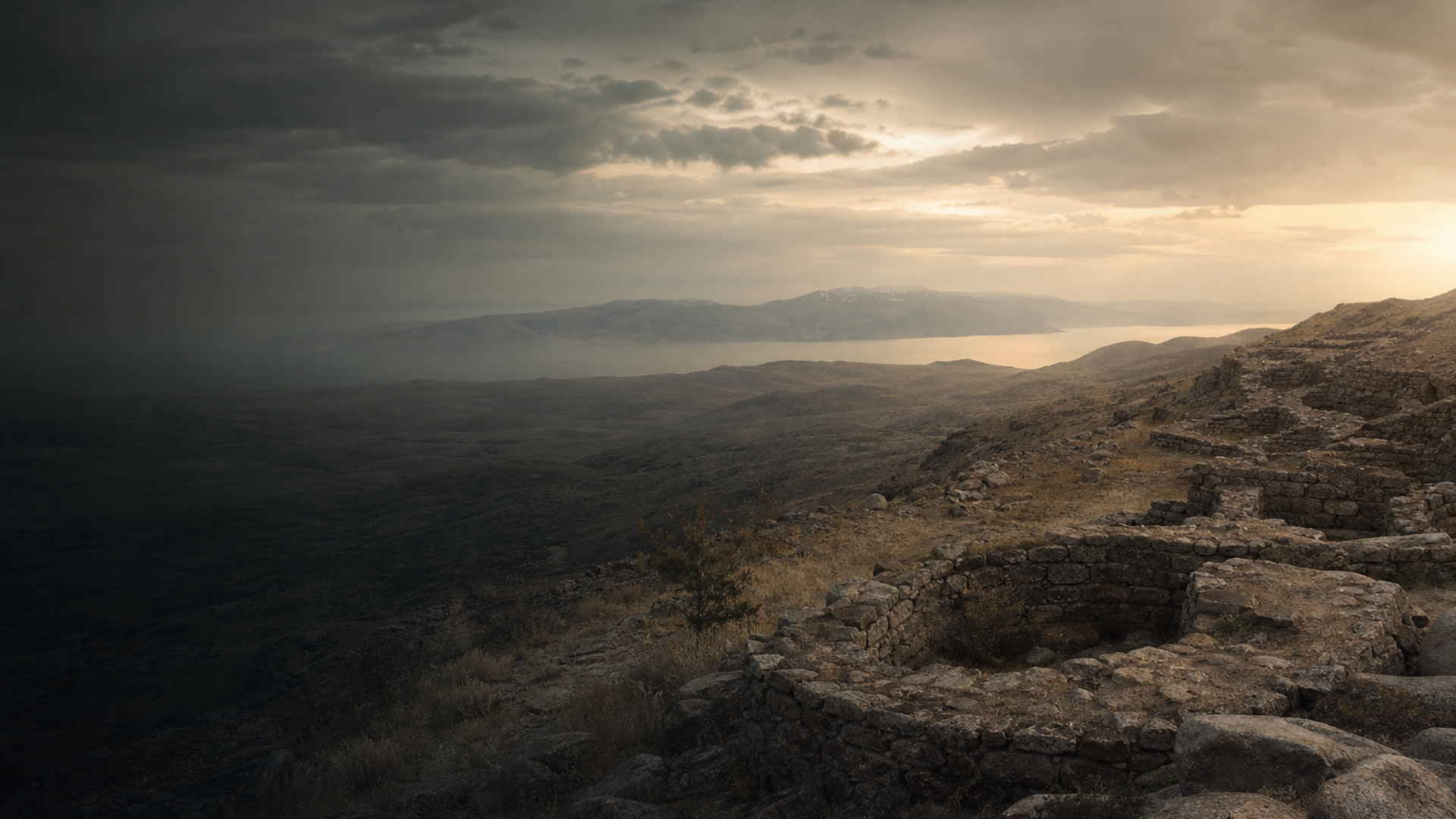
Rising from the slopes above the eastern Armenian highlands, the Armeniahashen occupants of Lchashen left a funerary landscape that bridges local Late Bronze Age traditions and wider Transcaucasian networks. Archaeological data indicates use of a cemetery at Lchashen (on the shores of what is now Lake Sevan) between roughly 1420 and 1150 BCE. Grave assemblages are characterized in excavation reports by carefully placed human remains accompanied by metalwork, beads, and pottery—evidence of craft specialization and long-distance exchange, though preservation and reporting vary by trench.

Cinematic in its silence, the cemetery offers fragments: stone-lined pits, clustered burials, and the echoes of seasonal herding and agricultural cycles. Material culture suggests interaction with neighboring Anatolian and Iranian highland communities, but the precise mechanisms—migration, marriage networks, or trading partnerships—remain subject to interpretation. Limited radiocarbon and stratigraphic control mean some chronological boundaries are provisional; ongoing analysis may refine the emergence and duration of Armeniahashen cultural traits.

Archaeological patterns point to a community rooted in the highland environment yet attentive to crossroads commerce. While grave goods imply status differentiation and craft connectivity, the degree to which these reflect external population movement versus local development is still being resolved through combined archaeological and genetic study.

  • Lchashen cemetery used c.1420–1150 BCE in eastern Armenia
  • Material culture suggests highland crafts and regional exchange
  • Chronology and mechanisms of interaction remain under study
Chapitre IV

Daily Life & Society

Archaeological evidence from Lchashen paints a picture of a community attuned to highland lifeways: mixed agriculture, seasonal herding, and metallurgical craft. Pottery shapes and metal fragments recovered from burials and settlement contexts indicate local production combined with styles or raw materials traceable beyond the immediate valley. Such patterns imply artisans who worked with bronze and organic materials, and households embedded in exchange networks stretching into Anatolia and the southern Caucasus.

Burial practice itself was a public expression of identity. Clustered graves with varied grave goods suggest social differentiation—some individuals interred with personal ornaments or more elaborate items—while others received simpler rites. These mortuary choices document social memory and possible lineage markers, though interpretation is cautious: preservation bias and excavation sampling mean some social categories may be underrepresented.

Seasonal mobility is likely part of the economic mix; ethnographic analogy and isotope work elsewhere in the region point to transhumant herding, and Lchashen’s location near fertile lakeshores and upland pastures would have supported such a pattern. Trade in metal and raw materials implied by artifacts hints at both local expertise and a responsiveness to broader Bronze Age demands.

  • Economy likely combined agriculture, herding, and local metallurgy
  • Mortuary variability indicates social differentiation and network ties
Chapitre V

Genetic Profile

Thirteen individuals from the Lchashen cemetery provide a modest ancient DNA window into Armeniahashen population history (samples dated c.1420–1150 BCE). Maternal haplogroups observed include H (4), N (2), T2h (2), H20 (1), and W (1); three individuals either yielded different or no confident mtDNA calls. The predominance of haplogroup H—common across much of West Eurasia—suggests substantial West Eurasian maternal ancestry in this Late Bronze Age community, while the presence of N, T2h, and W points to maternal lineages that are often associated with Near Eastern and Eurasian connections.

No consistent Y-DNA pattern is reported for this sample set in the provided data, so paternal structure remains unresolved. Genome-wide patterns from the broader Bronze Age Caucasus typically show admixture between local Near Eastern farmer-descended groups and northern/steppe-derived ancestries; the Lchashen mtDNA fits comfortably within that regional mosaic, but cannot alone resolve autosomal ancestry or migration pathways.

Because the dataset comprises 13 individuals, conclusions should be framed as informative but not definitive. Limited sample size and uneven preservation mean signals may reflect local kinship, burial selection, or wider demographic trends. Future genome-wide sequencing and isotopic analyses will better clarify ancestry proportions, kinship ties within the cemetery, and mobility patterns.

  • Maternal lineages dominated by West Eurasian haplogroup H and Near Eastern-associated types
  • No robust Y-DNA summary available; autosomal affinities require more genome-wide data
Chapitre VI

Legacy & Modern Connections

Archaeological and genetic traces from Armeniahashen leave an evocative legacy: a highland community entwined with Bronze Age exchange, whose maternal lineages resonate with modern West Eurasian diversity. Certain mtDNA haplogroups observed at Lchashen—especially H—remain common across contemporary Armenia and neighboring regions, suggesting at least partial maternal continuity, but continuity cannot be assumed without broader, genome-wide comparisons across time.

The Armeniahashen signal contributes to a larger narrative of the Caucasus as a genetic and cultural crossroads. Rather than a simple story of replacement, the evidence points toward palimpsests of local development, intermittent influxes of people and ideas, and durable social practices expressed in mortuary behavior. Ongoing aDNA sampling, coupled with archaeology and isotope studies, will increasingly reveal how Lchashen’s people connect to later populations in the Armenian Highlands and beyond.

  • mtDNA patterns show affinities with broader West Eurasian maternal lineages
  • Long-term continuity with modern populations remains plausible but not yet proven
Propulsé par l'IA

Assistant IA

Posez des questions sur la culture Lchashen: Armeniahashen Late Bronze Age

Assistant IA par DNAGENICS

Débloquer cette fonction
Posez des questions sur la culture Lchashen: Armeniahashen Late Bronze Age. L'assistant IA peut expliquer les résultats génétiques, le contexte historique, les preuves archéologiques et les liens génétiques avec les populations actuelles, dans les limites de l'interprétation.
Exemple d'analyse IA

La culture Lchashen: Armeniahashen Late Bronze Age représente un chapitre fascinant de l'histoire humaine…

L'analyse génétique met en évidence des similarités avec des populations antérieures et des signes d'adaptations propres. Les échantillons d'ADN ancien éclairent les schémas migratoires et les liens entre populations, avec des limites qui dépendent de l'étude et du contexte archéologique.

Il s'agit d'un aperçu de l'analyse IA. Accédez à l'assistant complet pour explorer :

  • Composition et similarité génétique
  • Schémas migratoires et origines
  • Vie quotidienne et pratiques culturelles
  • Contexte génétique actuel

Explorez d'autres cultures antiques

Découvrez les récits de civilisations issues du monde antique