Préparation du rapport

Chargement des informations et références disponibles

Connexion au corpus archéologique…

Collecte des archives antiques

Aller au contenu principal
Lchashen Bronze Age Voices
Profil culturel

Lchashen Bronze Age Voices

Burials from Lchashen (1420–1150 BCE) that link archaeology with maternal DNA patterns

1420 CE - 1150 BCE
Armenia (Lchashen cemetery)
Faites défiler pour commencer
Chapitre I

Le récit

Comprendre la culture Lchashen Bronze Age Voices

Archaeological burials from the Lchashen cemetery in Armenia (1420–1150 BCE) reveal Bronze Age lifeways and a maternal DNA profile dominated by West Eurasian haplogroups. Thirteen samples provide a preliminary glimpse of population history on the Armenian Highlands.

Time Period

1420–1150 BCE

Region

Armenia (Lchashen cemetery)

Common Y-DNA

Undetermined / low coverage

Common mtDNA

H (4), N (2), T2h (2), H20 (1), W (1), others unreported

Chapitre II

Chronologie

Moments clés de l'histoire de cette culture

1420 BCE

Earliest dated Lchashen burials (sampled)

Radiocarbon-dated burials at Lchashen mark the start of the sampled horizon (c. 1420 BCE); archaeological context shows Late Bronze Age funerary traditions.

1150 BCE

Terminal phase of sampled horizon

By c. 1150 BCE the Lchashen cemetery’s sampled burials conclude, corresponding to regional transformations in the Late Bronze Age.

Chapitre III

Origins & Emergence

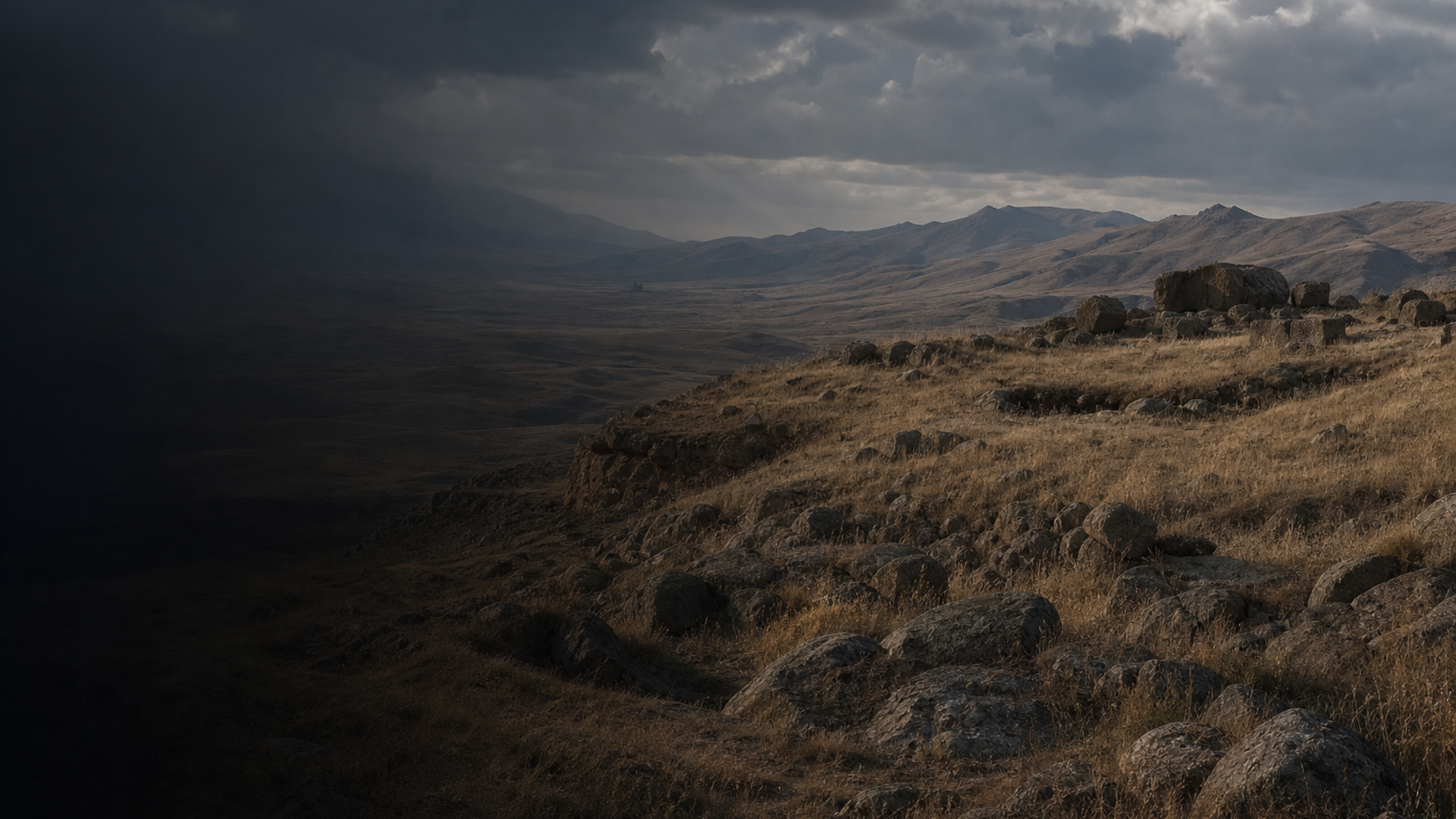
The Lchashen cemetery sits on the western shores of Lake Sevan in the Armenian Highlands and contains burials dated to the later Bronze Age horizon of the region (archaeogenetic samples dated 1420–1150 BCE). Archaeological data indicates continuity with long-standing highland funerary traditions: stone-lined graves, rich metalwork, and ceramics that reflect local styles shaped by long-term interaction across the plateau. Material culture at Lchashen suggests communities organized around mixed farming and animal herding, with skills in bronze metallurgy that tied them into wider regional exchange networks.

Archaeological evidence points to a culturally distinctive local expression within the Armenian Late Bronze Age, but the picture is nuanced. Limited evidence suggests both continuity from earlier Bronze Age traditions in the highlands and selective adoption of external motifs, hinting at mobility and contact rather than wholesale population replacement. The 13 ancient DNA samples from Lchashen provide a first skeletal voice to complement bones and pottery: maternal lineages are overwhelmingly West Eurasian in character, but the full story of population dynamics—especially male-mediated movements—is unclear because Y-chromosome data are sparse or unpublished for many individuals. As always with a modest sample set, conclusions are preliminary and invite more targeted sampling across the region.

  • Lchashen cemetery, Lake Sevan, Armenia; dated 1420–1150 BCE
  • Material culture shows local Late Bronze Age traditions with external contacts
  • Genetic sampling (13 individuals) offers a first but cautious demographic picture
Chapitre IV

Daily Life & Society

The graves of Lchashen preserve echoes of daily life: grave assemblages with metal tools, personal ornaments, and occasional imported objects point to craft specialization and long-distance exchange. Archaeological data indicates a mixed economy of cereals, pulse cultivation, and mobility-focused pastoralism—sheep, goats, and cattle remain central to daily subsistence and material wealth. Funerary variability at the cemetery suggests social differentiation; some burials are modest, others accompanied by rich bronzes and jewelry that signal status, craft identity, or long-distance connections.

Settlement traces associated with Lchashen-style burial rites show compact habitations and small-scale workshops, suggesting household-level production and artisanal skill passed across generations. Isotopic and archaeobotanical datasets from the Armenian Highlands more broadly indicate seasonal mobility in upland pastures and traded staples that tied communities to Anatolian and Near Eastern exchange webs. In biocultural terms, the maternal DNA lines recovered from Lchashen fit within this mosaic: they reflect wide West Eurasian maternal diversity consistent with exchange networks that moved people and goods together, though the limited sample size cautions against broad generalizations about community composition or kinship practices.

  • Mixed farming and pastoralism with craft specialization
  • Burial variability indicates social differentiation and long-distance ties
Chapitre V

Genetic Profile

Thirteen individuals from the Lchashen cemetery yield a preliminary maternal genetic portrait. Observed mtDNA haplogroups include H (4 individuals), N (2), T2h (2), H20 (1), and W (1), with the remaining samples either low-coverage or assigned to less frequent types. Haplogroup H and its sublineages are widespread across Europe and parts of the Near East in both the Bronze Age and later periods; its presence here aligns Lchashen with broader West Eurasian maternal diversity. Haplogroups N, T2h and W similarly appear in Bronze Age contexts across the Caucasus, Anatolia, and the Levant, indicating shared maternal ancestry components that likely moved through trade, marriage, and migration.

Notably, common Y-chromosome haplogroups for these samples are not resolved in the available dataset or show low coverage; therefore, interpretations about male-line ancestry and sex-biased migration remain tentative. Genetic affinities suggested by mtDNA alone cannot resolve admixture timing or the degree of continuity with earlier Neolithic and Bronze Age populations on the Armenian plateau. Because the total is 13 samples, this dataset is informative but limited—patterns of continuity or influx should be viewed as provisional until broader autosomal and Y-chromosome sampling clarifies population structure and admixture events across the Late Bronze Age Armenian Highlands.

  • MtDNA dominated by West Eurasian haplogroups (H, N, T2h, W)
  • Y-chromosome signal unresolved or low coverage—male-line dynamics remain unclear
Chapitre VI

Legacy & Modern Connections

Lchashen’s burials contribute to a longer narrative on the Armenian Highlands as a crossroads of culture and genes. The maternal lineages documented at Lchashen are common components of modern West Eurasian gene pools, and they hint at threads of continuity that may link Bronze Age communities to later populations in the region. However, genetic affinity is not direct proof of unbroken descent: centuries of mobility, demographic change, and cultural transformation intervene between Late Bronze Age burials and present-day populations.

Archaeologically, Lchashen remains an emblem of local Bronze Age complexity—skilled metalwork, nuanced burial rites, and participation in regional networks. Genetically, the site underscores the value and limits of mitochondrial data: mtDNA reveals part of the story of maternal ancestry but must be integrated with autosomal, Y-chromosome, isotopic, and archaeological evidence to build a robust picture of ancestry and migration. Future targeted sampling at Lchashen and surrounding sites, with higher-coverage genomes, will better illuminate how these Bronze Age voices contributed to the genetic landscape of the Armenian Highlands.

  • Maternal lineages match broader West Eurasian ancestry but do not prove direct continuity
  • Future higher-coverage autosomal and Y-DNA sampling will refine links to modern populations
Propulsé par l'IA

Assistant IA

Posez des questions sur la culture Lchashen Bronze Age Voices

Assistant IA par DNAGENICS

Débloquer cette fonction
Posez des questions sur la culture Lchashen Bronze Age Voices. L'assistant IA peut expliquer les résultats génétiques, le contexte historique, les preuves archéologiques et les liens génétiques avec les populations actuelles, dans les limites de l'interprétation.

Exemple d'analyse IA

La culture Lchashen Bronze Age Voices représente un chapitre fascinant de l'histoire humaine…

L'analyse génétique met en évidence des similarités avec des populations antérieures et des signes d'adaptations propres. Les échantillons d'ADN ancien éclairent les schémas migratoires et les liens entre populations, avec des limites qui dépendent de l'étude et du contexte archéologique.

Il s'agit d'un aperçu de l'analyse IA. Accédez à l'assistant complet pour explorer :

  • Composition et similarité génétique
  • Schémas migratoires et origines
  • Vie quotidienne et pratiques culturelles
  • Contexte génétique actuel

Explorez d'autres cultures antiques

Découvrez les récits de civilisations issues du monde antique