Préparation du rapport

Chargement des informations et références disponibles

Connexion au corpus archéologique…

Collecte des archives antiques

Aller au contenu principal
Masis Blur: Neolithic Dawn
Profil culturel

Masis Blur: Neolithic Dawn

A single Neolithic individual from Masis Blur offers a fragile glance into early Armenia

5633 CE - 5532 BCE
Masis Blur, Armenia (Caucasus)
Faites défiler pour commencer
Chapitre I

Le récit

Comprendre la culture Masis Blur: Neolithic Dawn

Archaeological context at Masis Blur (Armenia), c. 5633–5532 BCE, combined with one ancient mtDNA K sample, suggests maternal links to early farming networks. Limited sample size makes population conclusions preliminary; more data are required.

Time Period

5633–5532 BCE (Neolithic)

Region

Masis Blur, Armenia (Caucasus)

Common Y-DNA

Unknown (no Y samples)

Common mtDNA

K (1 sample)

Chapitre II

Chronologie

Moments clés de l'histoire de cette culture

5633 BCE

Masis Blur occupation (sample dated)

A human individual from Masis Blur dated to 5633–5532 BCE provides the site's only published ancient DNA insight to date.

Chapitre III

Origins & Emergence

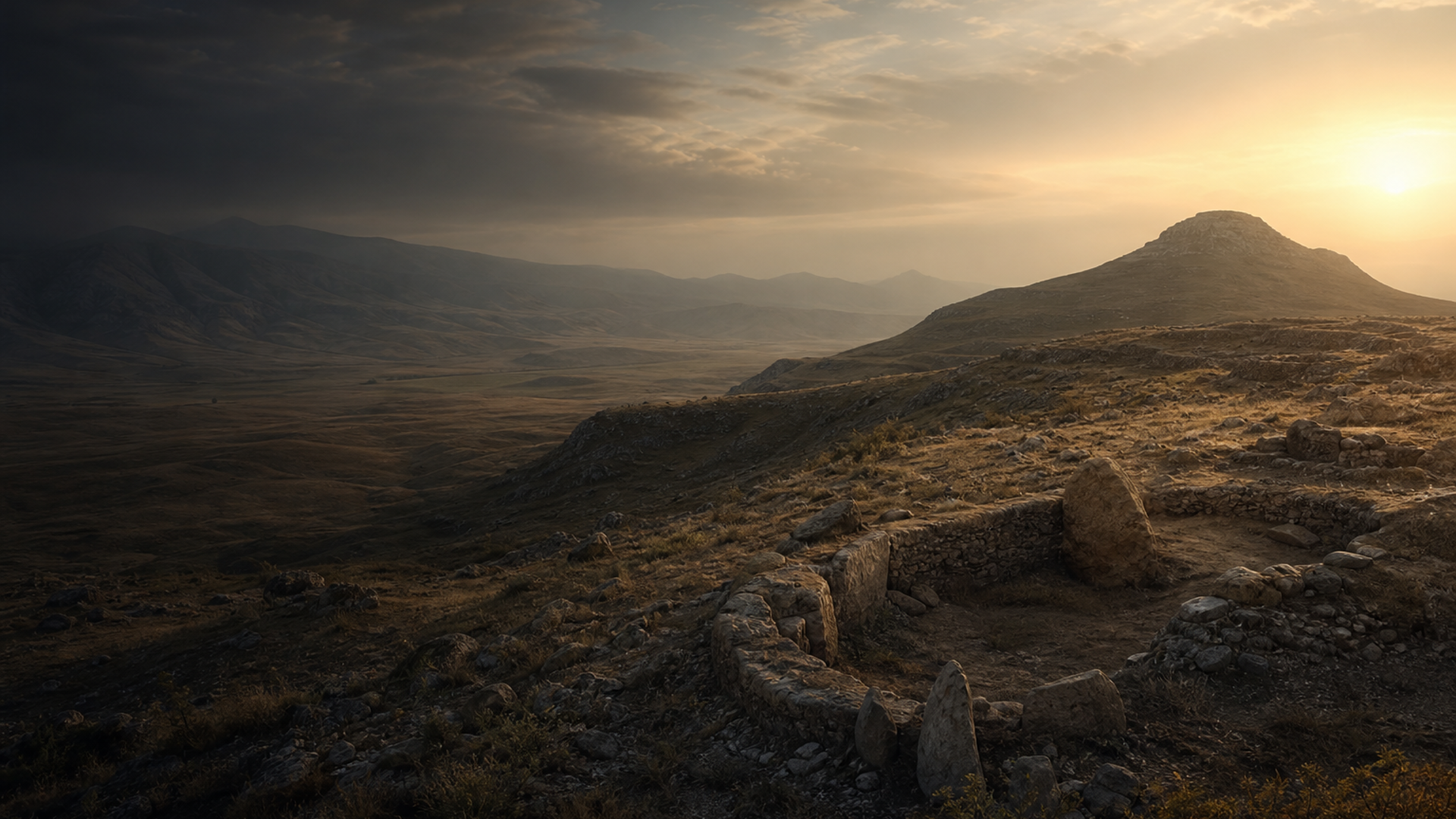
Perched in the highlands that cradle the Armenian plateau, Masis Blur belongs to a tapestry of Neolithic sites that mark the spread and local expression of early farming lifeways across the Near East and the South Caucasus. Archaeological data indicates occupation layers dating to the sixth millennium BCE; stratigraphy and material culture at nearby regional sites suggest households were experimenting with cultivation and animal management at this time.

Limited evidence from Masis Blur itself prevents a full reconstruction of cultural transmission, but the site's chronology (5633–5532 BCE) places it within the wider pulse of Neolithic expansion that connected Anatolia, the Levant, and the Caucasus. This was a period when communities negotiated new economies — mixing foraged traditions with domesticated cereals and herded animals — and when long-distance contacts could be expressed through raw materials, styles, and possibly marriage networks.

Archaeologists treat Masis Blur as a local expression of broader Near Eastern Neolithic dynamics: a locus where new subsistence strategies took root amidst preexisting forager traditions. Given the small sample count and limited published excavations from the site, conclusions about the community's specific origins remain provisional and invite further fieldwork and sampling.

  • Site dated to 5633–5532 BCE, within regional Neolithic expansion
  • Occupational context links to early farming economies in the Caucasus
  • Conclusions provisional due to limited excavation and sampling
Chapitre IV

Daily Life & Society

Archaeological patterns across Neolithic Armenia suggest daily life at Masis Blur would have revolved around small household compounds, craft activities, and seasonal cycles of planting and herding. Material remains typical of the region include pottery for storage and cooking, ground stone tools for processing cereals, and bone implements — though specific assemblages from Masis Blur remain sparsely published.

Communal life likely blended domestic labor, careful knowledge of local landscapes, and mobility tied to herd management. Social structures were probably organized around kin groups or extended households, with material culture reflecting practical choices as much as social identity. Ritual and symbolic behaviors, while harder to recover, can be inferred from parallels in the region: curated objects, possible burial practices, and curated lithics indicate attention to memory and lineage.

Because only a single ancient DNA sample is currently reported from Masis Blur, demographic reconstructions of family structure, sex-specific mobility, or kinship networks are not possible. Archaeological excavation focused on household floors, storage contexts, and burials — paired with more genetic sampling — would clarify everyday life and social organization at the site.

  • Household-centered activities with pottery and ground stone tools
  • Kin-based social structure inferred, but not confirmed by DNA
Chapitre V

Genetic Profile

Genetic data from Masis Blur currently rests on a single individual dated to 5633–5532 BCE. This individual carries mitochondrial haplogroup K. Haplogroup K is known from a range of early farming contexts across Europe and the Near East, and its presence here is consistent with maternal lineages that accompanied Neolithic dispersals. However, with only one mtDNA sample, any statements about population composition are preliminary.

No Y-chromosome data are reported for this individual, so paternal lineages at Masis Blur remain unknown. Broader aDNA studies in the Caucasus and adjacent regions reveal a complex mosaic: remnants of local hunter-gatherer ancestry, influxes related to Anatolian early farmers, and genetically distinct groups from the Zagros and steppe appear in different places and times. The Masis Blur mtDNA K therefore suggests potential maternal ties to early farmer networks but cannot resolve contributions from local hunter-gatherers or later migrations.

Future work should prioritize additional individuals, genome-wide sequencing, and direct comparison with contemporaneous samples from Anatolia, the Levant, and the South Caucasus. With more samples, researchers can test hypotheses about sex-biased mobility, marriage networks, and the timing of farmer–forager interactions in the Armenian highlands.

  • mtDNA K found in the single sampled individual, linking to early farmer lineages
  • No Y-DNA reported; population-level genetic inferences are preliminary
Chapitre VI

Legacy & Modern Connections

Masis Blur offers a poetic fragment of the deep past: a maternal lineage (mtDNA K) that resonates with broader Neolithic movements across the Near East. For populations today in Armenia and the Caucasus, ancient samples like this provide sparse but meaningful anchors tying modern genetic diversity to millennia-old demographic processes.

Archaeological continuity in the highlands is complex — later movements, cultural transformations, and demographic shifts overlay Neolithic layers. Thus, while the Masis Blur individual hints at ancient connections to farming networks, modern affinities must be inferred from much larger, multi-period datasets that integrate archaeology, linguistics, and dense genomic sampling. Each new site and sample strengthens the tapestry that links living people to their deep past.

  • mtDNA K connects the site to wider Neolithic maternal lineages
  • Modern connections require broader sampling across time and space
Propulsé par l'IA

Assistant IA

Posez des questions sur la culture Masis Blur: Neolithic Dawn

Assistant IA par DNAGENICS

Débloquer cette fonction
Posez des questions sur la culture Masis Blur: Neolithic Dawn. L'assistant IA peut expliquer les résultats génétiques, le contexte historique, les preuves archéologiques et les liens génétiques avec les populations actuelles, dans les limites de l'interprétation.
Exemple d'analyse IA

La culture Masis Blur: Neolithic Dawn représente un chapitre fascinant de l'histoire humaine…

L'analyse génétique met en évidence des similarités avec des populations antérieures et des signes d'adaptations propres. Les échantillons d'ADN ancien éclairent les schémas migratoires et les liens entre populations, avec des limites qui dépendent de l'étude et du contexte archéologique.

Il s'agit d'un aperçu de l'analyse IA. Accédez à l'assistant complet pour explorer :

  • Composition et similarité génétique
  • Schémas migratoires et origines
  • Vie quotidienne et pratiques culturelles
  • Contexte génétique actuel

Explorez d'autres cultures antiques

Découvrez les récits de civilisations issues du monde antique