Préparation du rapport

Chargement des informations et références disponibles

Connexion au corpus archéologique…

Collecte des archives antiques

Aller au contenu principal
Mycenaean Greece: Palaces and Distant Genes
Profil culturel

Mycenaean Greece: Palaces and Distant Genes

Archaeology from Peloponnese palaces meets DNA to reveal Aegean networks and mixed ancestries.

1610 CE - 950 BCE
Greece (Peloponnese, Attica)
Faites défiler pour commencer
Chapitre I

Le récit

Comprendre la culture Mycenaean Greece: Palaces and Distant Genes

Late Bronze Age Mycenaean communities (1610–950 BCE) in Peloponnese and Attica, sampled at major sites, show archaeological complexity and a genetic profile that links the Aegean to Anatolia and Steppe-related streams. N=19, results consistent but nuanced.

Time Period

1610–950 BCE

Region

Greece (Peloponnese, Attica)

Common Y-DNA

J (observed: 1/19)

Common mtDNA

X2 (2), J (2), HV (2), H7 (2), X2d (1)

Chapitre II

Chronologie

Moments clés de l'histoire de cette culture

1610 BCE

Early Palatial Flourishing

Construction and expansion of palaces in the Peloponnese, including early phases at Pylos, mark administrative centralization and craft intensification.

1200 BCE

Palace Destructions and Disruption

Widespread damage to palatial centers; archaeological evidence suggests a period of upheaval, reorganization, and changing trade networks.

950 BCE

Late Bronze Age Transformation

By this time many palatial systems had dissolved; regional communities persist, setting foundations for subsequent Iron Age societies.

Chapitre III

Origins & Emergence

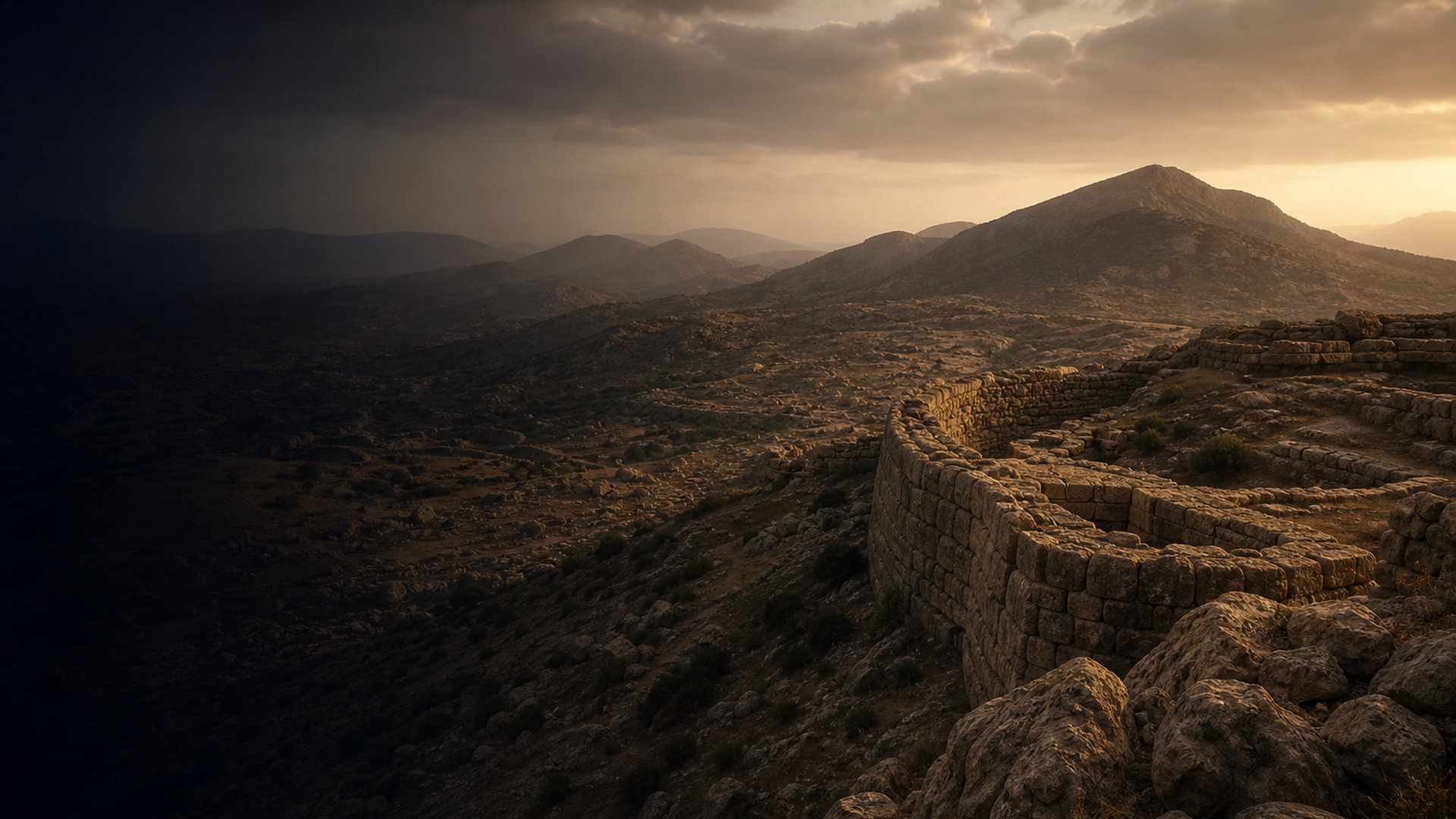
From the ramparts of palaces to coastal burial mounds, Mycenaean society coalesced in the eastern Peloponnese and across the Aegean during the Late Bronze Age. Archaeological layers dated here (c. 1610–1200 BCE) at sites such as Pylos (Palace of Nestor), Salamis (Agia Kyriaki), Galatas Apatheia, Peristeria Tryfilia, and Kolikrepi‑Spata in Attica reveal an era of monumental building, administrative records, and far‑flung exchange. Pottery styles, Linear B administrative tablets, fortifications, and grave goods chart cultural florescence and elite display.

Material culture indicates sustained interaction with Crete, western Anatolia, and the eastern Mediterranean. Limited evidence suggests waves of population movement and elite networks rather than simple mass replacement: the archaeological record is one of continuity punctuated by episodes of rupture (e.g., palace destructions in the later Bronze Age). Chronology is anchored by radiocarbon and stratigraphic sequences but exact tempos of change remain debated.

In sum, the Mycenaean emergence is best understood as a regional flowering built on long‑standing Aegean traditions, intensified trade, and intermittent demographic inputs. Genetic data (see Genetics) helps clarify where continuity holds and where external ancestries were layered onto local populations.

  • Major sites: Pylos, Salamis (Agia Kyriaki), Galatas Apatheia, Peristeria Tryfilia, Kolikrepi‑Spata
  • Monumental palaces and Linear B administration from c. 1610 BCE
  • Archaeology shows both continuity with earlier Aegean traditions and episodic external influence
Chapitre IV

Daily Life & Society

Within the shadow of palace walls, Mycenaean daily life combined agricultural rhythms, craft specialization, and complex social hierarchies. Farmers cultivated olives, grapes, and cereals on terraced hillsides; shepherds moved flocks across limestone country. Workshops near palace centers produced finely painted pottery, bronze tools, and luxury goods that travelled by ship along the Aegean coast.

Households varied widely: elite residences near palaces had storerooms, administrative archives, and imported luxuries; rural settlements show simpler architecture and local craft. Burial practices—tholos tombs, chambered graves, and shaft graves—reflect social differentiation and evolving ritual expression. Artistic motifs evoke maritime power, chariotry, and feasting; Linear B tablets record personnel, rations, and goods, giving rare administrative glimpses into labor and resource flows.

Skeletal remains and isotopic studies at some sites suggest varied diets and mobility: coastal and inland diets overlap but show differences in marine input. Archaeological evidence indicates long‑distance contacts—amber, tin, and ivory moved through exchange networks—while household economies sustained the palatial centers. Yet many details of everyday belief, language use beyond administrative elites, and the lived experience of women and subaltern groups remain incompletely documented.

  • Agriculture (olives, grapes, cereals) and pastoralism underpinned economies
  • Craft specialization and long‑distance trade fed palatial wealth
Chapitre V

Genetic Profile

The Greece_BA_Mycenaean dataset (n=19; samples dated c. 1610–950 BCE from Peloponnese and Attica) offers a window into the biological ancestry of Late Bronze Age Aegean communities. Mitochondrial haplogroups in this set include X2 (2), J (2), HV (2), H7 (2), and X2d (1), reflecting maternal lineages common in the broader Near Eastern and European Neolithic and Bronze Age pools. Y‑chromosome data are sparse here (J observed in 1 individual), so male lineage conclusions are tentative.

Genetically, Mycenaeans are best characterized as a blend: substantial continuities with earlier Aegean farmers and Minoan populations appear alongside admixture signals that introduce additional Caucasus/Anatolia‑related and Steppe‑associated ancestries seen in other Mycenaean series. In this 19‑sample collection, the diversity of maternal haplogroups and presence of Near Eastern‑linked lineages reinforce archaeological evidence for sustained eastern Mediterranean connections. However, sample numbers and geographic clustering (Peloponnese heavy) limit broader generalizations; population structure, social status of sampled individuals, and local micro‑region differences can bias results.

Therefore, while these genomes align with the prevailing model of Aegean continuity plus incremental external inputs, future sampling across more sites, burial types, and time slices is required to refine migration timing, sex‑biased admixture, and the relationship between genetic change and social transformations.

  • Mitochondrial diversity (X2, J, HV, H7) indicates mixed maternal ancestries
  • Limited Y‑DNA data (J observed) — male lineage conclusions are tentative
Chapitre VI

Legacy & Modern Connections

The Mycenaean palaces left an enduring cultural shadow: elements of their material world, administrative vocabulary (Linear B records the early Greek dialect), and myths were woven into later Greek memory. Genetically, modern populations of Greece carry threads of the same deep Aegean ancestry, layered with subsequent Classical, Roman, Byzantine, and medieval inputs. The genomes sampled from palace regions testify to a mosaic ancestry rather than a single founding group.

These ancient individuals help bridge archaeology and genetics: they illustrate how population movement, trade, and cultural transmission combine to produce regional identities over centuries. Yet conclusions remain probabilistic—ancient DNA is a powerful lens but must be read alongside pottery, architecture, and written tablets to reconstruct the human story of the Late Bronze Age Aegean.

  • Mycenaean culture informed later Greek language, myth, and material traditions
  • Modern Greek genetic landscapes retain Aegean ancestry mixed with later historical layers
Propulsé par l'IA

Assistant IA

Posez des questions sur la culture Mycenaean Greece: Palaces and Distant Genes

Assistant IA par DNAGENICS

Débloquer cette fonction
Posez des questions sur la culture Mycenaean Greece: Palaces and Distant Genes. L'assistant IA peut expliquer les résultats génétiques, le contexte historique, les preuves archéologiques et les liens génétiques avec les populations actuelles, dans les limites de l'interprétation.
Exemple d'analyse IA

La culture Mycenaean Greece: Palaces and Distant Genes représente un chapitre fascinant de l'histoire humaine…

L'analyse génétique met en évidence des similarités avec des populations antérieures et des signes d'adaptations propres. Les échantillons d'ADN ancien éclairent les schémas migratoires et les liens entre populations, avec des limites qui dépendent de l'étude et du contexte archéologique.

Il s'agit d'un aperçu de l'analyse IA. Accédez à l'assistant complet pour explorer :

  • Composition et similarité génétique
  • Schémas migratoires et origines
  • Vie quotidienne et pratiques culturelles
  • Contexte génétique actuel

Explorez d'autres cultures antiques

Découvrez les récits de civilisations issues du monde antique