Préparation du rapport

Chargement des informations et références disponibles

Connexion au corpus archéologique…

Collecte des archives antiques

Aller au contenu principal
Mygdalia Late Bronze Age Echoes
Profil culturel

Mygdalia Late Bronze Age Echoes

Five ancient genomes from Mygdalia (c.1626–1425 BCE) illuminate local lives at the edge of Mycenaean Greece

1626 CE - 1425 BCE
Mygdalia, Achaea (Patras region), Greece
Faites défiler pour commencer
Chapitre I

Le récit

Comprendre la culture Mygdalia Late Bronze Age Echoes

Archaeogenetic and archaeological evidence from Mygdalia (Achaea, Patras) reveals a Late Bronze Age community (c.1626–1425 BCE) with predominantly J male lineages and diverse maternal lines. Small sample sizes make conclusions preliminary.

Time Period

c.1626–1425 BCE (Late Bronze Age)

Region

Mygdalia, Achaea (Patras region), Greece

Common Y-DNA

J (4 of 5 sampled)

Common mtDNA

U, T, K1a (each observed)

Chapitre II

Chronologie

Moments clés de l'histoire de cette culture

1626 BCE

Radiocarbon-dated burials at Mygdalia

Radiocarbon dates place sampled burials at Mygdalia to c.1626–1425 BCE, anchoring the genetic data in the Late Bronze Age Aegean context.

Chapitre III

Origins & Emergence

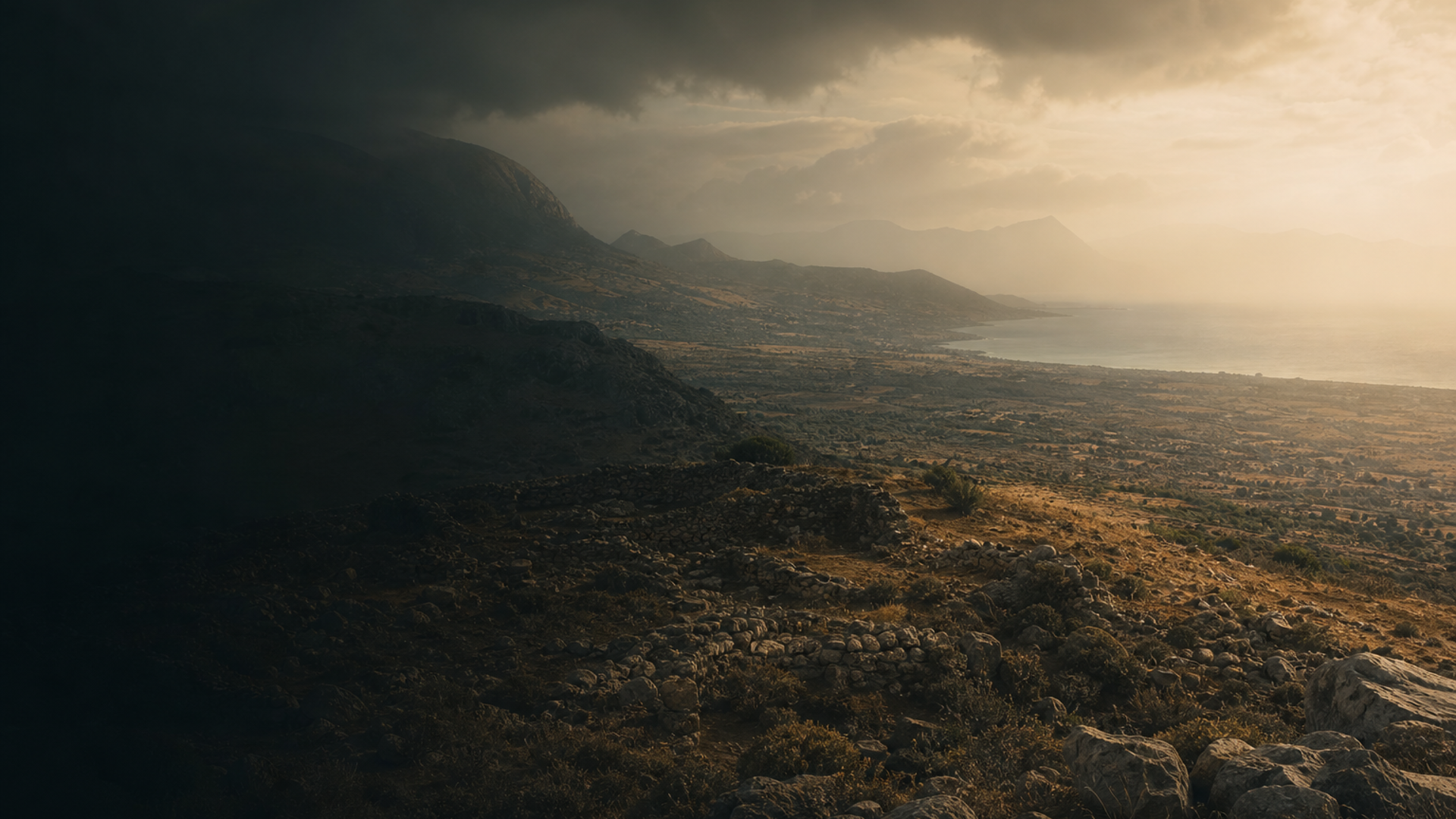
Archaeological data from Mygdalia (Achaea, near Patras) places occupation within the broader tapestry of Late Bronze Age Greece, roughly 1626–1425 BCE. Excavations have uncovered domestic structures, pottery styles, and burial contexts that fit a Mygdalian expression of the wider Aegean world. These material traces suggest a community engaged in farming, local craft production, and exchange with coastal and inland neighbors.

Genetically, five sampled individuals provide a narrow but telling glimpse. Four male burials carry Y‑DNA haplogroup J, a lineage known in Anatolia, the Levant, and the Aegean from the Neolithic onward. This predominance hints at patrilineal continuity or localized male kin groups, although the tiny sample size prevents broad generalizations. Maternal lineages (mtDNA U, T, K1a) show diversity consistent with long-standing regional maternal heterogeneity.

Limited evidence suggests Mygdalia participated in the shifting networks of the Late Bronze Age—seasonal trade, interregional alliances, and styles that echo Mycenaean influence without clear monumental palaces on site. Archaeology indicates interaction rather than isolation; genetics tentatively supports both continuity and connectivity. Further sampling is needed to move beyond preliminary patterns.

  • Occupied c.1626–1425 BCE in the Late Bronze Age
  • Material culture shows local Aegean traits with external connections
  • Genetic picture is preliminary due to a small sample (n=5)
Chapitre IV

Daily Life & Society

The built and material record from Mygdalia evokes a modest, resilient community living along the fertile slopes and coastal approaches of Achaea. Household archaeology—pottery, grinding stones, storage pits—points to mixed farming of cereals, pulses, and perhaps viticulture, complemented by pastoralism. Tools and repair evidence imply skilled household craft; imported or nonlocal vessels indicate participation in regional exchange.

Burial practices in the site assemblage show variability: simple inhumations and secondary depositions coexist, reflecting social differentiation or changing rites through generations. The dominance of Y‑DNA J among the sampled males raises the possibility of patrilocal residence patterns, where male kin remained local and incoming females joined households; the presence of three distinct mtDNA lineages hints at diverse maternal origins. Archaeological data indicates ties to coastal trade routes and the wider Mycenaean sphere, but Mygdalia lacks the monumental palatial architecture found at major centers, suggesting local leadership and community-scale organization.

Archaeological interpretation must remain cautious: the daily rhythms—bread baking, textile work, seasonal movement—are reconstructed from fragmentary evidence, and the genetic snapshot is too small to resolve the full social mosaic.

  • Mixed farming, pastoralism, and household craft remain central
  • Burial variability and genetic hints suggest patrilocal tendencies
Chapitre V

Genetic Profile

Five individuals from Mygdalia (dated 1626–1425 BCE) constitute the genetic dataset for this community. Four of the five males carry Y‑DNA haplogroup J, a lineage widespread across the Near East and recorded in Anatolia and the Aegean from the Neolithic onward. This concentration of J suggests local male-line continuity or the dominance of a few related male lineages at the site. However, with only five samples the pattern may reflect kin sampling bias (for example, several related males in the same cemetery) rather than population-wide homogeneity.

Mitochondrial DNA is more varied among the sampled individuals: haplogroups U, T, and K1a appear, reflecting maternal diversity. Haplogroup U is often associated with deep European maternal lineages, T and K1a with broader Eurasian connections; together they suggest a mixed maternal ancestry consistent with long-standing Aegean population complexity and mobility.

From a population-genetic perspective, the Mygdalia dataset is suggestive rather than definitive. The prevalence of Y‑J aligns with patterns seen in some Late Bronze Age Aegean and Anatolian contexts, hinting at genetic continuity across the eastern Mediterranean. Yet the low sample count (n=5) means conclusions about migration, kinship structure, and demographic change remain provisional. Future sampling across multiple burials and neighboring sites will be essential to test hypotheses of patrilineality, local continuity, and external contact.

  • Y‑DNA dominated by haplogroup J (4/5), suggesting male-line continuity
  • mtDNA shows maternal diversity (U, T, K1a); interpretations are preliminary
Chapitre VI

Legacy & Modern Connections

The human stories from Mygdalia resonate into the present: genetic threads that link ancient Achaea to broader eastern Mediterranean networks, and material traces that mirror the rhythms of rural life near major Bronze Age corridors. Modern populations in Greece and adjoining regions carry a mosaic of lineages shaped by millennia of local continuity and episodic contact. The J paternal signal at Mygdalia sits within this larger tapestry but is not a lone explanation for later genetic patterns.

Archaeologically, Mygdalia contributes a portrait of a non‑palatial community interacting with regional powers—an essential counterpoint to palace-centered narratives of the Late Bronze Age. Genetically, the findings emphasize how localized sampling can reveal kinship and community structure while underscoring the need for broader datasets. Limited evidence suggests continuity with longstanding Aegean populations, but expanding ancient DNA surveys will clarify how Mygdalia fits into the genetic history of Greece.

  • Sheds light on non‑palatial lifestyles in Late Bronze Age Greece
  • Preliminary genetic links to wider eastern Mediterranean ancestry
Propulsé par l'IA

Assistant IA

Posez des questions sur la culture Mygdalia Late Bronze Age Echoes

Assistant IA par DNAGENICS

Débloquer cette fonction
Posez des questions sur la culture Mygdalia Late Bronze Age Echoes. L'assistant IA peut expliquer les résultats génétiques, le contexte historique, les preuves archéologiques et les liens génétiques avec les populations actuelles, dans les limites de l'interprétation.
Exemple d'analyse IA

La culture Mygdalia Late Bronze Age Echoes représente un chapitre fascinant de l'histoire humaine…

L'analyse génétique met en évidence des similarités avec des populations antérieures et des signes d'adaptations propres. Les échantillons d'ADN ancien éclairent les schémas migratoires et les liens entre populations, avec des limites qui dépendent de l'étude et du contexte archéologique.

Il s'agit d'un aperçu de l'analyse IA. Accédez à l'assistant complet pour explorer :

  • Composition et similarité génétique
  • Schémas migratoires et origines
  • Vie quotidienne et pratiques culturelles
  • Contexte génétique actuel

Explorez d'autres cultures antiques

Découvrez les récits de civilisations issues du monde antique