Préparation du rapport

Chargement des informations et références disponibles

Connexion au corpus archéologique…

Collecte des archives antiques

Aller au contenu principal
Neolithic Echoes of Coastal Portugal
Profil culturel

Neolithic Echoes of Coastal Portugal

Six Middle Neolithic individuals from Lorga de Din and Lugar do Canto illuminate Portugal’s early farming world.

4500 CE - 2305 BCE
Portugal (Lorga de Din, Lugar do Canto)
Faites défiler pour commencer
Chapitre I

Le récit

Comprendre la culture Neolithic Echoes of Coastal Portugal

Portugal_MN (4500–2305 BCE): six Middle Neolithic individuals from Lorga de Din and Lugar do Canto connect local archaeology with genome-scale data. Limited samples suggest a mix of farmer-related lineages and local hunter-gatherer signals; conclusions are preliminary.

Time Period

c. 4500–2305 BCE

Region

Portugal (Lorga de Din, Lugar do Canto)

Common Y-DNA

H (1), I (1) — very small sample

Common mtDNA

H, H3, U8a, U (dominant maternal diversity)

Chapitre II

Chronologie

Moments clés de l'histoire de cette culture

2500 BCE

Middle Neolithic life and interweaving ancestries

Around 2500 BCE, coastal and riverine communities practiced mixed farming and foraging; genetic data from a few individuals indicate farmer-related ancestry blended with local hunter-gatherer lineages.

Chapitre III

Origins & Emergence

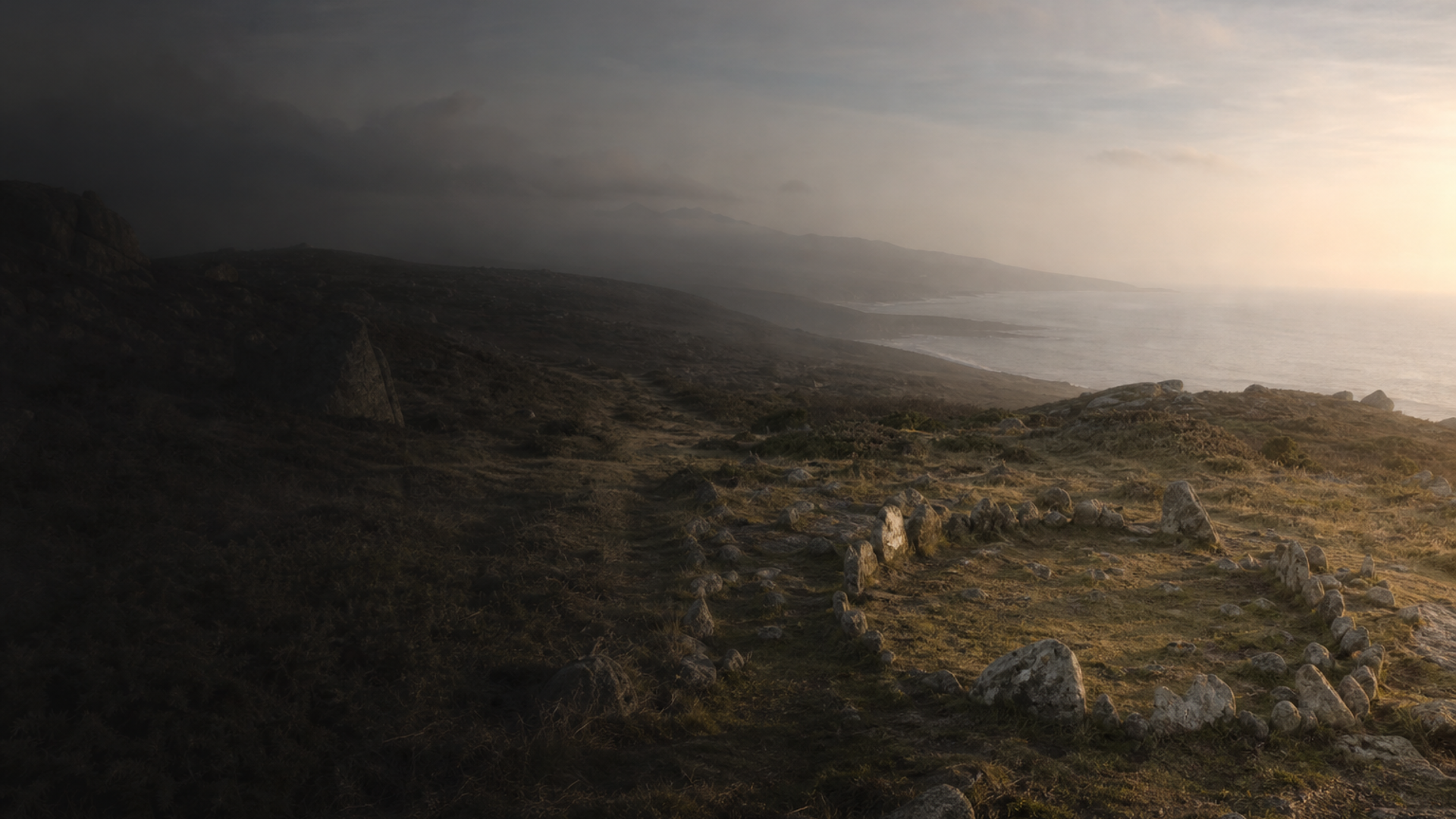
Along the muted coastline and river valleys of western Iberia, the Middle Neolithic unfolds as a slow, layered transformation between c. 4500 and 2305 BCE. Archaeological data indicates communities were practicing mixed farming—domesticated cereals and livestock—while continuing to exploit rich coastal and estuarine resources. Sites in the region display material culture affinities with broader Iberian Neolithic traditions: coarse and burnished pottery, polished stone tools, and localized funerary practices. At Lorga de Din and Lugar do Canto, human remains dating to this span offer direct biological traces of those lives.

The appearance of farming economies in Portugal is best seen as a palimpsest: incoming agriculturally-anchored populations carrying Anatolian-derived farmer ancestry interacted with long-standing Mesolithic groups. Limited evidence from these six samples suggests such interactions were ongoing and regionally variable. The archaeological record in western Iberia shows both continuity in coastal subsistence strategies and novel elements consistent with Neolithic lifeways. Given the small number of genomes, this picture remains provisional: these individuals are cinematic glimpses rather than a full panorama of Middle Neolithic demography.

  • Timeframe: c. 4500–2305 BCE, Middle Neolithic Portugal
  • Sites: human remains from Lorga de Din and Lugar do Canto
  • Pattern: mixing of early farmer economy with local coastal practices
Chapitre IV

Daily Life & Society

Archaeological evidence from Middle Neolithic Portugal paints an intimate portrait: households oriented to small-scale cereal cultivation, herding of sheep and goats, and continued reliance on rivers and the Atlantic for fish and shellfish. Pottery and tools hint at domestic tasks—cooking, storage, textile production—and at regional networks that carried ideas and objects along river corridors and shorelines.

Mortuary deposits at sites like Lorga de Din and Lugar do Canto, though not always extensively published, suggest localized burial practices that preserved skeletal remains useful for aDNA work. Skeletal assemblages from the region often show a life shaped by labor: robust limbs from repetitive activity, tooth wear from gritty diets, and occasional markers of trauma or stress. Social organization was likely kin-based and small-scale, with communal ties mediated by seasonal rounds and exchange. But crucially, these inferences rest on combined archaeological patterns across western Iberia, and the specific behaviors of the six sampled individuals must be interpreted cautiously.

  • Mixed subsistence: farming, herding, coastal foraging
  • Small-scale, kin-focused communities with regional connections
Chapitre V

Genetic Profile

Genome-scale analysis of six Middle Neolithic individuals from Portugal offers a rare molecular window into population dynamics at the Atlantic edge. Maternal lineages recorded include mtDNA H (two individuals), H3 (one), U8a (one), and U (one), a pattern that aligns with the broader Neolithic maternal diversity in Iberia where H and U subclades appear among farmer-descended and mixed-ancestry groups. These mtDNA haplogroups suggest continuity of maternal lineages that were common in Neolithic and late Mesolithic Europe.

On the paternal side, the small dataset reports Y haplogroups H (one) and I (one). Haplogroup I is frequently associated with European Mesolithic hunter-gatherers in many aDNA studies, whereas a single Y-H result is unexpected in the European context and must be treated with caution—low coverage, contamination risk, or rare local lineages can complicate interpretation. Autosomal ancestry in Middle Neolithic Iberia typically shows a major Anatolian farmer component mixed with varying Western Hunter-Gatherer (WHG) resurgence; these six individuals likely reflect that spectrum, but with only six samples the conclusions are preliminary. Limited sample count (<10) means that population-level claims (timing of admixture, sex-biased processes) remain tentative and will benefit from larger, contextualized datasets.

  • mtDNA diversity: presence of H, H3, U8a, U — aligns with Neolithic Iberian patterns
  • Y-DNA: I present (hunter-gatherer-associated); one H reported but interpretation is cautious
Chapitre VI

Legacy & Modern Connections

The genetic and archaeological echoes of Middle Neolithic Portugal contribute threads to the long tapestry of Iberian ancestry. Maternal lineages like mtDNA H and U subclades persist into later periods and can be traced at low frequency in modern Iberian populations, reflecting long-term continuity and mixture. The admixture between incoming farmers and local foragers at sites such as Lorga de Din and Lugar do Canto likely set demographic foundations that would be reshaped in subsequent millennia by later migrations and cultural shifts.

Because only six genomes underpin this portrait, we must treat modern connections as suggestive rather than definitive. These individuals offer cinematic snapshots of ancestral strands, showing how localized interactions between people and place contributed to the genetic mosaic of Atlantic Iberia. Future sampling across more sites and chronologies will clarify how these Middle Neolithic threads were woven into the genetic fabric seen today.

  • Maternal lineages show continuity that can contribute to modern Iberian ancestry
  • Small sample size makes direct modern links tentative; further sampling needed
Propulsé par l'IA

Assistant IA

Posez des questions sur la culture Neolithic Echoes of Coastal Portugal

Assistant IA par DNAGENICS

Débloquer cette fonction
Posez des questions sur la culture Neolithic Echoes of Coastal Portugal. L'assistant IA peut expliquer les résultats génétiques, le contexte historique, les preuves archéologiques et les liens génétiques avec les populations actuelles, dans les limites de l'interprétation.
Exemple d'analyse IA

La culture Neolithic Echoes of Coastal Portugal représente un chapitre fascinant de l'histoire humaine…

L'analyse génétique met en évidence des similarités avec des populations antérieures et des signes d'adaptations propres. Les échantillons d'ADN ancien éclairent les schémas migratoires et les liens entre populations, avec des limites qui dépendent de l'étude et du contexte archéologique.

Il s'agit d'un aperçu de l'analyse IA. Accédez à l'assistant complet pour explorer :

  • Composition et similarité génétique
  • Schémas migratoires et origines
  • Vie quotidienne et pratiques culturelles
  • Contexte génétique actuel

Explorez d'autres cultures antiques

Découvrez les récits de civilisations issues du monde antique




