Préparation du rapport

Chargement des informations et références disponibles

Connexion au corpus archéologique…

Collecte des archives antiques

Aller au contenu principal
Odigitria Minoans (Crete)
Profil culturel

Odigitria Minoans (Crete)

Five Bronze Age individuals from Moni Odigitria connect material culture with early DNA

2210 CE - 1680 BCE
Crete, Greece (Heraklion, Moni Odigitria)
Faites défiler pour commencer
Chapitre I

Le récit

Comprendre la culture Odigitria Minoans (Crete)

Genome data from five individuals (2210–1680 BCE) recovered at Moni Odigitria, Heraklion, Crete illuminate Minoan lifeways. Archaeology indicates continuity with Neolithic Aegean traditions; limited genetic evidence hints at Anatolian-farmer ancestry and diverse maternal lineages. Conclusions are preliminary.

Time Period

c. 2210–1680 BCE

Region

Crete, Greece (Heraklion, Moni Odigitria)

Common Y-DNA

G (observed, 1/5)

Common mtDNA

J, I5, HV, U, K (each observed once)

Chapitre II

Chronologie

Moments clés de l'histoire de cette culture

1700 BCE

Neopalatial Flourishing

Around 1700 BCE Minoan palatial culture expanded across Crete, marked by intense craft production, maritime exchange, and architectural renewal—context for many Odigitria samples.

Chapitre III

Origins & Emergence

The assemblage from Moni Odigitria sits at the heart of Crete’s Bronze Age drama. Archaeological layers and associated artifacts dated between roughly 2210 and 1680 BCE place these individuals within the long arc of Minoan cultural florescence: a world of coastal trade, palace economies, and elaborated ritual spaces. Excavations at Moni Odigitria (Heraklion) have recovered pottery styles, architectural fragments, and burial treatments that continue regional Neolithic traditions while embracing early Bronze Age innovations.

Archaeological data indicate continuity from earlier Neolithic farming communities in the Aegean alongside visible influences from Anatolia and the broader eastern Mediterranean. Material culture—ceramic forms, decorative motifs, and imported objects—suggests Crete was a nexus of interaction rather than an isolated island. Limited evidence from only five dated individuals restricts our ability to generalize, but the combination of context and chronology supports a scenario where local populations absorbed external influences without complete population replacement.

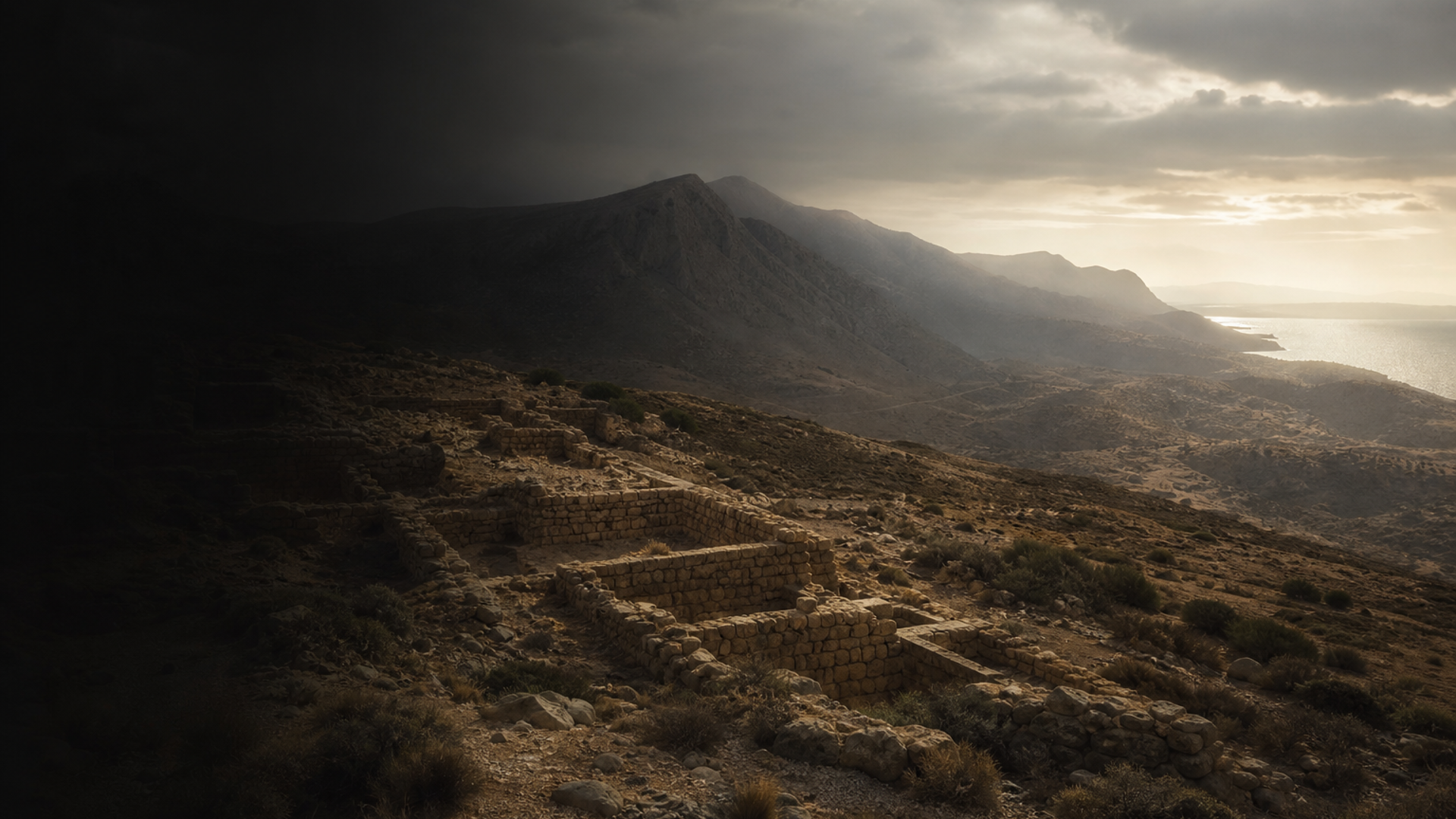
The cinematic sweep of the island—sunlit harbors, terraced fields, and labyrinthine settlements—belies a complex genetic and cultural palimpsest. While archaeological evidence anchors these people in place and time, their biological ancestry must be read alongside the caveats inherent to small sample sizes.

  • Samples dated c. 2210–1680 BCE from Moni Odigitria, Heraklion
  • Material culture shows Neolithic continuity with eastern Mediterranean influences
  • Small sample size means origin interpretations are provisional
Chapitre IV

Daily Life & Society

Life for inhabitants of Bronze Age Crete unfolded between sea and stone: fishing coves, olive groves, and densely organized settlements where craft specialization and exchange were visible in the archaeological record. At Moni Odigitria, funerary contexts and associated grave goods—pottery, beads, and sometimes copper items—evoke households embedded in networks of trade and ritual. Archaeological evidence indicates people lived in multiroom houses, practiced mixed farming, and participated in island-wide exchange of goods and ideas.

Iconography and architectural fragments recovered across Crete imply a society with organized craft production and ceremonial arenas; fresco fragments and painted pottery suggest symbolic landscapes and maritime motifs were socially salient. Stable isotope studies from comparable Minoan sites (where available) typically point to diets of cereals, pulses, seafood, and domesticated animals, reflecting a Mediterranean subsistence base enriched by marine resources. Social differentiation appears in burial variability—some individuals interred with richer assemblages—though Moni Odigitria’s record is modest in size.

As with genetic data, archaeological interpretations must account for sampling bias: the domestic, ritual, and mortuary records we see are shaped by preservation and past excavation priorities. Yet even sparse remains conjure a vivid image of responsive, mobile communities who navigated local tradition and long-distance connections.

  • Mixed farming, fishing, and craft production indicated by artifacts
  • Burial goods and house structures suggest household-based social networks
Chapitre V

Genetic Profile

Five genome samples from Moni Odigitria provide a narrow but informative window into Minoan biological ancestry. Among the Y-DNA and mtDNA results recorded, one male carries haplogroup G, while maternal lineages are diverse: J, I5, HV, U, and K (each observed once). This pattern—limited paternal diversity and varied maternal haplogroups—is consistent with localized population structure and exogamous marriage practices, though with only five individuals such inferences remain tentative.

Archaeological and broader ancient-DNA studies of the Aegean have often pointed to a strong contribution from Anatolian-Neolithic farmer ancestry in Minoan populations, with additional inputs from eastern Mediterranean and Caucasus-related sources at varying levels. The Moni Odigitria sequences fit this broad expectation: genetic signals align with a population profile primarily rooted in earlier Neolithic farmers of the region rather than wholesale replacement by steppe-derived groups. However, because the sample count is low (<10), these findings should be treated as preliminary and hypothesis-generating rather than definitive.

Future sampling across multiple Cretan contexts, paired with isotopic and proteomic studies, will better resolve questions of mobility, kinship, and sex-biased gene flow. For now, the Odigitria genomes reveal a tapestry of maternal diversity woven onto a background of deep Anatolian-Aegean ancestry, resonant with the island’s archaeological story of continuity and connection.

  • Observed Y-DNA: G (1); mtDNA: J, I5, HV, U, K (each 1)
  • Genetic signal consistent with Anatolian-Neolithic farmer ancestry; conclusions provisional
Chapitre VI

Legacy & Modern Connections

The Odigitria individuals remind us that modern Cretan and Aegean populations are shaped by millennia of layered interactions. Archaeological continuity across Neolithic and Bronze Age layers suggests cultural persistence, while genetic data hint at long-term demographic stability punctuated by episodic exchanges. Limited but diverse maternal lineages echo a pattern of mobility—women moving between communities or islands—overlaying a broadly local genetic substrate.

For contemporary residents and visitors, the island’s material remains and emerging genetic portrait combine to tell a story of resilience and connectivity: craftspeople, farmers, and traders who navigated a Mediterranean of currents and ideas. Given the small number of samples, however, any direct line to modern populations should be drawn cautiously. Expanding the dataset will refine how Minoan genomes contributed to later Aegean and Mediterranean gene pools, and will clarify which elements of daily life and identity persisted through subsequent centuries.

  • Suggests long-term demographic continuity in Crete with episodic external influences
  • Modern genetic links are plausible but require larger ancient DNA datasets to confirm
Propulsé par l'IA

Assistant IA

Posez des questions sur la culture Odigitria Minoans (Crete)

Assistant IA par DNAGENICS

Débloquer cette fonction
Posez des questions sur la culture Odigitria Minoans (Crete). L'assistant IA peut expliquer les résultats génétiques, le contexte historique, les preuves archéologiques et les liens génétiques avec les populations actuelles, dans les limites de l'interprétation.

Exemple d'analyse IA

La culture Odigitria Minoans (Crete) représente un chapitre fascinant de l'histoire humaine…

L'analyse génétique met en évidence des similarités avec des populations antérieures et des signes d'adaptations propres. Les échantillons d'ADN ancien éclairent les schémas migratoires et les liens entre populations, avec des limites qui dépendent de l'étude et du contexte archéologique.

Il s'agit d'un aperçu de l'analyse IA. Accédez à l'assistant complet pour explorer :

  • Composition et similarité génétique
  • Schémas migratoires et origines
  • Vie quotidienne et pratiques culturelles
  • Contexte génétique actuel

Explorez d'autres cultures antiques

Découvrez les récits de civilisations issues du monde antique