Préparation du rapport

Chargement des informations et références disponibles

Connexion au corpus archéologique…

Collecte des archives antiques

Aller au contenu principal
Orkney: Middle Bronze Age Echoes
Profil culturel

Orkney: Middle Bronze Age Echoes

Island burials and maternal lineages from Links of Noltland (Westray, Orkney)

1743 CE - 1300 BCE
Orkney (Westray), United Kingdom
Faites défiler pour commencer
Chapitre I

Le récit

Comprendre la culture Orkney: Middle Bronze Age Echoes

Archaeological and genetic glimpses from 22 Middle Bronze Age individuals (1743–1300 BCE) excavated at Links of Noltland, Westray, revealing maternal lineages and island lifeways amid uncertain paternal signals.

Time Period

1743–1300 BCE

Region

Orkney (Westray), United Kingdom

Common Y-DNA

Limited or inconsistent Y-DNA data (insufficient coverage)

Common mtDNA

T, H39, K, H, U (see counts)

Chapitre II

Chronologie

Moments clés de l'histoire de cette culture

2500 BCE

Earlier Neolithic foundations

Neolithic settlement and ritual landscapes established precedents that influenced Bronze Age Orcadian lifeways.

Chapitre III

Origins & Emergence

The Middle Bronze Age horizons at Links of Noltland on Westray (Orkney) sit within a long human story on the northern edge of Britain. Archaeological data indicates activity at the site between roughly 1743 and 1300 BCE, a period when island communities negotiated wind, sea and scarce arable land. Material traces from Orkney in this era are often fragmentary: cist burials, concentrations of domestic midden, and occasional metalwork and ceramics that suggest long-distance connections across the North Atlantic and the Scottish mainland.

Archaeology points to continuity with earlier Neolithic and Bronze Age practices in the Northern Isles, but also to local adaptations—settlement clustering, coastal resource intensification, and funerary placements that pay close attention to shoreline topography. Limited evidence suggests that some of these communities maintained strong maritime networks, exchanging raw materials and ideas.

Genetic data from 22 individuals provides a new dimension to origins: maternal lineages common at Links of Noltland echo patterns seen elsewhere in Bronze Age Britain, hinting at a mix of local continuity and incoming influences. However, preservation and sample coverage impose limits—interpretations about population movements should remain cautious and framed as probabilistic rather than definitive.

  • Site: Links of Noltland, Westray, Orkney (1743–1300 BCE)
  • Archaeological record: burials, settlement traces, scarce metalwork
  • Interpretation: local continuity with maritime connections
Chapitre IV

Daily Life & Society

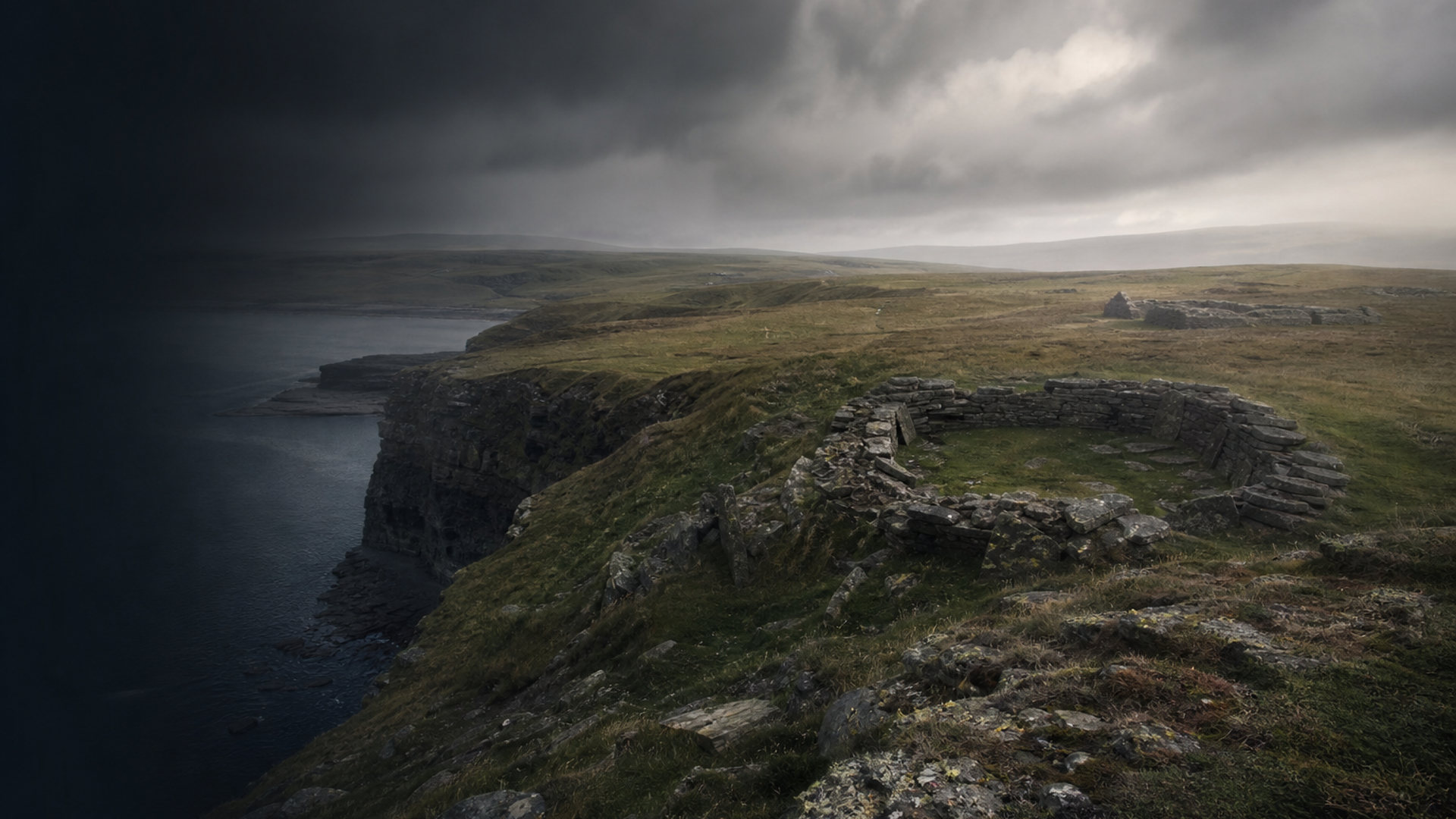
Life on Bronze Age Westray can be imagined as an interplay of wind, sea and stone. Archaeological remains suggest households organized around small stone-built structures and defended by the toughness of island weather. Diets likely combined pastoralism—sheep and cattle—with marine resources: shellfish, sea fish and seabirds are common in Northern Isles middens. Domestic debris and cist burials point to tightly knit kin groups with funerary practices oriented to local topography.

Craft and exchange were part of daily existence. Bronze items are relatively rare in Orkney compared with southern Britain, but when present they signal participation in wider exchange networks. Pottery styles and tool types show both regional distinctiveness and shared forms across the Scottish archipelago. Socially, communities may have been organized around extended family units with status differences expressed through burial placement and the occasional inclusion of exotic goods.

Seasonality would have structured labour: peat cutting, livestock grazing on machair (coastal grassland), and fishing seasons. The landscape itself—low, open and exposed—shaped a culture accustomed to mobility and resilience. Archaeological evidence indicates pragmatic adaptation rather than monumental centralization in this Middle Bronze Age phase.

  • Economy: mixed pastoralism and marine exploitation
  • Material culture: modest bronze use, local pottery traditions
Chapitre V

Genetic Profile

Ancient DNA recovered from 22 individuals at Links of Noltland offers a window into maternal ancestry in Middle Bronze Age Orkney. Mitochondrial haplogroups observed include T (5 individuals), H39 (4), K (3), H (3), and U (2); the remaining samples carry other or unassigned maternal lineages. These counts indicate a diversity of maternal lines, with haplogroups common across Bronze Age Britain and Atlantic Europe.

The prevalence of T and sublineages of H suggests maternal continuity with broader British and northwestern European populations, while K and U reflect deeper Paleolithic and Neolithic maternal ancestries that persisted into the Bronze Age. The presence of H39—an H subclade observed in northern contexts—may reflect regional continuity, though subclade distributions remain incompletely understood.

Crucially, reliable Y-chromosome (paternal) signals for this assemblage are limited or inconsistently reported, so inferences about male-mediated migration or patrilineal continuity are constrained. With a sample size of 22, maternal patterns are moderately robust, but caution remains necessary: population structure, kinship within the burial sample, and preservation biases can skew frequency estimates. Future sampling and higher-coverage genome-wide data will better resolve admixture sources, affinities to mainland Scotland, Scandinavia, and earlier Neolithic inhabitants, and the balance between local continuity and incoming gene flow.

  • mtDNA counts: T (5), H39 (4), K (3), H (3), U (2) — moderate diversity
  • Y-DNA: insufficient or inconsistent coverage; paternal patterns unclear
Chapitre VI

Legacy & Modern Connections

The genetic and archaeological imprint of Middle Bronze Age Orkney contributes to the long tapestry of Orcadian ancestry. Maternal haplogroups found at Links of Noltland resonate with lineages still present in modern northern Britain, suggesting elements of continuity along female lines. Culturally, practices adapted to island life—resource mixing, seasonal mobility, and small-scale exchange—helped shape resilient community identities that would underlie later Orcadian traditions.

However, linking ancient individuals directly to modern populations requires caution. Centuries of migration, Viking-era movements, and more recent demographic shifts have layered additional ancestry over Bronze Age foundations. The current dataset of 22 individuals provides a meaningful but partial snapshot: it highlights continuity and connection without resolving the full story of Orkney’s genetic history. Continued excavation and genome-wide studies will refine how these Bronze Age islanders contributed to the genetic mosaic of the North Atlantic.

  • Maternal continuity visible but partial; modern ancestry layered by later migrations
  • Dataset valuable but not definitive—more sampling needed for full picture
Propulsé par l'IA

Assistant IA

Posez des questions sur la culture Orkney: Middle Bronze Age Echoes

Assistant IA par DNAGENICS

Débloquer cette fonction
Posez des questions sur la culture Orkney: Middle Bronze Age Echoes. L'assistant IA peut expliquer les résultats génétiques, le contexte historique, les preuves archéologiques et les liens génétiques avec les populations actuelles, dans les limites de l'interprétation.
Exemple d'analyse IA

La culture Orkney: Middle Bronze Age Echoes représente un chapitre fascinant de l'histoire humaine…

L'analyse génétique met en évidence des similarités avec des populations antérieures et des signes d'adaptations propres. Les échantillons d'ADN ancien éclairent les schémas migratoires et les liens entre populations, avec des limites qui dépendent de l'étude et du contexte archéologique.

Il s'agit d'un aperçu de l'analyse IA. Accédez à l'assistant complet pour explorer :

  • Composition et similarité génétique
  • Schémas migratoires et origines
  • Vie quotidienne et pratiques culturelles
  • Contexte génétique actuel

Explorez d'autres cultures antiques

Découvrez les récits de civilisations issues du monde antique