Préparation du rapport

Chargement des informations et références disponibles

Connexion au corpus archéologique…

Collecte des archives antiques

Aller au contenu principal
Pumapunku at Tiwanaku
Profil culturel

Pumapunku at Tiwanaku

A solitary ancient genome illuminates a monumental Andean landscape

670 CE - 774400 CE
Pumapunku, Lake Titicaca basin, Bolivia
Faites défiler pour commencer
Chapitre I

Le récit

Comprendre la culture Pumapunku at Tiwanaku

Archaeological and genetic evidence from Pumapunku (Bolivia) links a single mtDNA B2 lineage to the Tiwanaku heartland (sample dated 670–774 CE). Findings are preliminary but add a maternal thread to the story of highland Andean communities and their monumental architecture.

Time Period

670–774 CE (sample); Tiwanaku c. 400–1000 CE

Region

Pumapunku, Lake Titicaca basin, Bolivia

Common Y-DNA

Unknown / no Y-DNA reported (n=1)

Common mtDNA

B2 (1 sample)

Chapitre II

Chronologie

Moments clés de l'histoire de cette culture

400 CE

Tiwanaku urban expansion

Urban growth and monumental construction consolidate Tiwanaku as a major ritual and administrative center in the Lake Titicaca basin.

700 CE

Pumapunku individual (genetic sample)

A human individual sampled at Pumapunku is radiometrically dated to 670–774 CE and carries mtDNA haplogroup B2; conclusions remain preliminary (n=1).

1000 CE

Regional transformation

Increasing social change and regional shifts lead to the waning of classic Tiwanaku urban forms and the reorganization of highland communities.

Chapitre III

Origins & Emergence

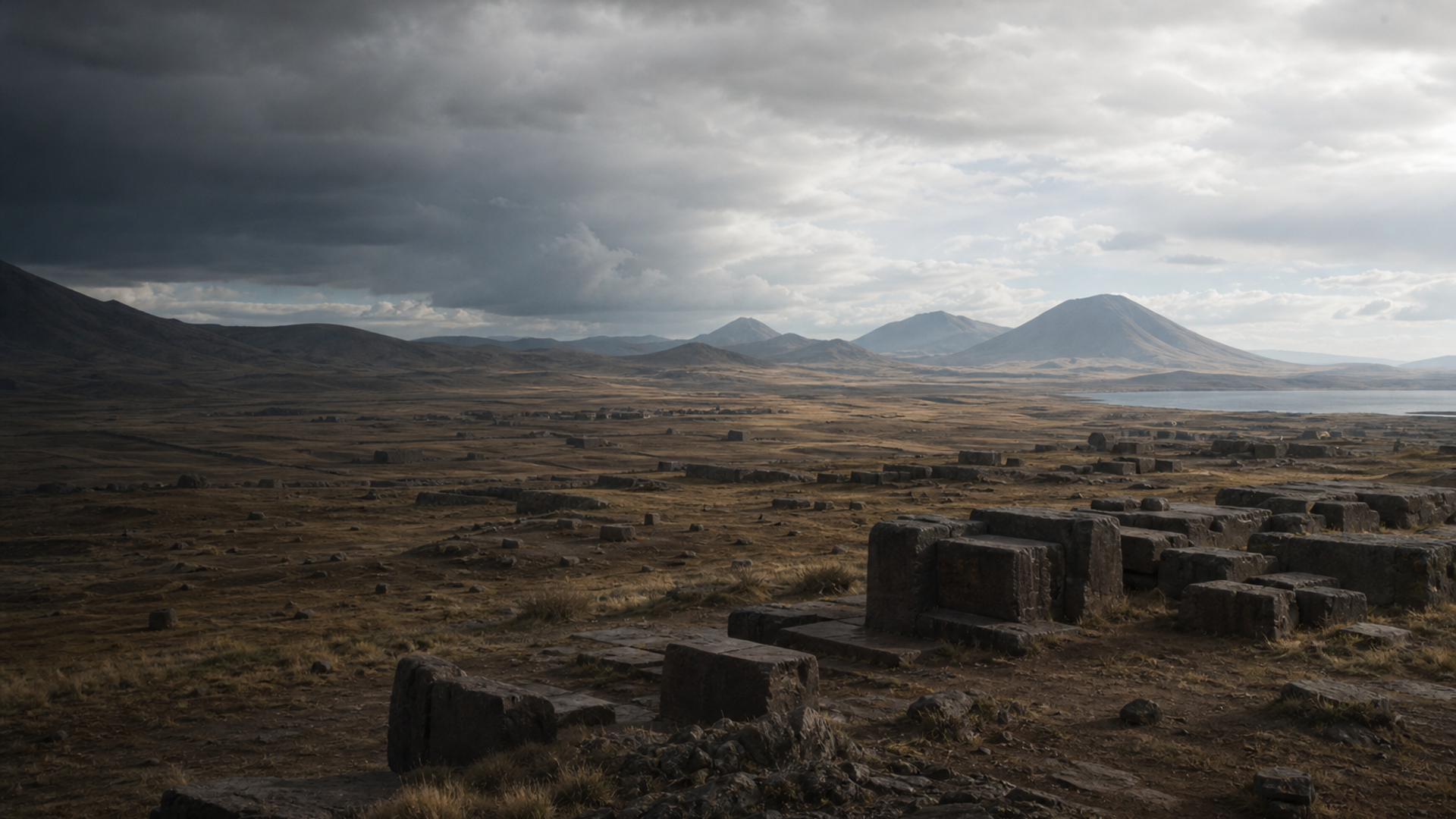
Pumapunku sits like a carved heart within the larger Tiwanaku metropolis on the western shore of Lake Titicaca. Archaeological data indicates the stone plaza, finely dressed megaliths and complex masonry that characterize Pumapunku were created and reworked during the Tiwanaku Middle Horizon (roughly AD 400–1000). The monumental stones — precisely cut and fitted — reflect both technical mastery and a ritualized urban program of public architecture.

Limited excavation and stratigraphic study at Pumapunku mean that chronology remains partly debated; radiocarbon and architectural sequencing suggest major building phases during the broader Tiwanaku florescence. The single ancient DNA sample from Pumapunku, dated 670–774 CE, falls squarely within this tradition of highland urbanism and offers a rare biological glimpse into the people who used these spaces. While the architectural record speaks to collective labor, ritual performance and regional influence across the southern Andean altiplano, the genetic signal from this solitary individual must be treated cautiously: it can suggest individual maternal affiliation but cannot alone define population-level origins or movements.

  • Pumapunku: a monumental complex within Tiwanaku cityscape
  • Major construction and modification during Tiwanaku Middle Horizon (c. 400–1000 CE)
  • Chronology refined by architecture and limited radiocarbon evidence; genetic sample dated 670–774 CE
Chapitre IV

Daily Life & Society

Life in the Tiwanaku world blended highland agriculture, pastoralism and craft specialization beneath an imprint of ceremonial architecture. Archaeobotanical and landscape studies across the Lake Titicaca basin indicate intensive agriculture — including raised fields (suka kollu) that buffered frost and improved yields — alongside herding of camelids for fiber, transport and meat. Pottery styles, textiles and carved stone iconography found in and around Pumapunku reflect craft workshops and ritual agents tied to broader exchange networks.

Archaeological traces of food processing, domestic floors and craft debris suggest households were embedded in a city that organized labor at both communal and specialized scales. Pumapunku’s monumental stones and plazas likely staged public ceremonies, elite display and perhaps pilgrimage, while the surrounding terraces and fields sustained daily life. Mobility between upland and coastal zones, inferred from material exchange and isotopic work elsewhere in the region, hints at dynamic social links that a single genome might only partially reflect. Archaeological data indicates a complex society where ritual architecture and everyday subsistence were inseparable.

  • Intensive agriculture (raised fields) and camelid pastoralism supported urban populations
  • Monumental plazas at Pumapunku likely hosted communal ritual and civic activity
Chapitre V

Genetic Profile

The genetic evidence from Pumapunku is currently limited — one human individual dated to 670–774 CE with mitochondrial haplogroup B2. Haplogroup B2 is a widely recognized Native American maternal lineage, common across many Indigenous populations in the Americas. Archaeogenetic studies in the Andes more broadly show long-term highland continuity with episodes of local gene flow, but interpretations at Pumapunku must be conservative because n=1.

No Y-chromosome (paternal) haplogroups are reported for this sample, so male-line inferences cannot be made. The presence of mtDNA B2 in this individual suggests maternal ancestry that aligns with broader Native American maternal diversity, but it does not by itself demonstrate direct continuity to any single modern group. Limited evidence suggests population structure across the altiplano — diverse communities linked by trade, ritual and mobility — and a single maternal lineage may reflect those local dynamics or simply the ancestry of one household or mortuary context.

In sum, the Pumapunku genome adds an important data point to Andean ancient DNA but highlights the urgent need for more samples: increasing sample counts would permit robust statements about population continuity, admixture, and connections to modern Aymara and Quechua-speaking peoples. Until then, conclusions must remain preliminary and framed by archaeological context.

  • mtDNA B2 observed in one individual (670–774 CE); typical of Native American maternal lineages
  • No Y-DNA reported; single sample limits population-level inferences
Chapitre VI

Legacy & Modern Connections

Pumapunku’s stones continue to speak — to archaeologists, to local communities and to anyone who stands within the scale of its plazas. The architectural legacy of Tiwanaku informed later Andean polities; elements of ritual practice, iconography and agricultural technology echo in the cultural repertoire of the altiplano today. Genetic data, even when sparse, offers a complementary line of evidence: mtDNA B2 ties the individual from Pumapunku into a broader Indigenous genetic heritage across the Americas.

Archaeology and ancient DNA together create a nuanced narrative: material culture reveals collective behaviors, urban planning and ritual landscapes, while genetic data traces threads of ancestry that connect past people to present communities. Because the current genetic sample count is low, any modern connection should be presented as suggestive rather than definitive. Continued ethical collaboration with local communities and expanded sampling will clarify how the people who built Pumapunku relate biologically and culturally to the living descendants of the Andes.

  • Pumapunku’s architecture shaped regional identity and later Andean traditions
  • A single mtDNA B2 link suggests maternal ties to Indigenous American lineages; more data needed to map modern connections
Propulsé par l'IA

Assistant IA

Posez des questions sur la culture Pumapunku at Tiwanaku

Assistant IA par DNAGENICS

Débloquer cette fonction
Posez des questions sur la culture Pumapunku at Tiwanaku. L'assistant IA peut expliquer les résultats génétiques, le contexte historique, les preuves archéologiques et les liens génétiques avec les populations actuelles, dans les limites de l'interprétation.
Exemple d'analyse IA

La culture Pumapunku at Tiwanaku représente un chapitre fascinant de l'histoire humaine…

L'analyse génétique met en évidence des similarités avec des populations antérieures et des signes d'adaptations propres. Les échantillons d'ADN ancien éclairent les schémas migratoires et les liens entre populations, avec des limites qui dépendent de l'étude et du contexte archéologique.

Il s'agit d'un aperçu de l'analyse IA. Accédez à l'assistant complet pour explorer :

  • Composition et similarité génétique
  • Schémas migratoires et origines
  • Vie quotidienne et pratiques culturelles
  • Contexte génétique actuel

Explorez d'autres cultures antiques

Découvrez les récits de civilisations issues du monde antique