Préparation du rapport

Chargement des informations et références disponibles

Connexion au corpus archéologique…

Collecte des archives antiques

Aller au contenu principal
Santa Elena Ceramic People
Profil culturel

Santa Elena Ceramic People

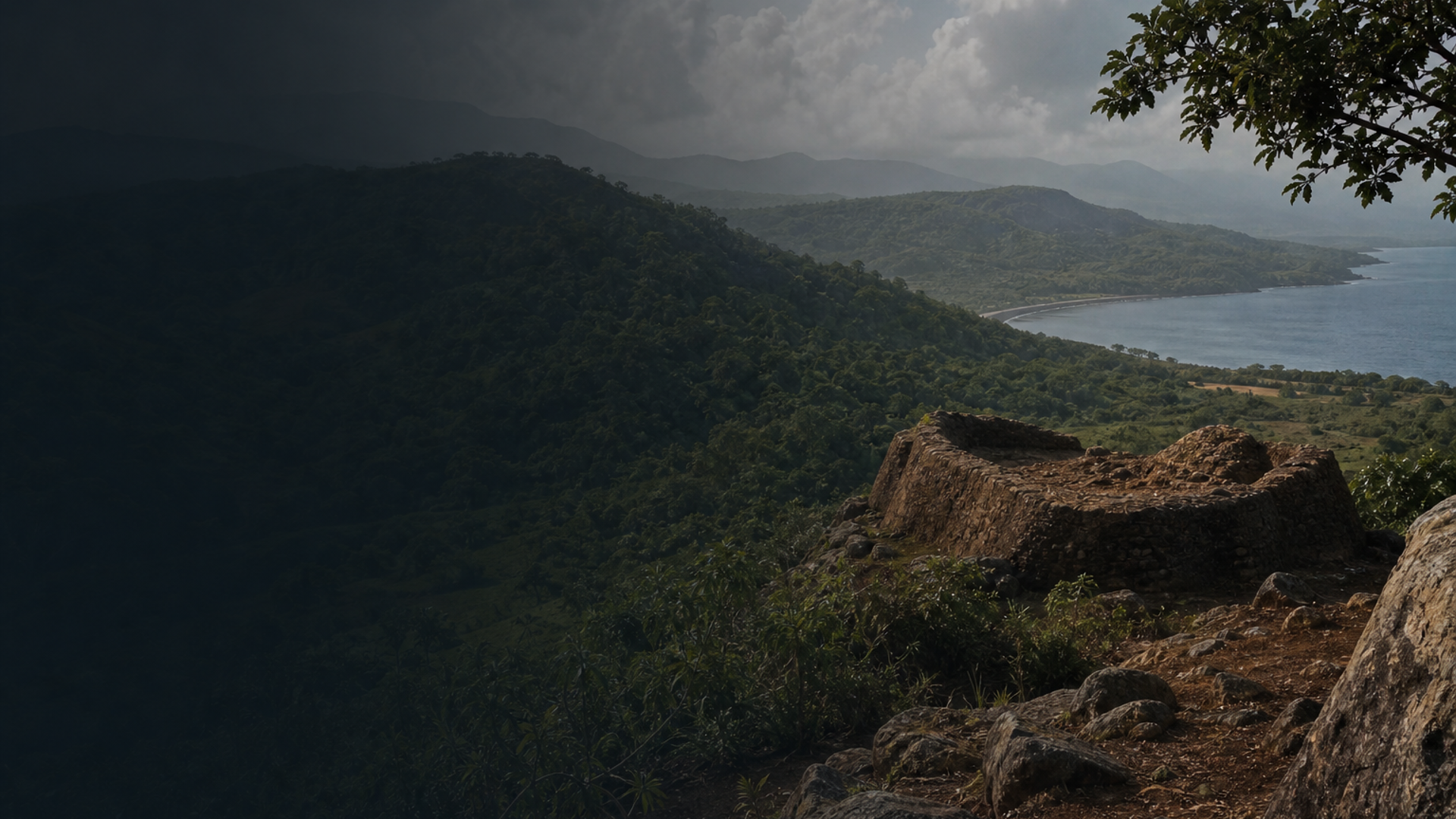
A fragmentary portrait of Puerto Rico’s 900–1300 CE coastal communities

900 CE - 1300 CE
Santa Elena, Puerto Rico
Faites défiler pour commencer
Chapitre I

Le récit

Comprendre la culture Santa Elena Ceramic People

Archaeological and ancient-DNA evidence from Santa Elena, Puerto Rico (900–1300 CE) hints at Ceramic Period communities carrying Indigenous American mtDNA lineages A2, C, and D1. Small sample sizes make conclusions preliminary; archaeological context links pottery, coastal subsistence, and regional Arawak-related interaction.

Time Period

900–1300 CE

Region

Santa Elena, Puerto Rico

Common Y-DNA

Undetermined / not reported

Common mtDNA

A2, C, D1

Chapitre II

Chronologie

Moments clés de l'histoire de cette culture

900 CE

Ceramic Period emergence at Santa Elena

Pottery-bearing settlements appear along Puerto Rico’s coasts, marking participation in wider Ceramic traditions.

1200 CE

Regional interaction and local change

Variation in pottery styles and site use suggests shifting exchange networks and adaptations to local environments.

1493 CE

First sustained European contact

European arrival begins a period of rapid demographic and cultural transformation across the Caribbean.

Chapitre III

Origins & Emergence

The Santa Elena Ceramic assemblage belongs to the broader Ceramic Period traditions of the Greater Antilles, anchored on the north coast of Puerto Rico between roughly 900 and 1300 CE. Archaeological data indicates the presence of pottery-bearing villages at coastal localities such as Santa Elena. These communities are often interpreted as part of the south-to-north dispersal of ceramic-producing groups (frequently associated in literature with Arawak-speaking populations) that reshaped the Caribbean after earlier Archaic occupations.

Material culture — principally decorated and utilitarian ceramics, shell middens, and coastal habitations — creates an evocative landscape of canoes pushing out across blue water, smoke rising over drying fish, and shared pottery traditions carried between islands. Limited evidence suggests this was not a single homogeneous migration but a networked process of movement, exchange, and local adaptation. Radiocarbon-calibrated dates from Santa Elena fall into the specified 900–1300 CE bracket, but the archaeological record on Puerto Rico’s north coast remains unevenly sampled.

Because genetic sampling here is small (three individuals), any reconstruction of origins must be cautious. The combined archaeological and preliminary genetic picture points toward continuity with Indigenous American lineages and regional ties to other Ceramic Period groups in the Greater Antilles, but the fine details of population movement and interaction remain under active study.

  • Ceramic Period presence at Santa Elena: ca. 900–1300 CE
  • Material culture: pottery, shell middens, coastal village sites
  • Regional connections likely with south-to-north Arawak-related dispersals
Chapitre IV

Daily Life & Society

Life at Santa Elena can be imagined through the traces left in earth: potsherds, food debris, stone tools, and middens testify to a mixed coastal subsistence of fishing, shellfish gathering, and horticulture. Archaeological excavations in Ceramic Period contexts on Puerto Rico recover hearth features, storage-associated pottery, and concentrations of shell that indicate seasonal or permanent use of shoreline resources.

Settlement layouts likely consisted of small villages or hamlets oriented to lagoons, inlets, and rich reef zones. Canoes and open-water navigation allowed people to maintain inter-island ties — carrying pottery styles, raw materials like stone and shell, and social practices. Craft production focused on ceramics for cooking and storage and on shell and bone tools for fishing and weaving. Social life would have combined household-level production with communal gatherings, ritual activities, and mortuary practices; however, specific ceremonial behaviors at Santa Elena remain poorly documented in the published record.

Archaeology suggests resilience and adaptability: communities balanced cultivation of root crops and tubers with intensive marine harvesting. Changes in pottery style and site distribution across the Ceramic Period hint at shifting social networks and responses to environmental and demographic pressures.

  • Mixed economy: horticulture, fishing, shellfish gathering
  • Small coastal villages with pottery production and exchange
Chapitre V

Genetic Profile

Ancient DNA data from Santa Elena currently derive from three sampled individuals dated within the 900–1300 CE range. All reported uniparental markers are mitochondrial: one individual carries haplogroup D1, one carries haplogroup C, and one carries haplogroup A2. These mtDNA lineages are widely recognized pan‑American maternal lineages common among Indigenous populations from North to South America and in prior Caribbean aDNA studies.

The absence of reported Y‑chromosome haplogroups for these three individuals means paternal lineages remain undetermined for this dataset. Because the sample size is very small (<10), conclusions about population structure, sex-biased migration, or continuity with earlier Archaic groups are preliminary. Nonetheless, the mtDNA results are consistent with an Indigenous American maternal ancestry at Santa Elena and do not show evidence of recent Old World admixture within this time frame.

When placed in a broader genetic context, these lineages support archaeological interpretations of Ceramic Period communities in the Greater Antilles as carrying Indigenous American maternal ancestry — potentially linked to southward origins in northern South America and subsequent regional interaction. Future, larger-scale aDNA sampling (including autosomal and Y‑DNA data) will be required to test hypotheses about migration routes, demographic size, and genetic continuity with modern Caribbean populations.

  • mtDNA lineages A2, C, D1 recovered (one individual each)
  • Sample size (n=3) is very small — interpretations are preliminary
Chapitre VI

Legacy & Modern Connections

The genetic and archaeological traces from Santa Elena form a delicate bridge to Puerto Rico’s deep past. mtDNA lineages such as A2, C, and D1 persist in many Indigenous-descended and admixed communities across the Americas, and their presence in Santa Elena speaks to maternal continuity in the region before European contact. Cultural legacies — pottery traditions, coastal lifeways, and island-to-island networks — shaped the trajectory of Caribbean history and inform modern understandings of identity on Puerto Rico.

At the same time, the picture is incomplete. With only three ancient individuals sampled, we cannot map the full range of ancestries, demographic events, or cultural affiliations. Ongoing collaborations between archaeologists, geneticists, and descendant communities are essential to expand sampling, refine chronologies, and ensure interpretations honor both the scientific record and living heritage.

  • mtDNA continuity suggests links to broader Indigenous American maternal lineages
  • Expanded sampling and community engagement needed to refine connections
Propulsé par l'IA

Assistant IA

Posez des questions sur la culture Santa Elena Ceramic People

Assistant IA par DNAGENICS

Débloquer cette fonction
Posez des questions sur la culture Santa Elena Ceramic People. L'assistant IA peut expliquer les résultats génétiques, le contexte historique, les preuves archéologiques et les liens génétiques avec les populations actuelles, dans les limites de l'interprétation.
Exemple d'analyse IA

La culture Santa Elena Ceramic People représente un chapitre fascinant de l'histoire humaine…

L'analyse génétique met en évidence des similarités avec des populations antérieures et des signes d'adaptations propres. Les échantillons d'ADN ancien éclairent les schémas migratoires et les liens entre populations, avec des limites qui dépendent de l'étude et du contexte archéologique.

Il s'agit d'un aperçu de l'analyse IA. Accédez à l'assistant complet pour explorer :

  • Composition et similarité génétique
  • Schémas migratoires et origines
  • Vie quotidienne et pratiques culturelles
  • Contexte génétique actuel

Explorez d'autres cultures antiques

Découvrez les récits de civilisations issues du monde antique