Préparation du rapport

Chargement des informations et références disponibles

Connexion au corpus archéologique…

Collecte des archives antiques

Aller au contenu principal
Shenxian Cave: A Sui–Tang Moment
Profil culturel

Shenxian Cave: A Sui–Tang Moment

A single mitochondrial genome linking Guangxi caves to East Asian maternal lineages

601 CE - 673 CE
Guangxi, South China (Pingguo, Baise)
Faites défiler pour commencer
Chapitre I

Le récit

Comprendre la culture Shenxian Cave: A Sui–Tang Moment

Archaeological material from Shenxian Cave (Pingguo, Baise, Guangxi) dated to 601–673 CE yields one mtDNA D4a sample. Limited evidence suggests local continuity and regional connections during the Sui–Tang transition; genetic conclusions are preliminary due to the single sample.

Time Period

601–673 CE

Region

Guangxi, South China (Pingguo, Baise)

Common Y-DNA

Not reported (no Y-DNA data)

Common mtDNA

D4a (1)

Chapitre II

Chronologie

Moments clés de l'histoire de cette culture

601 CE

Earliest range for Shenxian sample

Radiometric/archaeological dating places the individual's context at or after 601 CE (start of the sample range).

618 CE

Establishment of the Tang Dynasty

The Tang dynasty begins (618 CE), marking political changes that influenced trade and connectivity in southern China.

673 CE

Latest range for Shenxian sample

The upper bound of the sample's date range, 673 CE, situates the individual in early Tang-era contexts.

Chapitre III

Origins & Emergence

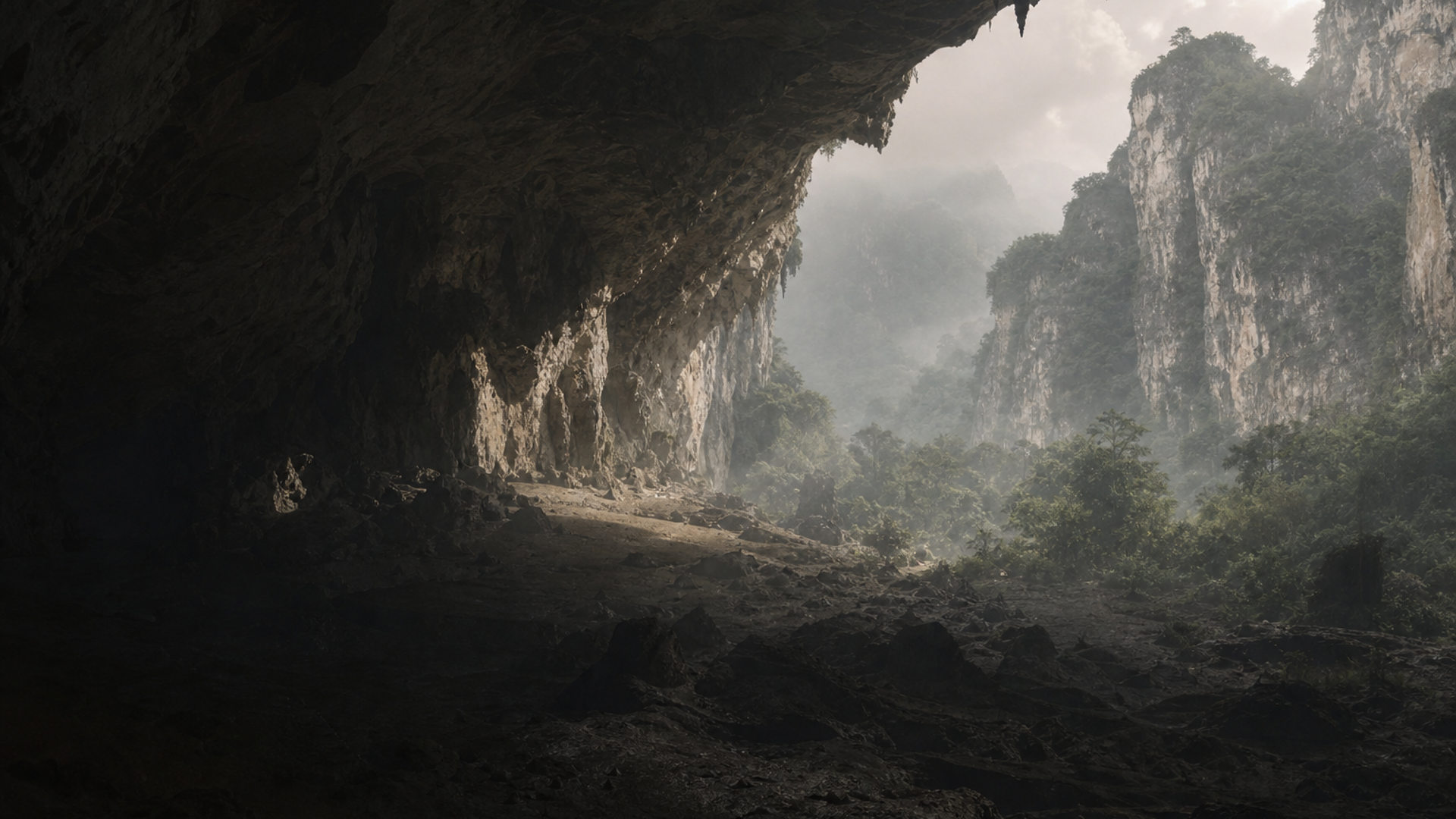
Set against the limestone hills of Pingguo County, Shenxian Cave preserves a narrow but vivid window into the late Sui and early Tang centuries (601–673 CE). Archaeological data indicates human activity in and around karst caves in Guangxi across many centuries; in this case, the context at Shenxian is dated to the early 7th century CE, a time of political reconfiguration as Sui rule gave way to Tang consolidation.

The cave find should be read as a snapshot rather than a population portrait. Limited evidence suggests local groups in Guangxi maintained long-term occupation of upland and riverine niches, combining upland resources with wet-rice lowland agriculture in nearby valleys. Material traces regionally include ceramics and small-scale trade goods that signal connections to wider southern China and maritime networks emerging in the Tang era. While the Shenxian individual stands within these larger movements, the single sample cannot resolve whether observed patterns reflect local continuity, recent migration, or episodic contact.

Archaeology at Shenxian Cave therefore frames an evocative question: how did communities at the southern margins of imperial China negotiate mobility, trade, and identity during the Sui–Tang transition? The genetic result provides a maternal thread to begin answering that question, but broader sampling is required to weave a fuller regional story.

  • Shenxian Cave: Pingguo County, Baise City, Guangxi (dated 601–673 CE)
  • Context fits late Sui–early Tang transition in southern China
  • Single-site sample offers a limited, preliminary view of local origins
Chapitre IV

Daily Life & Society

Archaeological evidence from Guangxi in the Sui–Tang period points to rhythms of life shaped by rice terraces, riverine fisheries, and upland forest resources. Ethnohistoric and archaeological data indicate that communities in Baise and surrounding counties exploited diverse ecological zones: irrigated paddy valleys for staple crops, hammocks and limestone slopes for hunting and foraging, and river corridors for communication.

Material culture in southern China during the early Tang often includes locally produced ceramics and small metal tools; at Shenxian Cave the assemblage context (where preserved) suggests domestic or funerary use of cave spaces, a practice documented in karst regions elsewhere. Regional trade and exchange intensified in the Tang era, bringing goods and ideas along inland and coastal routes. This connectivity may have introduced new pottery styles, agricultural techniques, and social ties.

Socially, households likely centered on kin networks tied to land and seasonal cycles. Archaeological indicators point to communal labor for irrigation and rice cultivation, and to regional market exchange that began to accelerate in the 7th century CE. Yet at Shenxian, the evidence is fragmentary: the single genetic sample complements—but does not substitute for—broader excavation data that would clarify household structure, craft production, and ritual practice.

  • Subsistence likely centered on wet-rice agriculture plus upland resources
  • Cave contexts in karst regions may reflect domestic, storage, or ritual use
Chapitre V

Genetic Profile

The Shenxian Cave project produced one ancient mitochondrial genome assigned to haplogroup D4a, dated between 601 and 673 CE. Mitochondrial lineage D4 is widespread across East Asia and into northeastern regions; subclade D4a appears across modern populations in China, Japan, Korea, and Siberia, and in some ancient East Asian samples. This maternal marker ties the Shenxian individual into a broad East Asian maternal network but does not by itself resolve fine-scale ancestry or recent migrations.

Critically, no Y‑chromosome (paternal) data are reported for this individual, so paternal affinities remain unknown. With a sample count of one, inferences about population structure, sex-biased migration, or demographic shifts are necessarily provisional. Archaeogenetic practice therefore treats this result as an important but preliminary datapoint: it confirms that an East Asian maternal lineage was present in Guangxi in the early 7th century, but it cannot distinguish whether that lineage reflects long-term local continuity, recent maternal migration, or admixture at community or household levels.

Future sampling from Shenxian Cave and nearby contemporaneous sites, including autosomal genomes and additional uniparental markers, would allow robust testing of hypotheses about continuity, incoming gene flow during Tang-era trade, and relationships to modern Guangxi populations. Until then, the genetic finding remains a cinematic, single-voiced witness to a complex regional history.

  • mtDNA: D4a (one individual) — links to widespread East Asian maternal lineages
  • No Y-DNA reported; single sample means conclusions are highly preliminary
Chapitre VI

Legacy & Modern Connections

Even a lone ancient genome can illuminate threads between past and present. Haplogroup D4a persists in modern East Asian populations, so the Shenxian individual likely shares deep maternal ancestry with communities across China and its neighbors. Archaeological continuity in Guangxi—seen in settlement patterns and long-term landscape use—suggests the possibility of genetic persistence in the region, but linking one ancient individual directly to any modern ethnic group would be speculative.

The discovery at Shenxian Cave underscores the value of integrating archaeology and genetics: material traces provide the cultural and ecological context, while DNA offers biological relationships. Together they open cinematic views of lived experience during the Sui–Tang era. Responsible interpretation, however, emphasizes uncertainty and the need for more samples: only expanded excavation and targeted ancient DNA sampling can turn this single voice into a chorus that reveals population dynamics across southern China.

  • D4a connects the Shenxian individual to broader East Asian maternal lineages
  • Direct links to specific modern groups are possible but remain unproven without more data
Propulsé par l'IA

Assistant IA

Posez des questions sur la culture Shenxian Cave: A Sui–Tang Moment

Assistant IA par DNAGENICS

Débloquer cette fonction
Posez des questions sur la culture Shenxian Cave: A Sui–Tang Moment. L'assistant IA peut expliquer les résultats génétiques, le contexte historique, les preuves archéologiques et les liens génétiques avec les populations actuelles, dans les limites de l'interprétation.
Exemple d'analyse IA

La culture Shenxian Cave: A Sui–Tang Moment représente un chapitre fascinant de l'histoire humaine…

L'analyse génétique met en évidence des similarités avec des populations antérieures et des signes d'adaptations propres. Les échantillons d'ADN ancien éclairent les schémas migratoires et les liens entre populations, avec des limites qui dépendent de l'étude et du contexte archéologique.

Il s'agit d'un aperçu de l'analyse IA. Accédez à l'assistant complet pour explorer :

  • Composition et similarité génétique
  • Schémas migratoires et origines
  • Vie quotidienne et pratiques culturelles
  • Contexte génétique actuel

Explorez d'autres cultures antiques

Découvrez les récits de civilisations issues du monde antique