Préparation du rapport

Chargement des informations et références disponibles

Connexion au corpus archéologique…

Collecte des archives antiques

Aller au contenu principal
South Scandinavian Early Bronze Age (Denmark)
Profil culturel

South Scandinavian Early Bronze Age (Denmark)

Genetic glimpses from four Danish EBA sites, c. 1611–1232 BCE — small sample, cautious conclusions

1611 CE - 1232 BCE
Denmark (South Scandinavia)
Faites défiler pour commencer
Chapitre I

Le récit

Comprendre la culture South Scandinavian Early Bronze Age (Denmark)

Archaeogenetic and archaeological notes from four Early Bronze Age Danish locales (Bybjerg, Magleø, Vasagard, Klæsterupholm Mose). Limited samples (n=4) suggest local Y-haplogroup I lineages and common European mtDNA H, K, W1 — preliminary but evocative.

Time Period

c. 1611–1232 BCE

Region

Denmark (South Scandinavia)

Common Y-DNA

I1, I

Common mtDNA

H, K, W1

Chapitre II

Chronologie

Moments clés de l'histoire de cette culture

2000 BCE

Early Bronze Age horizons rise in Scandinavia

Regional Bronze Age cultural networks expand across the Baltic, increasing metal exchange and stylistic interaction.

1611 BCE

Earliest sampled individual (Bybjerg)

One of the dataset's radiocarbon dates; marks the oldest sampled life in this set (c.1611 BCE).

1232 BCE

Latest sampled individual (Klæsterupholm Mose)

Most recent individual in the set is dated to c.1232 BCE, spanning roughly four centuries of the Early Bronze Age.

Chapitre III

Origins & Emergence

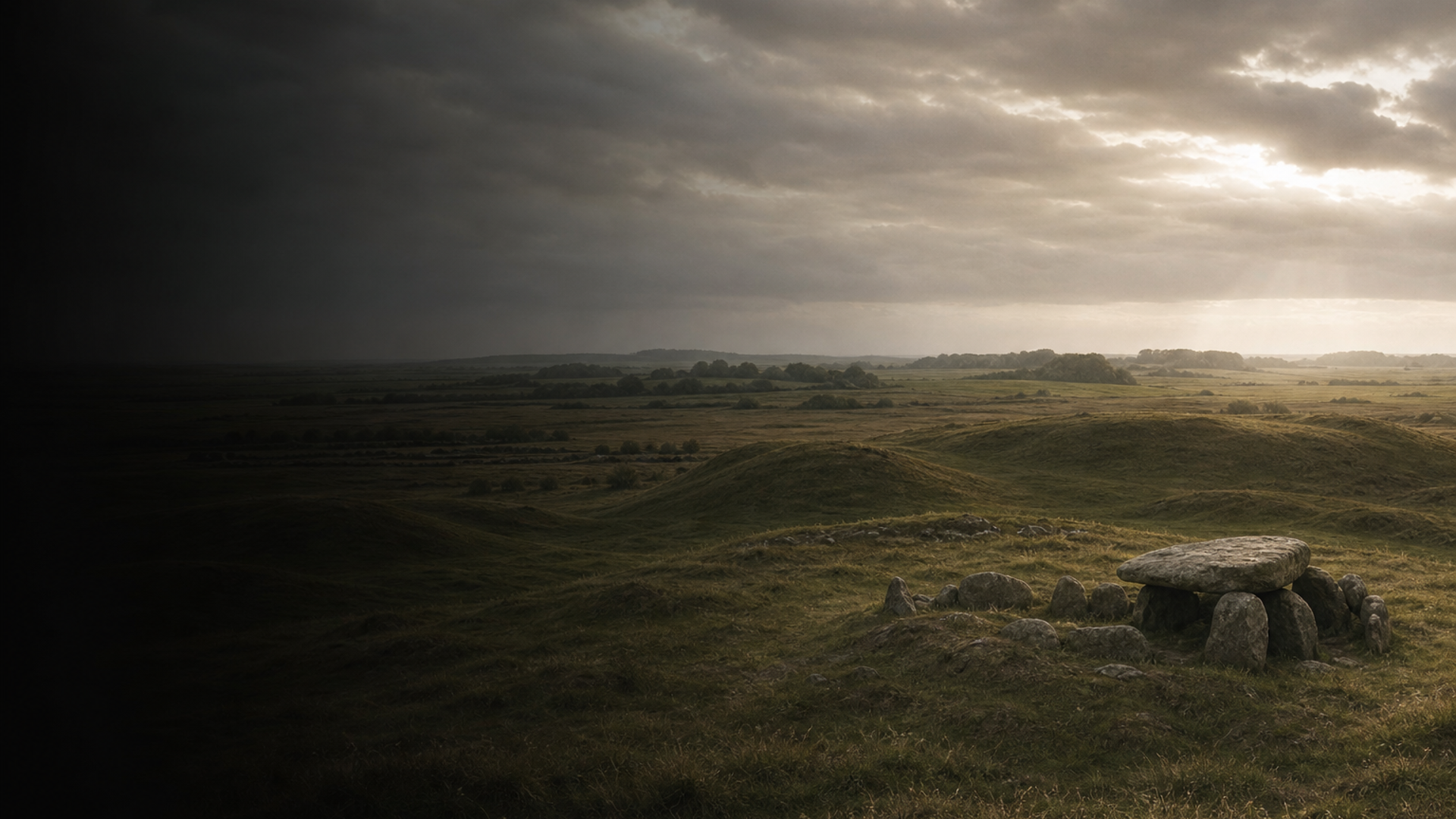
The Denmark_SouthScandinavia_EBA group sits within the southern Scandinavian Early Bronze Age horizon (commonly dated c. 2000–1000 BCE in regional frameworks), here represented by four radiocarbon-calibrated samples dated between 1611 and 1232 BCE. Archaeological landscapes of this era are cinematic: sunlit barrows on moraine ridges, shorelines threaded with bead and bronze, and inland wetlands that preserved organic traces. The sites included in this dataset — Bybjerg and Magleø on Zealand, Vasagard on Bornholm, and Klæsterupholm Mose in Jutland — capture different micro-regions of Denmark.

Archaeological data indicates continued local traditions of burial, metalwork exchange, and seafaring connections across the Baltic, but fine-grained cultural attribution at each sampled locus is uneven. Limited evidence suggests these individuals lived in communities shaped by both long-standing northern European lifeways and the wider Bronze Age networks that circulated raw metals and ideas. Genetic sampling is sparse (n=4); therefore any narrative connecting specific migrations or cultural transformations to these particular individuals must remain tentative. Where regional patterns are stronger, they point to a population mosaic: local continuity in some lineages alongside influences visible in material culture. This dataset offers a fragile but vivid window — a handful of voices from a coastline of bronze and peat — into processes of adaptation and connectivity in southern Scandinavia at the cusp of the Middle Bronze Age.

  • Samples dated c. 1611–1232 BCE from four Danish locales
  • Sites span Zealand, Bornholm, and Jutland regions
  • Interpretations are preliminary due to low sample count
Chapitre IV

Daily Life & Society

Archaeology paints the daily world of southern Scandinavian Early Bronze Age communities in broad strokes: mixed farming, pastoral herding, coastal fishing, and craft production woven into seasonal rhythms. People lived in farmsteads set among rolling fields and wetlands; diet and mobility were shaped by the sea and the land. Bronze objects — tools, pins, and ornaments — were symbols of status and long-distance exchange rather than ubiquitous essentials, so material culture often reflects social differentiation.

At the sampled locations, contextual notes vary. Bybjerg and Magleø lie in the Zealand archipelago where coastal routes concentrated exchange; Bornholm (Vasagard) is an island nexus in the Baltic; Klæsterupholm Mose indicates a wetland context typical for organic preservation. Archaeological data indicates that ritual activity and deposition in wetlands coexisted with barrow burials and farm-based household life. Limited osteological data from small samples can hint at mobility (isotopes) or diet (stable isotopes), but those lines of evidence are not uniformly available for every individual in this set. Thus reconstructions of everyday life must combine regional archaeological patterns with cautious, case-by-case genetic and isotopic assessments.

  • Economy: mixed farming, herding, coastal resources
  • Material culture shows long-distance exchange and local craft
Chapitre V

Genetic Profile

The genetic snapshot from Denmark_SouthScandinavia_EBA is small — four individuals — and must be read with caution. Y-chromosome lineages in this set are dominated by haplogroup I: two samples assigned to I1 and one to general I. In northern Europe, I1 is a lineage that becomes common in later centuries and is considered characteristic of many Scandinavian male lines; its presence here suggests elements of local paternal continuity or regional ancestry components during the Early Bronze Age.

Mitochondrial diversity in the four samples includes H (two individuals), K (one), and W1 (one). Haplogroup H is the most frequent mtDNA lineage across much of Europe in the Bronze Age and later; K and W1 are also known in Neolithic and Bronze Age contexts. These maternal assignments align broadly with pan-European maternal diversity, indicating connections across northern and central Europe rather than isolated insularity.

Autosomal profiles are not summarized here individually, but in the broader region Early Bronze Age individuals commonly display substantial steppe-derived ancestry layered onto Neolithic farmer-derived and Mesolithic hunter-gatherer contributions. If these Danish samples follow the regional pattern, they likely carry a mixture of these ancestries, though with only four genomes this remains a hypothesis. In sum: the Y and mtDNA signals point to continuity with northern European lineage pools, but the low sample count (<10) makes any population-level claim preliminary. Future, larger datasets will be required to resolve sex-biased migration, kinship patterns, and fine-scale population structure.

  • Y-DNA in this set: I1 (2), I (1) — suggests regional paternal continuity
  • mtDNA: H (2), K (1), W1 (1) — maternal lineages consistent with European diversity
Chapitre VI

Legacy & Modern Connections

These four Bronze Age genomes contribute to a long story of human presence along Denmark’s shores. Genetic markers like I1 and mtDNA H remain part of the modern northern European landscape, and their ancient occurrences here hint at threads of continuity that weave through millennia of demographic change. Archaeologically, the Early Bronze Age is a period when local traditions and long-distance exchange both shaped identity — a dynamic echoed in genetic mosaics.

Caveats are essential: with only four sampled individuals, narratives about ancestry, migration, or kinship remain provisional. Still, these data points help anchor broader regional patterns and invite targeted sampling of burial mounds, settlements, and wetland deposits. As genomic databases grow, the whispered stories in these genomes may be amplified into a clearer chorus about how Bronze Age peoples in Denmark connected to neighbors across the Baltic and beyond.

  • Modern relevance: lineages observed here persist in northern Europe
  • Small sample size means conclusions about continuity are tentative
Propulsé par l'IA

Assistant IA

Posez des questions sur la culture South Scandinavian Early Bronze Age (Denmark)

Assistant IA par DNAGENICS

Débloquer cette fonction
Posez des questions sur la culture South Scandinavian Early Bronze Age (Denmark). L'assistant IA peut expliquer les résultats génétiques, le contexte historique, les preuves archéologiques et les liens génétiques avec les populations actuelles, dans les limites de l'interprétation.
Exemple d'analyse IA

La culture South Scandinavian Early Bronze Age (Denmark) représente un chapitre fascinant de l'histoire humaine…

L'analyse génétique met en évidence des similarités avec des populations antérieures et des signes d'adaptations propres. Les échantillons d'ADN ancien éclairent les schémas migratoires et les liens entre populations, avec des limites qui dépendent de l'étude et du contexte archéologique.

Il s'agit d'un aperçu de l'analyse IA. Accédez à l'assistant complet pour explorer :

  • Composition et similarité génétique
  • Schémas migratoires et origines
  • Vie quotidienne et pratiques culturelles
  • Contexte génétique actuel

Explorez d'autres cultures antiques

Découvrez les récits de civilisations issues du monde antique