Préparation du rapport

Chargement des informations et références disponibles

Connexion au corpus archéologique…

Collecte des archives antiques

Aller au contenu principal
Titriş Höyük: Echoes of Early Bronze Anatolia
Profil culturel

Titriş Höyük: Echoes of Early Bronze Anatolia

Seven genomes from Şanlıurfa reveal a cautious glimpse into Early Bronze Age life and ancestry.

2338 CE - 2100 BCE
Titriş Höyük, Şanlıurfa Province, Turkey
Faites défiler pour commencer
Chapitre I

Le récit

Comprendre la culture Titriş Höyük: Echoes of Early Bronze Anatolia

Archaeogenetic and archaeological data from Titriş Höyük (2338–2100 BCE) offer preliminary insight into a small Early Bronze Age community in Şanlıurfa. Y-chromosome diversity shows Near Eastern affinities; mtDNA remains limited. Conclusions are tentative due to seven samples.

Time Period

2338–2100 BCE (Early Bronze Age)

Region

Titriş Höyük, Şanlıurfa Province, Turkey

Common Y-DNA

T (1), F (1), J (1), J2b (1) — 7 samples total

Common mtDNA

Limited/insufficient mtDNA reported

Chapitre II

Chronologie

Moments clés de l'histoire de cette culture

2338 BCE

Early Bronze Age occupation at Titriş Höyük

Excavated layers and dated samples indicate a community active in the Early Bronze Age (c.2338–2100 BCE) in Şanlıurfa Province.

Chapitre III

Origins & Emergence

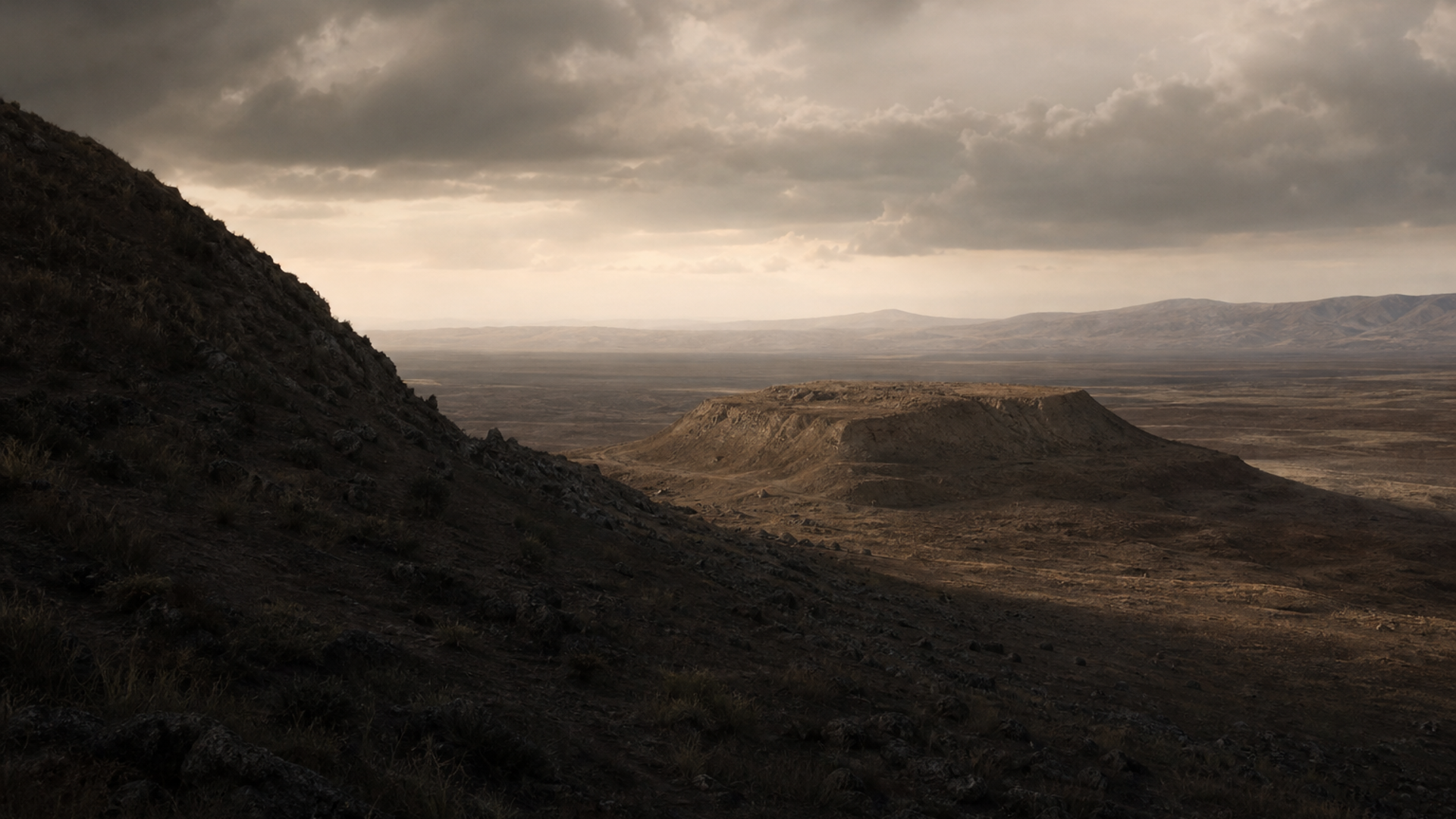
Titriş Höyük sits as a layered mound in the fertile plains of Şanlıurfa Province, Anatolia, where human occupation intensifies in the Early Bronze Age. Archaeological data indicates sustained settlement activity across the third millennium BCE, with the period represented here dated between roughly 2338 and 2100 BCE. The site occupies a corridor of interaction bridging northern Mesopotamia and central Anatolia, a landscape of irrigated fields, pastoral routes and long-distance exchange.

Material culture at contemporaneous Anatolian and northern Mesopotamian sites suggests growing social complexity — visible in craft specialization, metallurgy, and regional exchange networks — and Titriş Höyük likely participated in these dynamics. Limited evidence suggests local continuity from earlier Chalcolithic occupants, but the archaeological record also points to incoming influences mediated by trade of metals, pottery styles, and raw materials.

Genetic data from seven individuals provide a complementary line of evidence: rather than revealing a single intrusive event, the Y-chromosome diversity hints at a community with Near Eastern affinities and a mosaic of paternal lineages. However, with a small sample set, any narrative of population replacement or major migration remains provisional. Ongoing excavation and additional ancient DNA sampling are needed to clarify the site's demographic history.

  • Located in Şanlıurfa Province; dated 2338–2100 BCE
  • Positioned between northern Mesopotamia and central Anatolia, a zone of exchange
  • Limited genetic data suggest local Near Eastern paternal diversity
Chapitre IV

Daily Life & Society

Archaeological remains in the wider region imply an Early Bronze Age lifeway of mixed farming, herding and craft production. At Titriş Höyük, archaeological data indicates households engaged in cereal cultivation, caprine and cattle husbandry, and small-scale metallurgy and ceramic production — practices common across Anatolian EBA settlements. Storage features and craft debris would point to seasonal planning and specialized activities within the community.

Social organization can be inferred indirectly from house sizes, domestic architecture, and burial practices elsewhere in the region: variability in household investment and mortuary expression suggests emerging social differentiation, but direct evidence from Titriş Höyük must be treated cautiously. Trade connections likely brought exotic raw materials and finished goods into everyday life, leaving traces in pottery styles and metal objects.

Material culture articulated identity in a landscape of overlapping influences: local traditions persisted even as people adopted techniques and objects from neighboring regions. The genetic snapshot available complements this picture by indicating multiple paternal lineages within a single community, consistent with a networked society where mobility, marriage, and exchange shaped daily life.

  • Economy likely based on cereals, herding, and craft production
  • Household variation and trade indicate social complexity
Chapitre V

Genetic Profile

Seven individuals from Titriş Höyük (dated 2338–2100 BCE) yielded Y-chromosome haplogroups T (1), F (1), J (1) and J2b (1). No single paternal lineage dominates these samples, which suggests local diversity rather than a uniform incoming male line. Haplogroups J and J2b are frequently encountered in the Near East and Anatolia in both ancient and modern datasets, and their presence here aligns with archaeological expectations of regional continuity and Near Eastern affinities.

Haplogroup T and F are less common but not unheard of in the broader Near Eastern and Mediterranean genetic landscape; their occurrence among these seven individuals highlights a heterogeneous paternal pool. Notably, classic Steppe-associated Y lineages (e.g., R1a/R1b) are not observed among these particular samples, but the absence in a small cohort should not be taken as evidence of region-wide absence.

Autosomal and mitochondrial information are limited or not fully reported for this sample set; mtDNA results were insufficient to characterize maternal lineages robustly. Because the sample count is below ten, all genetic inferences must be considered preliminary. The combined archaeological and genetic evidence supports a model of local population continuity with connections across Anatolia and the Levant, mediated by trade and mobility, rather than a simple replacement event. Expanded sampling from Titriş Höyük and nearby sites is necessary to resolve finer-scale demographic questions.

  • Y-DNA shows Near Eastern/Anatolian affinities (J, J2b) alongside T and F
  • Sample count (7) is small — interpretations are preliminary
Chapitre VI

Legacy & Modern Connections

The genetic signals and material traces from Titriş Höyük contribute to a long arc of human occupation in southeastern Anatolia. Many paternal lineages found in the region today derive, in part, from the mosaic of Bronze Age ancestries; haplogroups such as J and J2 persist across modern Near Eastern populations. Yet direct lines of descent are complex: millennia of migrations, cultural transformations and population admixture mean that continuity is often partial and uneven.

Culturally, Titriş Höyük represents a chapter in the story of urbanizing Anatolia — a landscape where local traditions intertwined with broader networks of exchange. For modern inhabitants of Anatolia and neighboring regions, these archaeological and genetic findings highlight deep, multilayered roots in the soil and the mitochondrial and Y-chromosomal variants that persist in the present. Continued interdisciplinary work will sharpen the connections between ancient DNA and modern genetic diversity while respecting the provisional nature of current conclusions.

  • Some paternal lineages persist regionally, but direct descent is complex
  • Findings underscore long-term Anatolian occupation and connectivity
Propulsé par l'IA

Assistant IA

Posez des questions sur la culture Titriş Höyük: Echoes of Early Bronze Anatolia

Assistant IA par DNAGENICS

Débloquer cette fonction
Posez des questions sur la culture Titriş Höyük: Echoes of Early Bronze Anatolia. L'assistant IA peut expliquer les résultats génétiques, le contexte historique, les preuves archéologiques et les liens génétiques avec les populations actuelles, dans les limites de l'interprétation.
Exemple d'analyse IA

La culture Titriş Höyük: Echoes of Early Bronze Anatolia représente un chapitre fascinant de l'histoire humaine…

L'analyse génétique met en évidence des similarités avec des populations antérieures et des signes d'adaptations propres. Les échantillons d'ADN ancien éclairent les schémas migratoires et les liens entre populations, avec des limites qui dépendent de l'étude et du contexte archéologique.

Il s'agit d'un aperçu de l'analyse IA. Accédez à l'assistant complet pour explorer :

  • Composition et similarité génétique
  • Schémas migratoires et origines
  • Vie quotidienne et pratiques culturelles
  • Contexte génétique actuel

Explorez d'autres cultures antiques

Découvrez les récits de civilisations issues du monde antique